
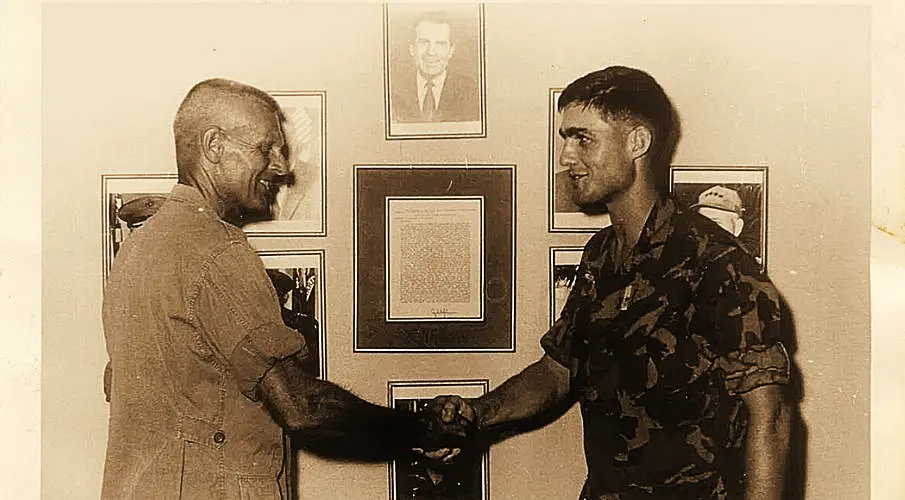
Robert Swan Mueller III was born on August 7, 1944 in Manhattan, grew up on the Main Line of Philadelphia, went to Princeton, to Vietnam, to Quantico, to Washington. He died Friday evening at the age of 81 from complications of Parkinson’s, which had been diagnosed in 2021. His wife Ann, by his side since 1966, and his two daughters asked for privacy. Donald Trump wrote on Truth Social: “Robert Mueller just died. Good, I am glad he is dead. He can no longer hurt innocent people.”

You pause. Not out of surprise — but because even those who know Trump need a moment to process this sentence.
See also our article: Good, I am glad he is dead” - a president completely unhinged
Mueller was not a man who talked much. He was someone who acted — and stayed silent when others would have shouted.

When he went to Vietnam in 1968, he did so because a close friend and Princeton lacrosse teammate had been killed there. He volunteered, led an infantry platoon, earned the Bronze Star for carrying a wounded soldier to safety under enemy fire. Four months later, a bullet hit him in the thigh. He returned to his platoon three weeks later. Then his wife Ann, whom he met in Hawaii during a leave, convinced him that the law was a more meaningful path than war. He listened to her.
He studied law at the University of Virginia, became a federal prosecutor, rose through the ranks, became head of the Criminal Division at the Department of Justice, and then in 1995 did something that surprised his colleagues: he called Eric Holder, then the chief prosecutor in Washington, and asked if he could use a homicide prosecutor. Holder said he was slightly overqualified. Mueller asked when he could start.
For three years he worked in Washington as a homicide prosecutor, helped reduce the murder rate, comforted families — and answered his own phone: “Mueller, homicide division.”
On September 4, 2001, Mueller was appointed the sixth FBI Director. One week later, the towers fell.

Statement by President George W. Bush on the passing of Robert Mueller:
"Laura and I are deeply saddened by the loss of Robert Mueller. Bob dedicated his life to public service. As a Marine in Vietnam, he proved he was ready for tough assignments. He earned a Bronze Star and a Purple Heart before returning home to pursue law. In 2001, only one week into the job as the 6th Director of the F.B.I., Bob transitioned the agency mission to protecting the homeland after September 11. He led the agency effectively, helping prevent another terrorist attack on U.S. soil. Laura and I send our heartfelt sympathy to his wife of nearly 60 years, Ann, and the Mueller family."
George W. Bush asked him daily at the morning briefing what the FBI was doing to prevent the next attack. Mueller took over an agency that, according to the 9/11 Commission, had “failed again and again” — broken chains of command, crashing computers, unread wiretaps due to lack of translators. Mueller rebuilt the FBI, from a law enforcement agency into a 21st century intelligence service. And when the CIA set up secret detention sites after September 11, where terror suspects were interrogated and tortured, it was Mueller’s agents who reported the abuses. In October 2002, FBI agents in Guantánamo opened a file they later labeled “war crimes.”
Then came the moment that defined Mueller the most — and that hardly anyone knows.
In early 2004, Mueller, together with his superior, Deputy Attorney General James Comey, determined that President Bush had ordered the NSA to wiretap Americans without judicial authorization. The program was called Stellarwind, highly classified, and according to Mueller had never saved a life, never uncovered an Al Qaeda operative in the United States. Above all, it violated the Constitution. Mueller took notes. He wrote that the president was “trying to circumvent the law.” At 1:30 a.m. on March 12, 2004, he sat at his kitchen table and wrote a resignation letter. The next morning, he sat alone with George W. Bush in the White House, the letter in his breast pocket.
Bush thought of the Saturday Night Massacre of 1973, when Nixon forced his attorney general and his deputy to resign to protect his Watergate tapes — a desperate act that ultimately destroyed his presidency. Bush backed down. The program was placed on a legal footing. Mueller never spoke about it publicly.

He led the FBI for twelve years — longer than any director after J. Edgar Hoover. In 2011, Barack Obama asked him to stay for two more years. Congress agreed. When Mueller stepped down in June 2013, Obama said countless Americans were alive because the FBI under Mueller’s leadership had dismantled Al Qaeda cells.
Mueller believed his public life was over.
On May 17, 2017, eight days after Trump had fired FBI Director Comey — because of the Russia investigation, as Trump himself told the Russian foreign minister and the Russian ambassador in the Oval Office — Mueller was appointed special counsel.
When Trump learned of it, he is said to have said: “Oh my God. This is terrible. This is the end of my presidency.” He knew, Mueller later wrote, that a thorough FBI investigation would uncover facts about his campaign and himself that the president could have understood as crimes.
Mueller’s team worked for almost two years. It charged Russian intelligence officers and the leadership of the Internet Research Agency in St. Petersburg, the troll factory that conducted a disinformation campaign on behalf of the Kremlin in 2016. It sent Paul Manafort, Trump’s first campaign chairman, to prison for fraud. It secured a guilty plea from Michael Flynn, Trump’s first National Security Advisor. It convicted Roger Stone, one of Trump’s oldest political advisers, for lying to investigators.
Then came the decisive question: obstruction of justice by the president.
Mueller hesitated. He allowed himself to be limited by Trump’s lawyers to written questions, waived a subpoena for sworn testimony. When Trump’s answers arrived on November 20, 2018, Trump invoked memory failure on almost every key question. Mueller gave in — again.
The 448 page final report went on March 22, 2019 to Attorney General William Barr, Mueller’s longtime colleague and family friend. Barr kept the report under wraps for 25 days and publicly announced that Mueller had found no sufficient evidence of obstruction of justice. Trump declared he was “completely exonerated.”
Mueller wrote Barr an angry letter. He spoke of “public confusion about critical aspects of the results of our investigation.” Publicly, he still remained silent — until Trump commuted Roger Stone’s prison sentence in July 2020. Then Mueller wrote an op ed in the Washington Post and stated that every decision in the case had been based solely on facts and law. “Any claims to the contrary are false.”
In December 2020, Trump pardoned Manafort and Stone. In October of that same year, Flynn had already been pardoned. All three later played a role in mobilizing the crowd that stormed the Capitol on January 6, 2021.
Former White House counsel under Trump, Ty Cobb, criticized Trump’s “shameful” and “disgraceful” reaction to Robert Mueller’s death:
“He is a demented narcissist. He seriously hates anyone who stands up to him, has turned the Department of Justice into a machine of revenge and governs the country in a very authoritarian way — with the support of a cowardly cabinet and even more cowardly Republicans in Congress.”
In July 2024, the Supreme Court ruled by six to three that presidents cannot be criminally prosecuted for actions within the scope of their official authority. Justice Sonia Sotomayor wrote in her dissent: “The president is now a king above the law.”
With Trump’s reelection in 2024, all ongoing criminal proceedings were halted.
Mueller had said in one of his rare public appearances in 2020 that it does not matter in what way one serves. “The only thing we ask is that you work for your country and your community.”

He did that. For over five decades, under four presidents, in Vietnam, in Washington, in homicide divisions and special counsels, with a resignation letter in his breast pocket that never had to be sent — because it did not have to be sent.
He died Friday evening. And Trump wrote: “Robert Mueller just died. Good, I am glad he is dead. He can no longer hurt innocent people.”
Senator Mark Warner of Virginia, leading Democrat on the Senate Intelligence Committee, wrote that Mueller dedicated his life to service and deeply believed in the rule of law. That is one America.
The other America now has its president.
Updates – Kaizen News Brief
All current curated daily updates can be found in the Kaizen News Brief.
To the Kaizen News Brief In English


R.I.P. Es ist einfach nur beschämend was dieser demente Narzisst von sich gibt 😢
…ja, das ist es wahrlich
Robert Mueller, ein sehr aufrechter, integerer und tapferer Mann.
Die USA hat ihm viel zu verdanken.
Sehr viel.
Er musste nicht alles an die Öffentlichkeit zerren und laut brüllen um etwas zu erreichen.
Fakten und das Gesetz waren auf seiner Seite.
Er hat sich an Trump gewagt.
Aber in einigen Punkten zu lange gezögert.
So verlief alles im Sande und mit dem Urteil vom Supreme Court, war Trump fein raus.
Trump vergisst aber nicht
Und er hat kein Problem auf Tote zu spucken.🤬
…das benehmen von trump ist unterirdisch, die leistungen dieses mannes waren es nicht
Ein vorheriges Lektorat würde der Veröffentlichung guttun.
Der Text ist bewusst so gebaut und gewollt