
While missiles fly above the Persian Gulf and drones trace their paths, one of the most mobile units of the U.S. armed forces is leaving its usual position in the Indo-Pacific. 2,200-2,500 soldiers of the U.S. Marines aboard three amphibious warships are on their way to the Middle East. The 31st Marine Expeditionary Unit, normally permanently stationed in Japan and part of the U.S. Indo-Pacific Command, is being moved into a region where war has been raging for weeks. Officially American military representatives say this does not mean an invasion. No ground troops in Iran. Perhaps that is true. And yet the troops are on their way.

A Marine Expeditionary Unit is not an ordinary formation. It combines several military capabilities in a single task force: In addition to the Marines themselves it includes a squadron of F-35 fighter jets as well as tiltrotor aircraft of the type MV-22 Osprey, which can take off and land like airplanes but can also hover like helicopters. The ships on which they travel are floating bases - for rapid landings, for evacuations, for amphibious operations along coastlines. The fact that such a formation is now being pulled from the Indo-Pacific shows how seriously the situation in the Middle East is now being assessed.
Donald Trump publicly announced on February 28 what began shortly afterward: massive air strikes by American and Israeli forces on military installations and state targets in Iran. Already on the first day the strikes hit the top of Iran’s power apparatus. Supreme leader Ayatollah Ali Khamenei was killed in an attack in Tehran. State television itself confirmed this. A few days later influential religious circles named his son Mojtaba Khamenei as his successor - religious authority and command over the armed forces in one hand, from one day to the next.

Iran has responded ever since. Missiles and drones are flying toward Israel, toward American military bases in the region, toward states along the Persian Gulf. Israel in turn is intensifying its attacks in Lebanon against Hezbollah. The war that began as an air campaign has long developed its own momentum that is difficult to slow. Defense Secretary, or as he is affectionately called in Trump circles, war secretary, Pete Hegseth announced that the next wave of attacks will be the largest of the entire campaign. More missions, more bombardments than on any previous day of the war. Washington is building up militarily while at the same time increasing pressure in other ways.

What can happen in 3 minutes with War Secretary/Defense Secretary, former Fox moderator Hegseth …
Left image: Hegseth: Another example of a false headline that I saw yesterday: “The war is expanding.” Here is a real headline for a truly patriotic press: Iran is shrinking, retreating underground. The only thing expanding is our advantage, not to mention that our partners in the Gulf are now intervening even more strongly and going on the offensive.
Right image: Hegseth: Today the largest volume of attacks that America has flown over Iran and over Tehran will take place again. The number of missions and bombardments will be the highest so far, it will continue to be increased and will only keep rising. And quantity has its very own quality.
In short: Within just a few minutes he first declares that the war is not expanding and then at the same time announces that more attacks will be flown than ever before. Is this man competent?

Through the Rewards for Justice program the U.S. government is offering bounties of up to ten million dollars for information about leading members of the Islamic Revolutionary Guard Corps. The manhunt targets ten individuals from within the Iranian power apparatus. Information is sought about the new supreme leader Mojtaba Khamenei himself, about Ali Asghar Hejazi, deputy chief of staff in the office of the supreme leader, as well as about intelligence minister Esmail Khatib, who heads the entire security apparatus. In addition Washington is seeking information about the secretary of the defense council, the commander of the Revolutionary Guards as well as several advisers to the supreme leader.

Military pressure, intelligence operations and international manhunts are running simultaneously. This is no longer a reaction. This is a strategy operating on several levels at once. No one knows exactly what will come next. But the structure that is now being built - Marines from the Indo-Pacific, the largest wave of attacks in preparation, million-dollar bounties on the heads of Iran’s leadership - can no longer be explained with the word caution. It looks like preparation for something that does not yet have a name.

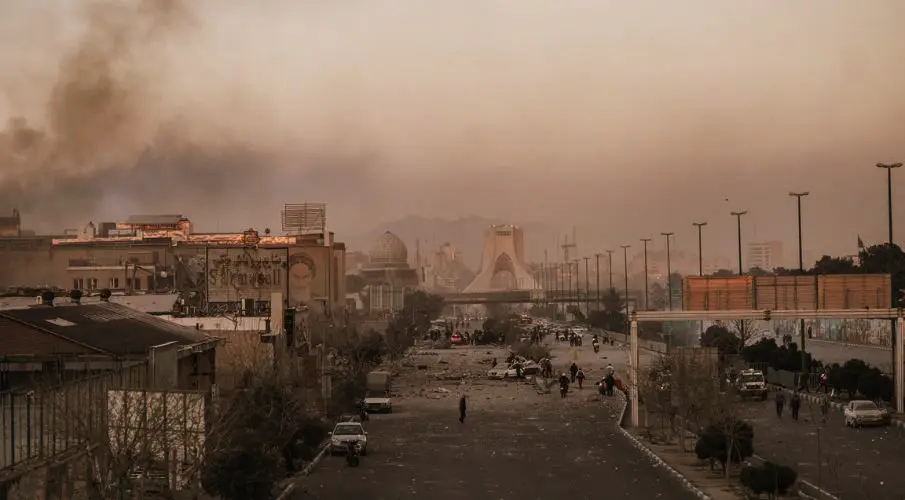
Tehran - Many people are desperate. The mullah regime does not care One is here. One sees it. And precisely for that reason one cannot simply leave again. We will remain, in rotation, continue reporting, continue documenting and at the same time, in hours that hardly seem made for it, work on a major documentation. An examination of this war. More than necessary. Perhaps also more than that: perhaps a small impulse. Perhaps nothing at all. But the silence that arises when one remains silent would be louder.
Updates – Kaizen News Brief
All current curated daily updates can be found in the Kaizen News Brief.
To the Kaizen News Brief In English


Bitte passt alle auf euch auf. Wir sind in Gedanken bei euch.