
On October 13, 2026, Donald Trump lashed out at people pointing to Russian and Chinese support for Iran, writing: "I see so many comments from the Radical Left Morons and Lunatics that China and Russia are helping the 'wonderful' Islamic Republic of Iran. If they are, it's at a very low level, but I don't believe they are at all." 8 days later, Vladimir Putin welcomed U.S. special envoy Steve Witkoff to St. Petersburg. If Russia could do anything to help resolve the crisis surrounding Iran, it would be glad to help, the Kremlin leader assured him. While Washington was talking about Russia's willingness to make peace, entirely different documents had long been sitting in the files of Russian defense manufacturers. Production schedules, supply agreements, and internal correspondence document a military contract for Iran. It involves at least 90 launchers for modern Russian precision-guided missiles. Deliveries were scheduled from late 2024 through December 2025. Whether all the launchers were actually delivered has yet to be confirmed. The contract itself is documented in the records examined.

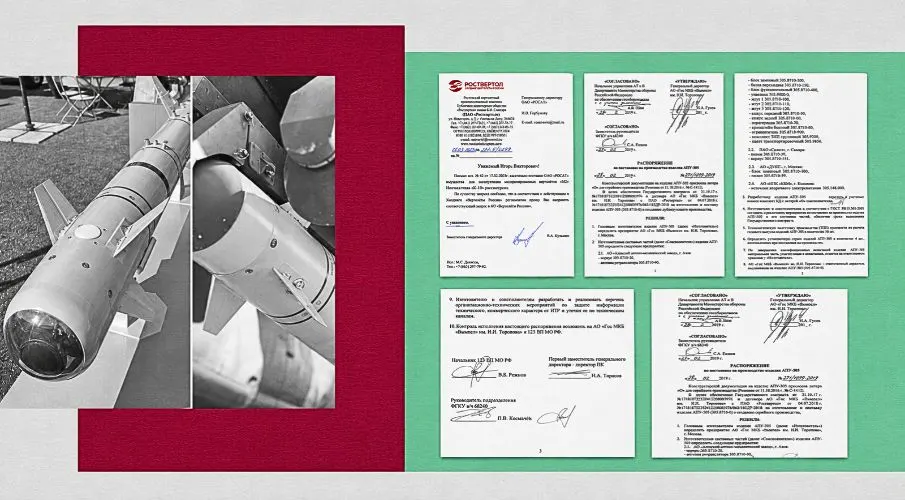
Image on the left: The Russian LMUR precision-guided missile, also known as Product 305 or Kh-39, carries a 25-kilogram warhead and can be guided by an operator during flight. Russia uses this weapon in its war against Ukraine and planned to supply missile launchers to Iran.
Image on the right: Trump's post from October 13, 2026
The documents come from within Russia's state-controlled defense holding company KTRV, which oversees the production of a large share of the country's air-launched missiles. A key role is played by the Moscow-based Vympel Design Bureau, named after I. I. Toropov. The designation K-10 appears repeatedly throughout the paperwork. Behind that simple combination of letters and numbers is Iran. A supply request dated October 20, 2022, explicitly identifies the recipient as "K10 Iran." What looks like an ordinary administrative code in later production schedules actually identifies a specific foreign customer. Details like these are precisely what make the documents politically uncomfortable. While presidents talk about peaceful intentions, factories still have to order their components under verifiable contract numbers.
The planned deliveries involve launchers for Russia's light multipurpose guided missile, the LMUR, also known as Product 305 or Kh-39. Russia has been using this weapon in its war against Ukraine since 2022. It weighs approximately 105 kilograms and carries a 25-kilogram warhead. An electro-optical targeting system with thermal imaging allows it to engage moving targets. A radio link enables an operator to guide the missile even while it is in flight. The APU-L launcher carries 2 of these missiles at a time. The weapon was originally developed for Russian attack helicopters, including the Ka-52M and Mi-28NM. That matters considerably for Iran, which has also ordered Russian Mi-28 helicopters.

Russian Mi-28NE attack helicopters built for export, including those intended for Iran, are equipped with special protective devices against sand and dust. The photographs show these devices at the engine air intakes, along with the corresponding technical drawings.
Translation of the text in the image: "Mi-28NE attack helicopters exported to countries in the Middle East, including Iran, are equipped with a device that protects against sand and dust and consists of multiple cyclone separators. This device is installed at the helicopter engine's air intake."
The industrial preparations go back a long way. On February 28, 2019, an order approved in coordination with the Russian Ministry of Defense authorized serial production of the APU-305 launcher. Vympel was given the lead role. Other participants included Salyut in Samara and DUKS in Moscow. They were joined by the KBM Machine-Building Design Bureau in Kolomna and the Azov Optical-Mechanical Plant, AOMZ, in the Rostov region. AOMZ alone was assigned 16 different components, including housing parts and locking mechanisms. Relay antennas and cable connections were also part of the contract. The production order explicitly requires measures to protect the work from foreign technical intelligence gathering. So the Russian defense industry was well aware of just how much attention such projects could attract.

Russian government and defense industry documents dated February 28, 2019, record the authorization of serial production of the APU-305 launcher. They identify the participating manufacturers, the components each was responsible for, and oversight by the Russian Ministry of Defense.
The AOMZ plant was attacked by Ukrainian forces overnight on September 25-26, 2026. It is involved in at least 7 Russian missile programs. Its importance is also clear from a letter dated May 28, 2024, sent by Vympel management to KBM. The document was co-signed by the head of the 123rd Military Representation. In it, the company warned that delays in delivering power supply units threatened the timely assembly of the APU-L and APU-305 launchers. The letter included a detailed delivery schedule. 6 entries concerned Russian defense contracts for helicopter factories, including Rostvertol and the plant in Ulan-Ude. Additional deliveries were intended for Progress in Arsenyev.
2 entries explicitly concerned foreign customers. One was for China. Under contract number 532/1629-24//063, 140 power supply units were scheduled between mid-2024 and late 2025. The entry also included a reference to 192 units for export to China. China currently operates neither the Ka-52M nor the Mi-28NM as standard carriers of these missiles. The equipment could therefore be intended for other Chinese aircraft. From a military standpoint, such weapons could be useful for attacks on coastal positions, among other things. Whether they were actually intended for that purpose is not clear from the document.
The other foreign contract carries the number 032-24/361//063. Next to it is K-10. The schedule called for power supply units for 90 dual-rail launchers, which AOMZ was supposed to receive between late 2024 and December 2025. This makes it possible to trace the planned production all the way down to the individual suppliers. The documents do not confirm that all 90 launchers subsequently reached Iran. Nor do they establish that every launcher was actually completed. But the documented preparations already show just how closely the Russian defense industry was tailoring its production to Iranian orders.

The Russian LMUR precision-guided missile, also known as Product 305 or Kh-39, mounted on an attack helicopter launcher. The photograph shows how the missile is attached beneath the aircraft, along with parts of the launching equipment whose manufacture is described in the Russian defense industry records examined.
The Russian LMUR precision-guided missile, also known as Product 305 or Kh-39, mounted on an attack helicopter launcher. The photograph shows how the missile is attached beneath the aircraft, along with parts of the launching equipment whose manufacture is described in the Russian defense industry records examined.

A letter dated March 6, 2023, from Russian helicopter manufacturer Rostvertol concerns equipment for upgraded attack helicopters belonging to a foreign customer identified as K-10. Other Russian defense industry documents establish that this designation refers to Iran. Alongside it is the government-approved production order for the APU-305 launcher.
Additional documents from the Irkutsk Aviation Plant date back to 2022. An internal production schedule called for a total of 6 Yak-130 aircraft to be delivered to the recipient GP-K10 in 2023. 2 aircraft were scheduled for delivery in the second quarter, with another 4 in the final quarter. Other foreign customers were openly identified by their country codes. Kazakhstan appeared as GP-398, Myanmar as GP-104. Algeria was assigned GP-012. Iran's official country code would have been 364. Instead, the documents used K10. The designation appeared discreet enough, as long as nobody compared the records from different suppliers.
Additional documents from the Irkutsk Aviation Plant date back to 2022. An internal production schedule called for a total of 6 Yak-130 aircraft to be delivered to the recipient GP-K10 in 2023. 2 aircraft were scheduled for delivery in the second quarter, with another 4 in the final quarter. Other foreign customers were openly identified by their country codes. Kazakhstan appeared as GP-398, Myanmar as GP-104. Algeria was assigned GP-012. Iran's official country code would have been 364. Instead, the documents used K10. The designation appeared discreet enough, as long as nobody compared the records from different suppliers.
In September 2023, Iranian state television showed the first Yak-130 aircraft that had arrived in the country. One aircraft, tail number 101, was stationed at the 8th Tactical Air Base in Isfahan. The same number appears in the Russian records. On March 4, 2026, an Israeli F-35I fighter jet shot down an Iranian Yak-130 over Tehran. For these aircraft, that makes it possible to trace the entire route from Russian production planning to actual military deployment.
Meanwhile, Russia is also developing a ground-based version of this missile weapon system. During the Center-2026 military exercise, held between September 28 and October 3, the Product 347 system was presented. It uses a heavy Ural-63706 Tornado-U truck equipped with a rotating launcher. According to Russian specifications, the improved missile has a range of 20 kilometers. Traveling at approximately 230 meters per second, it covers 14 kilometers in about 1 minute. There is currently no evidence that Iran has deployed such systems. But in the Strait of Hormuz, which is barely 39 kilometers wide at its narrowest point, weapons like these would be particularly dangerous. Moving targets at sea could be attacked from the coast.

Internal Russian delivery schedule for 2024 and 2025: The table lists production contracts for APU-L and APU-305 missile launchers, including contract numbers, recipient factories, and monthly delivery quantities. Row 5 is particularly revealing: Under contract 032-24/361//063 and the designation K-10, the code name for Iran, 22 power supply units were scheduled for the Azov Optical-Mechanical Plant in November and December 2024, with another 68 planned for 2025. The total of 90 units was intended for the same number of dual-rail launchers. Row 9 also lists a separate export contract for China covering 192 units.
Delivery of these new ground-based systems to Iran has not been confirmed, nor has their deployment there. The suspicion that Russia may be developing the technology further for a foreign customer remains a military assessment based on the available evidence. The documented aircraft deliveries and the 90 planned launchers, however, are concrete parts of a long-standing Russian-Iranian defense relationship. There are also reports of Russian intelligence information that may have helped Iran carry out attacks on American forces in the Middle East.
In October, Trump declared that he did not believe Russia was supporting Iran. A few days later, Putin offered Washington his help in ending the war. By then, the Russian Ministry of Defense had long been involved in backing production contracts for Iranian weapons systems. With international shipping under pressure in the Strait of Hormuz and the consequences of the war weighing on energy prices, this cooperation takes on additional political significance. The question of how much responsibility Moscow bears for Tehran's military capabilities can hardly be answered with friendly words from St. Petersburg. The Russian production records already contain specific contract numbers.
Updates – Kaizen News Brief
Alle aktuellen ausgesuchten Tagesmeldungen findet ihr in den Kaizen Kurznachrichten.
To the Kaizen News Brief In English


