
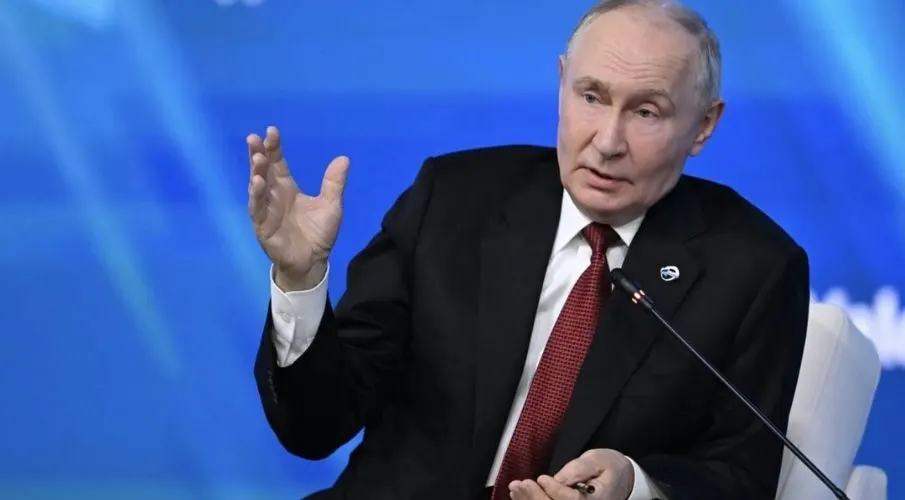
Vladimir Putin has been talking about peace again. Russia needs security, Ukraine does too, and all of Europe needs a new security framework. Shortly afterward, the Russian president declared that eastern Ukraine historically belongs to Russia. The man who sent his army across the border in 2022 now wants to negotiate what guarantees the country he invaded should provide to its aggressor. His claim to Ukrainian territory apparently stands beyond the very doubts he expects everyone else to accept.
On October 22, 2026, Putin spoke to journalist Pavel Zarubin on Russian state television. Earlier, he had attended an event at Moscow's Bolshoi Theatre marking the 150th anniversary of Russia's Union of Theatre Workers. The day before, U.S. special envoy Steve Witkoff had met with him. Putin said Russia was ready to resume U.S.-mediated talks with Ukraine in November. His goal, he said, was a final peace agreement that would guarantee long-term security for both countries. A temporary ceasefire would not be enough. Talks on various disputed issues could lead to a positive outcome. Russia wanted to bring the conflict to a permanent end.
Since February 2022, Russian forces have been waging a full-scale war of aggression against Ukraine. Moscow has the power to stop its military attacks. Instead, Putin talks about the conditions under which Russia could live securely after a peace agreement. That demand deserves particular attention because the Russian army is still fighting on Ukrainian territory, and Moscow is demanding land it has yet to fully conquer militarily. Putin also repeated his familiar account of how the war began. Russia had never wanted to go to war, he claimed. Ukraine's leadership had responded with hostility to issues of major concern to Moscow. He thus treats the decision to invade as though it were an unavoidable response to its neighbor's behavior. Russian troops, however, crossed Ukraine's borders on his orders. Neither political disagreements nor disputes over security give a country the right to occupy another country's territory by military force.
Putin is now demanding that any agreement also address Europe's entire security framework. Witkoff had explicitly raised that idea during their meeting, he said. Putin agreed and wanted to see how things developed over the coming days. The Russian president is making a demand that reaches far beyond Ukraine. After years of war, Moscow wants a hand in shaping a European order whose territorial foundations its own army has violated. His demand raises a question Putin leaves unanswered: What security can a smaller country expect in the future if its larger neighbor is allowed to turn historical claims of ownership into the basis for political negotiations?

Witkoff also met with Ukrainian President Volodymyr Zelenskyy in Norway on Tuesday. Kyiv was ready for new talks, Zelenskyy said. They could take place in early November. Ukraine supported all proposals for a ceasefire and an end to the war. A halt to attacks on energy infrastructure, along with humanitarian initiatives, would also be welcome.
U.S.-led mediation efforts had stalled in February when the war involving the United States and Israel against Iran began. Now, talks are once again being discussed. The territorial dispute remains unchanged. Russia is demanding that Ukraine surrender the entire Donbas region in the country's east. That includes territory still under Ukrainian control. Kyiv rejects giving up any such part of its territory. Putin counters that the Donbas is historically Russian land. That fact, as he sees it, must be taken into account during negotiations. He also claimed that residents there had voted to join Russia in referendums held 7 months after the invasion began. Those votes were organized under Russian occupation. They give Moscow no internationally recognized legal claim to Ukrainian territory. An occupying regime can change a border on a map and announce referendum results. That does not legally transfer a country's sovereignty.
Putin nevertheless explicitly declared that the disputed territory did not belong to Ukraine. It was territory of historical Russia, he said. With that claim, he places his own interpretation of history above today's national borders. People in the Donbas have been living with the consequences of that policy for years. New negotiations may take place in November. Zelenskyy is offering talks on a ceasefire. Putin is demanding a comprehensive peace agreement while continuing to claim Ukrainian land. While Moscow wants to negotiate security, it is demanding that Ukraine give up territory Russia is trying to bring under its control through its war of aggression.
Updates – Kaizen News Brief
Alle aktuellen ausgesuchten Tagesmeldungen findet ihr in den Kaizen Kurznachrichten.
To the Kaizen News Brief In English


