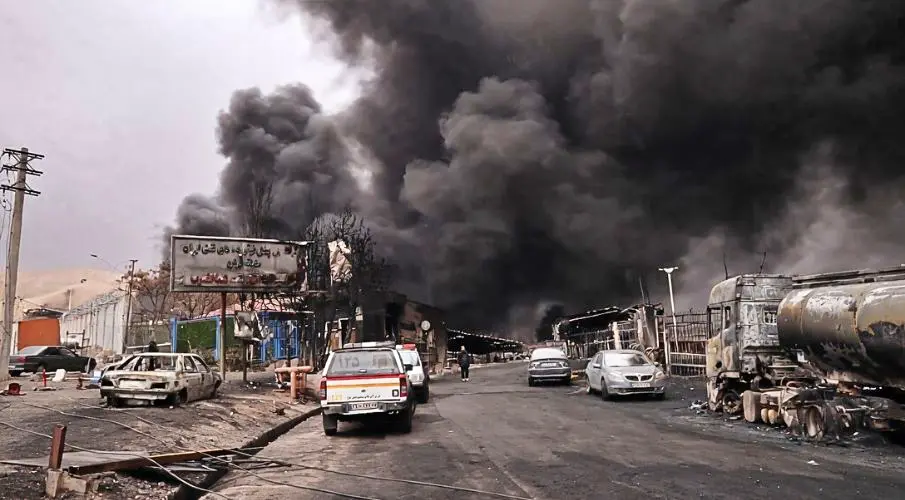
Off the coast of Dubai, a fully loaded oil tanker is in flames. Two million barrels of crude on board, struck by a projectile in an attack Kuwait attributes to Iran. The fire was contained, no oil leaked, the crew survived. But the message of this attack is clear. Energy has become a direct target, and with it one of the most sensitive lifelines of the global economy.

The Strait of Hormuz, through which roughly a fifth of the world’s oil normally flows, is effectively blocked. Tankers avoid the route, insurers pull back, ships wait. Instead of around 140 daily transits, there have been barely 150 for the entire month. Iran controls the passage, openly talking about fees for transit and excluding certain states entirely. Three Chinese vessels passed through the Strait of Hormuz, coordinated with unspecified parties, as Foreign Ministry spokesperson Mao Ning stated. China once again calls for an immediate ceasefire and points out that the passage is a vital route for energy and trade. Washington calls it illegal, Tehran ignores it. The situation is deadlocked, and it no longer affects just the region.
In the United States and globally, the impact is immediate. Gasoline prices average over four dollars per gallon, a level last seen in 2022. Since the war began, an increase of 35 percent. For Donald Trump, this becomes a political burden as he simultaneously increases pressure on Iran. At times through threats, at times through statements about alleged progress in talks, which are rejected by Iran.
At the same time, the military situation continues to escalate. Israel reports new strikes on Iranian infrastructure and at the same time missile launches from Iran. In Dubai, debris from intercepted missiles falls into residential areas, injuring four people. In Saudi Arabia, several missiles are intercepted, in the United Arab Emirates schools remain closed as a precaution. The war has reached everyday life.

Away from the front lines, the situation is also worsening. In Pakistan, a gas pipeline is blown up, in Myanmar long lines form at gas stations, fuel is rationed. In Europe, energy prices are rising again. Inflation in the eurozone climbs to 2.5 percent, driven mainly by energy, which has suddenly become significantly more expensive again. Christine Lagarde signals that interest rate hikes are possible if this trend continues.
While the economic consequences become visible, many military details remain unclear. Satellite images show damage to Al Udeid Air Base in Qatar after an Iranian attack, not officially confirmed. At the same time, footage appears to show an explosion near Isfahan, published by Donald Trump himself. Fireballs, secondary explosions, indications of military targets. Iran does not comment. At the same time, satellite data suggests that highly enriched uranium was moved to a facility near Isfahan shortly before the war began. François Diaz-Maurin of the Bulletin of Atomic Scientists assumes it is material that is only a technical step away from weapons-grade levels.

The humanitarian situation continues to deteriorate. In Iran, at least 1,574 civilians have been killed according to the Human Rights Activists News Agency, including 236 children. In Lebanon, the health ministry reports more than 1,230 dead and over 3,500 injured. In Israel, at least 17 people have been killed, in Gulf countries around 50. The United States reports 13 fallen service members and hundreds wounded. Numbers that show this war is no longer a limited conflict.
At the same time, international rules are increasingly under pressure. Turkey condemns attacks on UNIFIL peacekeepers in Lebanon as a serious violation of international law and demands accountability. Italy and France speak of growing risks for international forces and emphasize the central role of the mission for the stability of the region. Nevertheless, the fighting continues. Israel reports soldiers killed in southern Lebanon, the offensive is expanding.
Inside Iran, the situation is also worsening. UN Special Rapporteur Mai Sato criticizes new executions of members of the Mujahedeen-e-Khalq and warns that executions are being used to suppress political dissent. The Mujahedeen-e-Khalq is an Iranian opposition group in exile that once also fought militarily against the regime and now acts politically against the leadership in Tehran. Due to the widespread internet shutdown, it remains unclear how many additional cases there are.
Meanwhile, even international media come into focus. An Israeli soldier is dismissed after an incident involving a CNN crew in the West Bank. A producer was put in a chokehold, other soldiers openly claimed ownership of the territory. The incident is under investigation, the battalion involved has been temporarily removed from deployment.
At the same time, diplomatic pressure is increasing without visible results. Egypt’s foreign minister Badr Abdelattay speaks with counterparts from Saudi Arabia, the United Arab Emirates, Qatar and Jordan about mediation efforts. Talks were held in Islamabad with Pakistan and Turkey to bring the United States and Iran back to the negotiating table. At the same time, Pakistan’s foreign minister Ishaq Dar travels to Beijing to meet Wang Yi for further steps. China again calls for a ceasefire and describes the Strait of Hormuz as crucial for global trade.
But all these talks run against a reality that continues to intensify daily. Attacks on tankers, drones on airports, missiles over cities, destroyed infrastructure, rising prices. And political statements that further increase the risk.
When asked why potential strikes on power plants or desalination facilities are even being considered, Karoline Leavitt responds evasively. It would be best to make a deal, otherwise the U.S. military has capabilities beyond imagination. When asked whether this includes potential war crimes, she stays on message. The president will pursue his objectives.
It is precisely this combination that makes the situation so dangerous. Military escalation, economic pressure, political threats, lack of control. A war that can no longer be contained to one area and whose effects are already being felt worldwide. And while discussions revolve around strategy, deterrence and negotiations, reality shows something else. The fronts are hardening, the damage is increasing, and with each day the price that everyone will ultimately pay continues to rise.
Updates – Kaizen News Brief
All current curated daily updates can be found in the Kaizen News Brief.
To the Kaizen News Brief In English


Es fühlt sich an, wie in einer Waschmaschine.
Man wird mitgezogen, taucht unter. Taucht ein.
Dann ist man oben und hofft, dass es besser wird.
Aber man wird wieder hineingezogen.
Trump hat längst die Kontrolle verloren.
Hier kommen Kräfte und alte Feindschaften zum Ausbruch.
Wohin das noch führen soll?😞
Im Moment ist alles, inklusive 3. Weltkrieg, möglich.
…die lage ist sehr, sehr angespannt, leider