
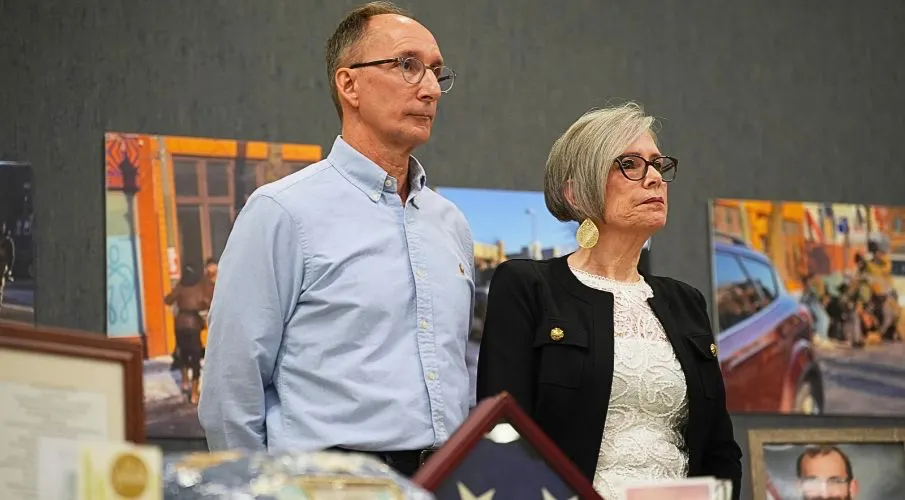
The first call came from a journalist. On January 24, 2026, Michael and Susan Pretti learned from the news that their son Alex had been shot and killed in Minneapolis. Then they saw the footage. Their 37-year-old son was lying in the street, federal agents standing over him, shots fired at close range. Those images haunt his parents to this day. On October 27, they sit before the cameras and demand something that, in a country governed by the rule of law, should never require a public plea: answers about their child's killing. No one from the federal government has called them in nine months, Michael Pretti says. Yet the government wasted no time making accusations against the dead man.
Alex Pretti's father: "Our son was shot and killed by the government, federal immigration agents, on January 24th, 2026. We learned about his death from the media as we saw him being shot repeatedly in the back after helping a woman from his community. This was not a protest that Alex was at. His hands were in the air, and his face was on the ground when he was executed by ICE agents. We know exactly what our eyes saw. No one from the federal government called us on that day. But they did go on TV to tell lies about Alex. No one has called us since. No one has recanted those lies."
Alex Pretti worked as an intensive care nurse at a veterans hospital. He was an American citizen with no criminal record and, according to his parents, had been observing immigration enforcement operations in his neighborhood. They stress that he had been peaceful and was not taking part in a protest. That day in January, according to his father, he helped a woman who had been shoved to the ground by officers. Pretti was carrying his own firearm. Eyewitness footage, however, shows him holding a cellphone immediately before officers forced him to the ground and shot him. No video has emerged showing him drawing his gun or attacking federal agents in those moments. That matters, especially given how much else the government claimed after his death.

Kristi Noem, then secretary of homeland security, called the nurse a domestic terrorist who had violently resisted federal agents. Administration officials portrayed him as an armed attacker. His death had barely become public knowledge before the assault on his character began. "The federal government went on TV and lied about Alex," Susan Pretti says. "They tried to slander his memory to cover up their crime." Her son could no longer answer those accusations. Nine months later, his mother had to do it for him, while footage of his final seconds had long since spread around the world.
The fatal shots have been attributed to Border Patrol agent Jesus Ochoa and Customs and Border Protection officer Raymundo Gutierrez. His parents are demanding an investigation and criminal accountability. "We want to clear our son's name," Susan Pretti explains. "We want the world to understand who Alex really was. We want our son's killers brought to justice once and for all." She describes her firstborn as exceptionally caring. He loved working with veterans and stood up to people who bullied others, she says. His parents are not political activists, she emphasizes. A son who cared for other people was killed in the street. His family then had to fight publicly to defend his good name.
The silence has names attached to it. U.S. Attorney General Todd Blanche and Minnesota's top federal prosecutor, Dan Rosen, are the targets of the family's accusations. Michael Pretti says his family was ignored and misled in their attempts to get information. Rosen did not agree to a meeting until July. Yet he refused to provide even basic information about the status of the investigation, according to the parents and their attorney, Steven Schleicher. The lawyer accuses the Justice Department of violating the rights of crime victims protected under federal law. He had already written to Blanche about it in July. The very authorities who should be providing answers are the ones maintaining the silence.
While the parents wait for information, Minnesota investigators are also fighting for access to the evidence. Attorney General Keith Ellison and Hennepin County Attorney Mary Moriarty sued the Trump administration in March, alongside investigative agency chief Drew Evans. The case concerns the fatal shootings of Pretti and Renee Good, as well as the shooting of Julio Cesar Sosa-Celis, who survived with injuries. Federal prosecutors acknowledged in court filings that they had stopped sharing evidence with state investigators. Minnesota is still seeking the cellphones of the officers involved and recordings of key interviews. The Trump administration is challenging the authority of state investigators. Minnesota officials, meanwhile, say they do not trust a federal government investigating its own officers.
Hennepin County Attorney Mary Moriarity announced an "important milestone" in the investigations into the fatal shootings of Renee Good and Alex Pretti, as well as the shooting of Julio Sosa-Celis. The Minnesota Bureau of Criminal Apprehension now has custody of the hard drives containing previously withheld evidence. It has also taken possession of the vehicle Renee Good was driving before ICE agent Jonathan Ross shot and killed her on January 7. Die Ermittlungsbehörde BCA verfügt inzwischen über die Festplatten mit zuvor zurückgehaltenem Beweismaterial. Außerdem befindet sich nun auch das Fahrzeug von Renee Good in ihrem Besitz, bevor sie am 7. Januar von ICE-Beamten Jonathan Ross erschossen wurde.
Government officers kill a citizen, and state investigators have to go to court just to gain access to the records. The federal government decides what evidence other investigators are allowed to receive. It denies Minnesota authorities the very trust it expects from the public. Neither Rosen's office nor the Justice Department initially responded to the parents' accusations. Silence here has long since become more than the absence of words. It keeps people away from what is known about the death of someone they love.
Government officers kill a citizen, and state investigators have to go to court just to gain access to the records. The federal government decides what evidence other investigators are allowed to receive. It denies Minnesota authorities the very trust it expects from the public. Neither Rosen's office nor the Justice Department initially responded to the parents' accusations. Silence here has long since become more than the absence of words. It keeps people away from what is known about the death of someone they love.

Michael Pretti says he and his wife love this country and trust its institutions. They believe in the rule of law. Those words are precisely what make the press conference so bitter. The father has to urge the federal prosecutor in charge to finally do his job and stop shielding the men who shot Alex. "At every single step, they have ignored us, misled us, and protected Alex's killers," he says. His wife calls the administration's treatment of the family cruelty. Nine months after their son's death, they still have not received a single call from the federal government.
What Michael Pretti misses most has nothing to do with political office. He wants to go to Minneapolis, visit his son, and talk with him about cars. Maybe go hiking, maybe ride bikes. Just sit together and see where the conversation takes them. "We wish Alex were still alive," he says. "This administration has taken that from us forever." The files concern jurisdiction and evidence. In Colorado, two parents sit with the knowledge that no one can bring their son back to them after January 24. All they ask is that the truth about his death not remain locked away as well.
Updates – Kaizen News Brief
Alle aktuellen ausgesuchten Tagesmeldungen findet ihr in den Kaizen Kurznachrichten.
To the Kaizen News Brief In English


😢
…das stimmt leider