
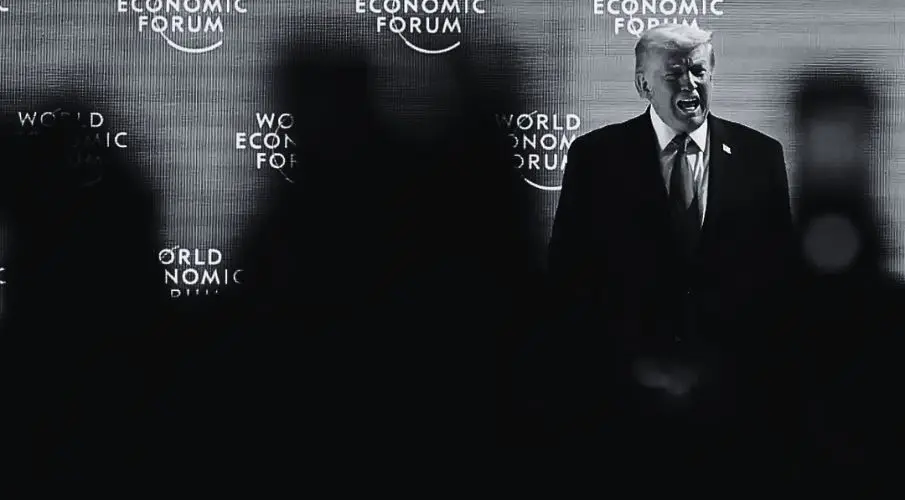
Donald Trump delivered a remarkable speech on Wednesday at the World Economic Forum in Davos that makes his leadership style in his second term unmistakably clear: he wants Greenland for the United States – if necessary through massive economic pressure on Europe. Before assembled heads of state and government, billionaires and business leaders, Trump repeated his demand for the Danish island. While he ruled out the use of military force, he made it unambiguously clear that European allies would pay a price if they stood in his way.

“We will probably get nothing unless I decide to use excessive strength and force, at which point we would honestly be unstoppable,” Trump said. “But I will not do that. That is probably the most important statement, because people thought I would use violence. I do not have to use violence. I do not want to use violence. I will not use violence.” What initially sounded like an all clear quickly revealed itself as a classic Trump tactic: one hand soothes while the other threatens. Just a few sentences later, he reminded listeners that he had already unilaterally imposed tariffs on European imports and that more could follow. Denmark and several European countries that have stood up for Danish sovereignty over Greenland he has already threatened with higher levies.

“You have a choice,” Trump said, addressing the European states. “You can say yes, and we will be very grateful. Or you can say no. We will remember.”
The hour long speech oscillated between praise and contempt for Europe. Trump spoke of his love for European countries, while at the same time criticizing their immigration policies and their turn toward renewable energy such as wind and solar power. He claimed European economies and security would collapse without American support. “Without us, most countries do not function at all,” Trump said. He supplied the rationale for his Greenland claim as well: only the United States was strong enough to protect the island from external threats. That defense, however, made sense only if the US owned Greenland, not merely leased it. He demanded “immediate negotiations” over transferring the island from Denmark to the United States.
Reactions from Europe varied. Rasmus Jarlov, chairman of the defense committee in the Danish parliament, was unimpressed: “I am glad that he rules out military force. I did not see any escalation in his remarks today. He insists that he wants Greenland, but that is not new. Of course we continue to insist that we will not hand over Greenland.” The European Parliament reacted more sharply: it officially suspended work on implementing the trade agreement concluded with the US last year. Bernd Lange, who chairs the committee on international trade, said it was “completely clear” that Trump had broken the agreement by threatening new tariffs on several European countries.
French President Emmanuel Macron also drew Trump’s attention. The US president repeated a story about pharmaceutical prices in France and claimed he had threatened Macron with tariffs – including 100 percent on wine. “It took three minutes for him to agree,” Trump said. The Elysee Palace dismissed this as “fake news.” In a statement on X, Macron’s office clarified that the president does not set pharmaceutical prices. “These are regulated by the social security system and have in fact remained stable. Anyone who has ever entered a French pharmacy knows that.”
Canada’s prime minister Mark Carney also took a hit. Trump criticized Carney’s speech from the previous day, in which he described the end of the US led world order and called for middle powers to band together. “Canada gets a lot of benefits from us. By the way, they should also be grateful, but they are not,” Trump said. “I watched your prime minister yesterday. He was not very grateful – they should be grateful to us, Canada. Canada lives because of the United States. Remember that, Mark, the next time you make your statements.” The day before, Carney had said: “Every day we are reminded that we live in an era of rivalry between great powers. That the rules based order is fading. That the strong can do what they can and the weak suffer what they must.” Without naming Trump or the United States, he warned: “Middle powers must act together, because if we are not at the table, we are on the menu.”
Amid all the attention on the Greenland demand, another issue received far less scrutiny: Trump had announced that he would present a major proposal on housing affordability in Davos. What followed, however, was thin. He repeated several familiar ideas — such as allowing homebuyers to tap their retirement savings for a down payment — and criticized Wall Street for its role in the housing market. The most concrete outcome was an executive order issued Tuesday evening directing multiple federal agencies to develop, within 60 days, guidelines on how to discourage institutional investors from purchasing single-family homes. Only about three percent of single-family homes are owned by large investors with more than 1,000 properties, while roughly 85 percent are owner-occupied.

“America will not become a nation of renters. We will not allow that,” Trump promised.
A curious detail went unnoticed in the long speech: Trump repeatedly confused Greenland with Iceland. “I help Europe, I help NATO, and until a few days ago, when I told them about Iceland, they loved me,” he said. It is precisely the tensions over Greenland, not Iceland, that are causing unrest. The day before, he had told reporters at the White House: “For example, without tariffs they would not even talk to us about Iceland.” Greenland’s government responded to the ongoing threats with practical measures: on Wednesday it published for the first time a brochure urging households to keep supplies for five days of self sufficiency in case of crisis. The government did not directly mention Trump’s remarks, but cited power outages as the reason for the recommendation.
The speech in Davos showed Trump’s strategy for his second term: he relies on a mix of intimidation and humiliation of long standing allies to push through goals he apparently sees as a key part of his legacy – the expansion of American territory. The question that remains after Davos: how long will Europe’s governments oscillate between appeasement and resistance before finding a common response to Trump’s new foreign policy, or “do we really want that?”

Our investigations and our commitment will continue. The consequences of this policy must not be overlooked for a single day – not as long as innocent people sit in prisons, not as long as help is denied where it is urgently needed. Europe stands before an upheaval that demands cohesion, not looking away. Right wing populism is not an abstract danger, it acts daily and destructively. We experience this on the front line. Yet precisely there, support is most lacking – for those who look, document, and object.

That this struggle is worth it is proven by the facts. Donald Trump has lost around 83 percent of all court cases brought against him. More than 40 percent of these decisions have already been implemented. Law works when it is used. Truth prevails when it is pursued persistently. The path there is called objectivity, endurance, and a clear focus on what matters – not distraction, not outrage loops. What must not paralyze us is the deliberate flooding with side issues, with serial noise, with the familiar Bannon strategy of escalating everything at once so that nothing remains tangible. That is exactly what we work against. Quietly, precisely, every day. But this path is only possible if we do not have to walk it alone. Anyone who reads our work, shares it, or considers it important helps us most by making it possible.
Updates – Kaizen News Brief
All current curated daily updates can be found in the Kaizen News Brief.
To the Kaizen News Brief In English


Warum gibt man ihm so viel Bûhne?
Wieso klatscht man, wenn er an das Rednerpult tritt?
Wieso klatscht man nach dieser wirren Sellbsthudelei und Drohungsrede?
Sind wir in Europa dankbar, dass er (erstmal) eine militärische Intervention ausschließt.
Sind wir dankbar, dass er in einem gröstenteils deutschsprachigen Land, damit prahlen „ohne uns würdet ihr heute alle deutsch sprechen“.
Island und Grönland des öfteren verwechseln.
Island würde ihn lieben und „Daddy“ nennen.
Mir fehlt da eine klare Aussage und Positionierung Islands.
Ist Europa so weit gesunken, dass 3/4 aller europäischen Staatschef auf seiner Schleimspur hängt und ihm die Füße küsst?
Von wie viele Europäern kamen klare Worte?
Von wie Vielen? Die muss man mit der Lupe suchen.
Kanada, ja der Premier hat die absolute Highlight Rede gehalten.
Alles auf den Punkt gebracht.
Kein niedetknien und kuscheln mit Trump.
Wir bräuchten dringend mehr Staatschef, die dieses Rückgrat haben.
Die USA sind kein verlässlicher Partner.
Sie sind ein Risiko.
Im schlimmsten Fall sogar der Feind. Für die Demokratie in jedem Fall.