
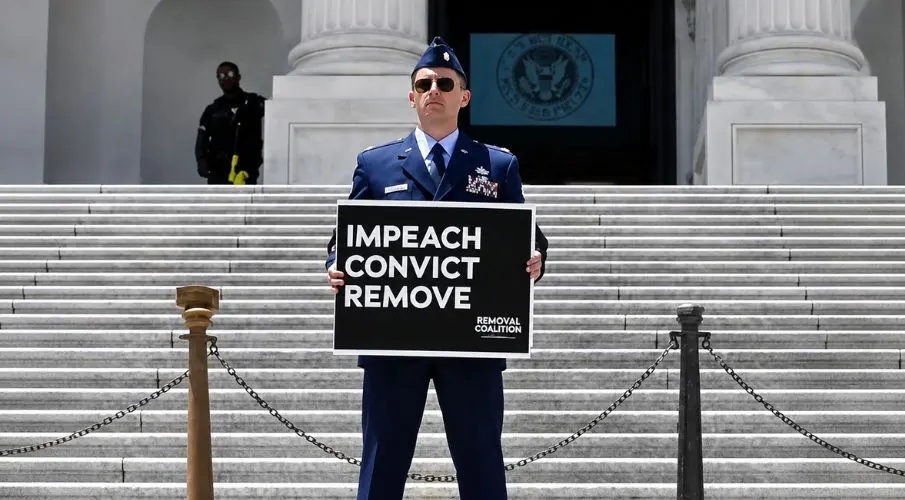
Jason Watson, a major in the U.S. Air Force, was taken into custody again on Tuesday, one day after a television interview in which he accused the president of violating the Constitution and engaging in massive corruption. He is being held in pretrial confinement in Maryland over “allegations of continued misconduct,” according to the Air Force. It did not say exactly what those allegations were. His lawyers believe his television appearance was the reason.
He had already been arrested last month, on the steps of the U.S. Capitol, when he called for Trump’s impeachment. Now he is back in a cell, barely after speaking out. The sequence repeats itself, a public accusation, then a hand on the elbow. In the interview on Monday, he said: “What is happening with President Trump is not normal. He has failed us.” And he continued: “And not only is he a failure as president, he is flagrantly violating the Constitution, breaking the law, engaged in rampant corruption, and is killing Americans. And that is unacceptable to me and it should be unacceptable to all of us.”
The July arrest came during a press conference held by the Removal Coalition. Watson accused the leadership of helplessness in the war against Iran and demanded that Trump and Vice President JD Vance be “impeached, convicted, and removed.” He was escorted off the premises in full uniform, holding a sign that read: “Impeach. Convict. Remove.” A gag order followed, along with the prospect of a court-martial or dismissal from the Air Force. He kept speaking anyway.
Watson is an active-duty service member and is putting a 17-year Air Force career on the line because he is invoking the First Amendment. His lawyers suspect that this is exactly what put him in the crosshairs. Rank and retirement are on the line because of a single appearance, along with the 17 years behind them. He himself had already calculated the price. “Nothing that is worth doing is something that you can do for free. Everything that is worthwhile is going to cost something. It’s going to be hard, it’s going to require sacrifice,” he said. “So all that I could do was ask myself: ‘What’s the highest price that I’m willing to pay?’ And this is what I ultimately came up with.” Knowing the price takes the force out of the threat. The question is no longer what his words will cost him. The question is whether the government can find a lawful name for the bill.

An officer swears an oath to the Constitution, and he obeys a chain of command. As long as both point in the same direction, the contradiction remains invisible. Watson claims that the man at the top of that chain is the one violating the Constitution, and at that moment oath and obedience split apart. He chose the oath over obedience. The law that protects him is also the law that binds him, because he cannot invoke the Constitution without touching the order that same Constitution places upon him. No law unties that knot for him, he has to cut through it himself, and he alone carries the bill.
Legally, the case is more complicated than the formula of a soldier being arrested for his opinion might suggest. Active-duty service members are also protected by the First Amendment, but far more narrowly than civilians. The Supreme Court has repeatedly ruled that freedom of speech may apply differently in the military because discipline and operational readiness require it. What is protected speech on a street can be a service offense inside the barracks. That inequality is intentional and has been firmly established for a long time.
Watson is a major and therefore an officer, and that narrows the space even further. Article 88 of the Uniform Code of Military Justice explicitly makes “contemptuous words” by an officer against the president punishable. Military law itself, however, also makes clear that harsh political criticism does not automatically fall under that provision as long as it does not become personally contemptuous. There is a narrow line between accusing the office and insulting the man, and that is the line along which this case will be fought.
What may hurt him most is the uniform. Defense Department rules allow active-duty service members to hold personal political opinions. But they prohibit creating the impression that they are speaking for the armed forces and bar political appearances in uniform. The uniform that gave his words weight also gives the other side leverage. Calling for impeachment is not itself a criminal offense, but appearing in uniform can be prosecuted under military law regardless of the content of the criticism. That gives the prosecution a convenient route. It does not have to attack the substance at all, the form is enough, and the prosecution speaks through a regulation while still meaning the words that were spoken in that uniform. If Watson then violated a lawful gag order, Article 92 could also come into play for failure to obey a lawful order.
Two opposite stories can be told about the same events. In one, the Air Force is prosecuting an officer who violated rules and disobeyed orders, and is simply doing its duty. In the other, a government is punishing a critic and dressing that punishment in the clothing of regulation. Which one is true depends on a single piece of proof that the agency has so far failed to provide.
The renewed pretrial confinement is therefore the sore point. It would not be unlawful simply because Watson criticized the president. But military confinement must rest on a specific military-law allegation and cannot become punishment for unwanted speech. Article 10 of the military code requires that a detained service member be informed of the specific accusation and that steps toward trial be taken without delay. The sequence raises suspicion. On Monday he speaks on television, on Tuesday he is behind bars, and in between there is no new incident that the Air Force has identified, only a phrase about “continued misconduct” that can mean everything and nothing. What cannot be pinned down cannot be disproved either, and that is precisely what makes a vague allegation useful as a tool.
The case concerns more than one man. Lock an officer away one day after an interview without saying why, and every other person in uniform learns the lesson that speaking is expensive and silence is safe. A force made compliant that way ultimately obeys fear and barely the law anymore, and that harms the military more deeply than any single uncomfortable speech. Trust, which no order can command into existence, declines further with every unnamed accusation.
Human rights law draws the line in the same place. Article 19 of the International Covenant on Civil and Political Rights protects political speech but permits restrictions that are provided by law and necessary, including for national security and public order. Article 9, at the same time, prohibits arbitrary detention. Military discipline can support a restriction, political retaliation cannot. The limit is narrowly drawn and tied to a purpose that the authorities must prove. If that purpose is missing, what remains is force, and force alone cannot stand under either of those articles. The decisive question will not be whether Watson insulted the president or demanded his impeachment. The decisive question will be whether the Air Force can show a specific and lawful reason for the renewed confinement, one that is also proportionate.
Watson has said what he had to say, and named the price that came with it. The Air Force is holding him and remains silent about the reason. That silence is now the subject of the case, and it weighs more heavily than any word they could come after him for.
Updates – Kaizen News Brief
All current curated daily updates can be found in the Kaizen News Brief.
To the Kaizen News Brief


Zu allererst meine Hochachtung gilt Major Watson. Eine klare Entscheidung trotz persönlichen Nachteilen, einer der den Sinn seines Eides erfüllt. Gebe es viele wie Ihn, wäre Trump schon längst weg und viele Menschen gerettet sowie die Naturreservate. Mein Wunsch für Major Watson viele Mitdtreiter
Absolut, daher unterstützt man wo man nur kann
je mehr mediale Aufmerksamkeit dieser Fall in den USA erhält, je mehr werden es zu Sargnägel an Trumps Präsidentschaft. Ob Major Watson das nun darf, oder nicht, er sagt die Wahrheit , und die wird am Ende gewinnen. Gerade weil er sein persönliches Schicksal dem unterordnet. Ein wahrhaft mutiger Soldat.
Vollkommen richtig
Der Mut dieses Mannes ist bewundernswert
Meine große Bewunderung für Major Watson.
Er weiß, was ihm droht, aber dennoch zieht er es durch!
Es bräuchte mehr wie ihn, gerade auch im Militär, in der Nationalgarde, bei den locale Polizeibehörden.
Dann wäre Trump mit seiner Entourage bald Geschichte.