
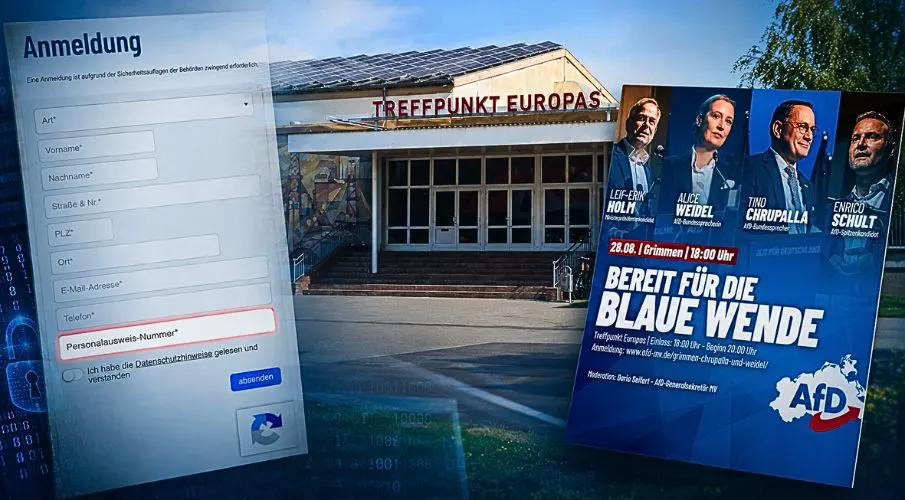
Before the AfD event in Grimmen on August 28, there is a form standing between the citizen and the hall, and on that form is a required field: the national ID card number. No number, no registration, no registration, no entry. To justify it, the party offers one sentence, saying that registration is "mandatory due to security requirements imposed by the authorities." Which authority, which requirement - that remains unanswered.
This is exactly where the trivial turns into the explosive. There would be nothing unusual about an authority requiring registration or an ID check at the entrance. But that does not remotely mean anyone ordered the party to collect and store the serial number of every visitor in advance. So far, nobody has been able to provide us with such an order in response to our inquiries, neither the party nor the agencies mentioned. The line about security requirements serves as a shield behind which almost anything can hide. It claims there is an order from above without showing it, and shifts responsibility onto an agency that does not respond. It is hard to imagine a more convenient way to disguise an imposition.

It is perfectly fair to ask who supposedly did this. The police? Vorpommern-Rügen County? The City of Grimmen? The State Criminal Police Office? The Federal Criminal Police Office, because of Weidel and Chrupalla? The registration page does not name any authority. There is no date, no case number, and certainly no legal basis. Yet those would be the first things an authority would have to name if it were demanding something like this.
If the AfD justifies collecting this data by citing "security requirements imposed by the authorities," then under Article 13 of the GDPR, at the time the data is collected it must transparently explain, among other things, who is responsible, the purpose for which the number is being processed, the legal basis for doing so, who receives the data, how long it will be stored, and whether providing it is required by law or what happens if someone refuses to provide it.
The state's police law knows this territory very well, and it does not match what is happening in Grimmen. Under Section 29 of the SOG M-V, police may establish a person's identity under certain conditions and may ask to examine an ID card for that purpose. Checking an ID at the entrance is something entirely different from a political party indiscriminately collecting the serial numbers of every guest in advance. For special threat situations, Section 40 of the SOG M-V allows reliability checks before events. But the law ties those checks to the written consent of the people concerned, police may tell the private party only whether there are concerns about a person's reliability, and the data must be deleted no later than after the event ends. None of that appears anywhere in this uncommented required field. The law recognizes the exceptional case and fences it in with consent and a deletion requirement. The form knows only the field.

Grimmen has a long documented history of far-right activity and today is also an exceptionally strong AfD voting area. The fact that Alice Weidel and Tino Chrupalla are taking their campaign specifically to a small town of 9,076 people therefore hardly seems accidental. In September 2025, members of the far-right party "The Third Way" stood outside a secondary school in Grimmen in the morning and handed teenagers flyers containing terms such as "death of the people," "foreign infiltration," and "foreigner ghettos." Years ago, there were already reports of neo-Nazi concerts, fraternity gatherings, demonstrations, and other far-right activities in and around Grimmen.
What happens to the number remains the great unknown. Does it stay with the party? Does it go to the police or to a private contractor? Is it checked against databases? Nobody says who receives the result or who decides who gets in, and nobody says when the number will be deleted either. The AfD's privacy policy is no help. It states in general terms that data submitted through registration forms remains on the hosting provider's servers until the process is completed. There is not a word about the ID card number, the alleged requirement, or any special recipient. For purposes of the investigation, the current state of affairs needs to be preserved before it can be changed: a screenshot of the field and the destination of the form. The service provider involved and the current version of the privacy policy should also be documented, with the date and time. If the field disappears after the first inquiry, at least there will be proof of what it looked like before.
Article 13 of the GDPR requires precisely the information that is missing here, from the purpose and legal basis to the possible recipients and the storage period. That includes telling people whether the number is mandatory and what happens if they refuse to provide it. If the only purpose is to establish that a Mr. Höcke really is Mr. Höcke, the party would have to explain why a name and a look at the ID card are not enough and why the serial number has to be stored. The German Identity Card Act allows the ID card to be used as proof of identity, but it places tight limits on the use of its serial number by private parties. The serial number connects a person to a government-issued document, and that is precisely why the law keeps private hands away from it.

The political side of this weighs heavily. A named list of guests attending a political party event allows conclusions to be drawn about political beliefs, and those count as specially protected data under Article 9 of the GDPR. Parties may keep such data on their own members and trusted associates, but an open campaign event attended by ordinary members of the public does not automatically fall into that category. When handing over the number becomes a condition of admission, even the much-invoked notion of consent starts to wobble, because the GDPR requires its voluntary nature to be examined whenever a service is made dependent on data that is not actually needed for that service. The result is a list containing more than names. It records who went to which party on a particular evening and makes political leanings something that can be looked up.
An address changes, and eventually an ID card does too - along with its serial number. But for as long as it remains valid, that serial number is the unique number of that government-issued document. Anyone who hands it over to a political party is giving away far more than just a name: an additional identifying marker whose use by private parties is expressly restricted by law.
The comparison with the exceptions now being cited is misleading. Grimmen is not an air base and it is not a parliament. During a tour of Nörvenich Air Base, the CDU required participants to provide their names and ID card numbers, and we also know of such advance disclosures for visits to the European Parliament, expressly tied to secure access to a high-security facility. The Treffpunkt Europas cultural center in Mecklenburg-Western Pomerania is none of those things. Those exceptions are justified by the site itself, the airfield, or the parliament building, where access controls rest on a clear basis. A campaign event in a small town of 9,076 people rests on no such basis, and anyone who merges the two is borrowing the rigor of a high-security compound to register ordinary citizens.
The State Commissioner for Data Protection points in the same direction. In his guidance for associations, he states that a legitimate interest may exist in collecting a name and address, but not automatically an ID card number. He should not merely be asked for a comment. What is needed is a clear assessment of this one required field.
That the question of why visitors to a political party should have to hand over their government-issued ID number, and which authority supposedly requires it, apparently has to be asked first by an international newsroom says enough about the state of the public sphere that should have been paying attention here long ago. A required field that everyone can see and nobody questions already says enough. That it took an outside look to make a visible field visible belongs to the story as well, and it shows how easily something outrageous can become normal.

Registration is the harmless part. What weighs more heavily is that a political party is demanding the state-issued identifier from every guest at a political event, invoking unnamed authorities and leaving open where the data goes, while the state's police law sets precise limits for exactly these kinds of checks.
It starts with the number. A party that demands the state-issued identifier from every visitor's ID card is laying the first row of stones for a registry recording who comes to it. Anyone who knows that their name and ID card number are sitting with a political party will think hard about showing up, and that is exactly the point of the effect. Where caution rules, power no longer needs a ban, people ban themselves. Control rarely begins with a prohibition. At the beginning there is a field you have to fill in. A country where government offices once kept files on their citizens ought to recognize what is happening. A registry does not require evil intent, only completeness. A data record outlives its purpose, and what it means later is decided by whoever one day gets their hands on it. A democracy depends on being able to attend an assembly without having to explain yourself. Take that basic freedom away from the guests and you take away the meaning of the assembly itself.
What is being applied in Grimmen has a name, and that name is heard in Washington, just on a smaller scale. There, a government declares dissenters to be a security problem, attaches a "but" to every fundamental right and calls surveillance protection. The AfD writes the same grammar, with a form instead of a decree. Anyone who admires the strongman across the Atlantic adopts his methods first and his speeches afterward. First the ID card number, then the list where someone can look up who showed up, who perhaps would be better off not showing up at all. That is why the decisive inquiry to the authorities cannot be some meaningless yes-or-no question about unspecified requirements. It has to be specific: Did any authority expressly order the AfD in Mecklenburg-Western Pomerania to collect and store the ID card numbers of every visitor? And if so, on what legal basis and with what deadline for deletion? The same question goes to the party, sharper still, along with the one that decides everything: Does someone get in if they show their ID card at the entrance but keep the number to themselves? As long as there is no answer, the simpler explanation remains the obvious one. The purge does not need a decree. A required field is enough.
Updates – Kaizen News Brief
All current curated daily updates can be found in the Kaizen News Brief.
To the Kaizen News Brief


Danke dafür das Sie dies aufgegriffen haben. So bereitet sich Diktatur vor.
Gerne, und die Recherchen gehen weiter …