
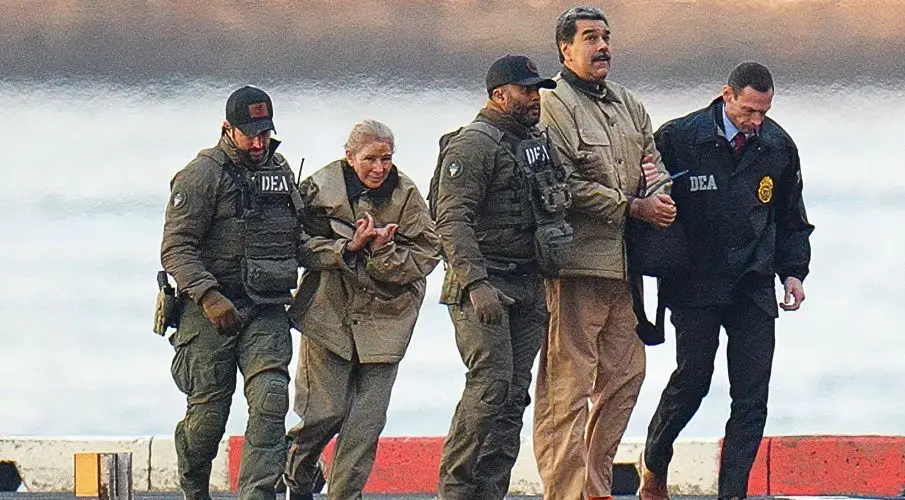
Under massive security, Nicolás Maduro and his wife Cilia Flores were brought on Monday to the federal courthouse in Lower Manhattan. Two days after their arrest during a US commando operation in Caracas, they appeared for the first time before an American judge. The now unsealed indictment accuses both, among other things, of narco-terrorism, conspiracy, and the importation of large quantities of cocaine into the United States. Both declared that they were not guilty.

From the very beginning of the hearing, the tension was palpable. Maduro spoke in Spanish, identified himself as the president of the Republic of Venezuela, and said he was here “kidnapped.” Judge Alvin Hellerstein, 92 years old, interrupted him several times and made it clear that the day was solely about formal matters. “There will be a time and a place for that,” the judge said when Maduro attempted to continue. Asked about his plea, Maduro stated through the interpreter: “I am innocent. I am not guilty. I am a decent person.” His attorney immediately clarified that his client was pleading not guilty on all four counts.

Maduro also stated that he was holding the indictment “for the very first time.” When Judge Hellerstein offered to read it to him, Maduro replied: “I would prefer to read it personally.” The judge responded calmly: “It is my duty to ensure a fair process. That is my duty, and that is my intention.” He then ordered that both Maduro and Flores remain in custody until further notice. He set March 17 as the date for the next hearing. Both defendants were then led out of the courtroom.
Maduro and his wife were brought into the courthouse through the detainee entrance. His wife appears very shaken, and there is the impression that injuries were being concealed.
Maduro wore a dark blue short-sleeved shirt over orange prison clothing and black over-ear headphones for translation. Flores sat several seats away in similar clothing. Through her attorney, she declared that she was “not guilty, completely innocent.” In the courtroom, Flores wore a bandage on her forehead, and near her right eye clear bruising was visible. When she stood to enter her plea, she appeared to lean on the arm of a US marshal for support. Her defense attorney Mark E. Donnelly, a former federal prosecutor from Houston, said after the session that Flores had serious injuries that required medical treatment. Maduro’s attorney Barry Pollack announced that he would file motions addressing both Maduro’s status as a head of state and the “lawfulness of his military abduction.” He also referred to his client’s health problems.

As Maduro left the courtroom, he turned once more and said in Spanish: “I am a prisoner of war.” With that, a hearing concluded that proceeded in a legally routine manner and precisely for that reason made the extraordinary background all the more stark. The proceedings followed the order of a federal court, but the images showed a fallen power holder forced to find his way in a new reality in which the judge is the highest authority.
Outside the courthouse, the divide was reflected. On one side were demonstrators with signs reading “Hands off Venezuela.” On the other side was a larger group with Venezuelan flags, singing the national anthem and chanting: “This dictatorship has fallen.” The scene felt like a political commentary in real time.

At the same time, in Caracas the National Assembly met for the first time since the US raid. The session was chaired by Jorge Rodríguez, brother of the new interim president Delcy Rodríguez and a longtime confidant of Maduro. The seat of Cilia Flores remained empty, her nameplate stood unattended. Maduro’s son Nicolás Maduro Guerra, who is also indicted in the United States and is referred to there as “Nicolasito” and “the prince,” took the floor. He spoke of the kidnapping of his parents and said: “Thanks to the struggle of the people, in the country and outside, they will return; our eyes will see them.”
Deputy Fernando Soto Rojas opened the session with a sharp speech. He called Maduro’s arrest a “barbaric” and “cowardly” attack. Shortly before his arrest, Maduro had signed a 90-day emergency decree instructing police and the military to arrest supporters of the US attack and to place key sectors such as the oil industry temporarily under military control.
In Washington, President Donald Trump meanwhile sharpened his tone. On Sunday evening he declared that his administration was now “responsible for Venezuela” and “in charge.” This statement contradicted remarks by Secretary of State Marco Rubio, who had earlier suggested that the goal was to force the new leadership in Caracas to cooperate, not to directly control the country. Trump went further and hinted at possible steps against additional states, including Colombia, Mexico, and the semi autonomous Danish territory of Greenland. Asked whether this could also mean an operation against Colombia, he said: “That sounds good to me.”
Reactions followed immediately. Colombia’s president warned that any attempt to detain him would provoke massive resistance. Denmark’s prime minister urged Trump to end the threats. Mexico’s president Claudia Sheinbaum, by contrast, said this was simply Trump’s way of speaking. Pressure also grew at the international level. The UN Security Council convened an emergency session. The political chief of the United Nations read out a statement by António Guterres in which he said he was “deeply concerned” that the United States may not have respected international law during the operation. At the same time, he warned of the precedent that such a military seizure could create.
Thus this day condensed into a tableau of courtroom, street, parliament, and diplomacy. A full assessment would take months. But in view of the deaths caused by the operation, the unresolved questions surrounding the legality of the arrest, and the political consequences, it is already clear that this case goes far beyond an ordinary criminal proceeding.
Updates – Kaizen News Brief
All current curated daily updates can be found in the Kaizen News Brief.
To the Kaizen News Brief In English


Genfer Menschenrechtskonvention (die USA gehören der nicht an, oder?) = jeder (Kriegs)gefangene muss adäquat, auch medizinisch, behandelt werden.
Offensichtlich wird Cilia Flores eine richtige medizinische Versorgung verwehrt.
Diese Verletzungen zeigen auch, dass es hier um eine brutale Entführung ging.
Und der Tod von Zivilisten in Kauf genommen wurde.
Der Sohn von Maduro steht wahrscheinlich ganz oben auf der Zielliste, wenn Venezuela bicht pariert.
Die „Rechtfertigung“ wäre dann die bestehende Anklage in den USA
…doch, die usa gehört der GMK an mit allen rechten und besonders pflichten
Dann ist es noch brisanter