

A Senate seat has no memory. The people waiting to occupy it do.
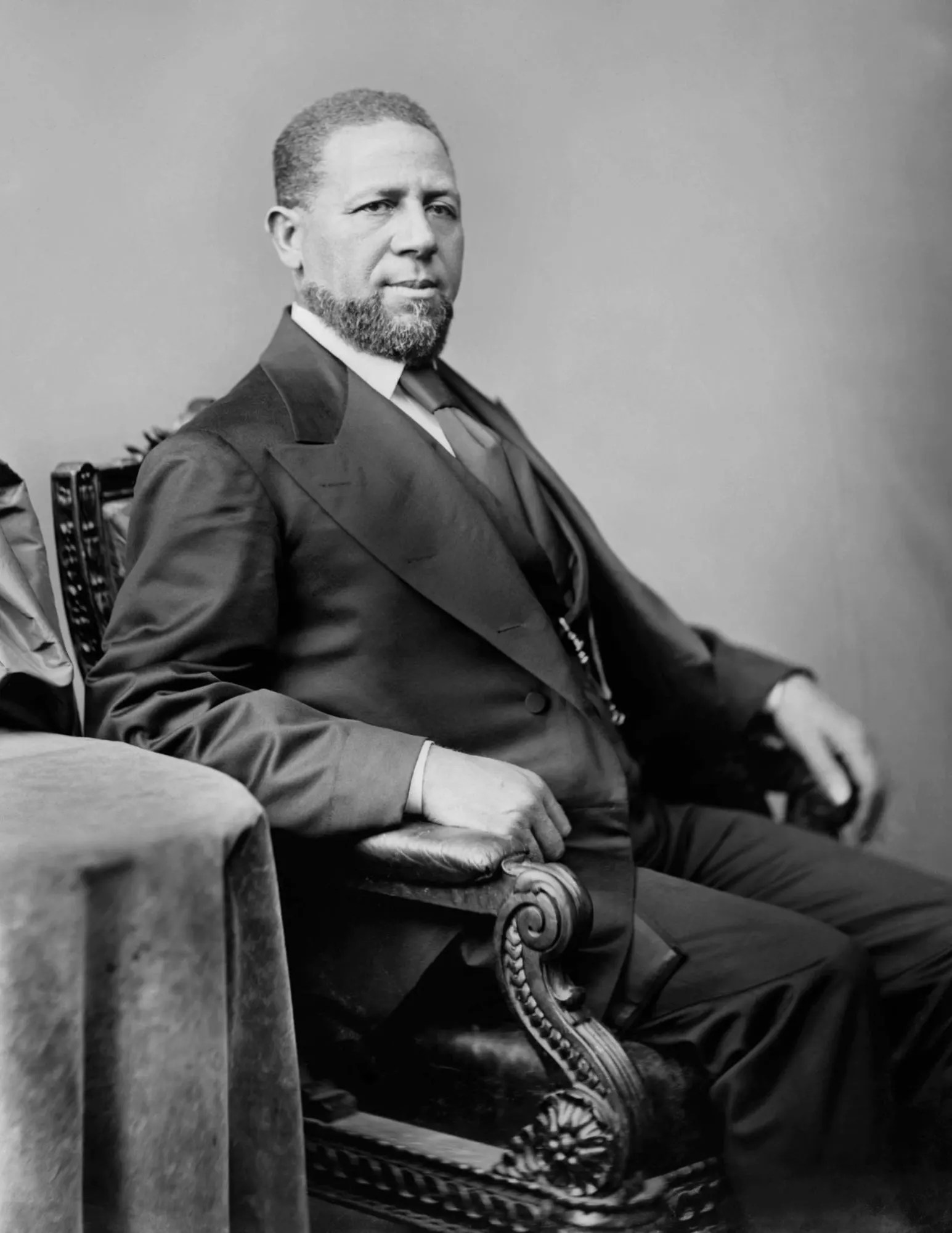
Hiram Revels, the first Black U.S. senator, occupied Mississippi's seat in 1870. The state legislature had chosen the former Union Army chaplain shortly after Mississippi was readmitted to the Union. He took the oath of office on February 25. In his first speech, he spoke out against efforts to keep Black people out of public office. They were simply demanding the rights they were entitled to under God's universal law. After him came Blanche K. Bruce, born into slavery in Virginia, who escaped during the Civil War. He represented Mississippi from 1875 to 1881 and became the first Black senator to serve a full term. Then Black Americans were violently driven out of politics. Bitter segregationists took that seat, men like James K. Vardaman and James O. Eastland. In January, Scott Colom will sit there.
For nearly 150 years, Mississippi hasn't sent a Black senator to Washington. Colom, 43, a district attorney, is the first Black candidate Mississippi voters have elected to the U.S. Senate in a popular election. The last time a Democrat won a Senate race here was in 1982. That was John C. Stennis, a staunch defender of racial segregation who didn't abandon those views until late in his career. On November 11, 2026, Colom defeated incumbent Republican Cindy Hyde-Smith in a state Donald Trump had won by more than 20 percentage points just two years earlier. More has changed here than the seating arrangement in one chamber of Congress. Mississippi has caught up with a part of its own history it preferred to keep at arm's length for generations.
Martin Luther King Jr. once described Mississippi as a state sweltering in the heat of injustice. The memory leads back to poll taxes and literacy tests used to keep Black Americans from voting. It leads back to civil rights workers murdered for trying to help others register to vote. Even today, Black residents make up around 37 percent of the population, a larger share than in any other state. A Black Democrat defeats the incumbent Republican senator here. That can't simply be filed away as an ordinary change of power. Every ballot carried a much longer history.

The counting went on for a long time. More than a week after the November 3 election, votes were still being counted, with lawyers from both parties watching closely. With around 99 percent of the vote counted, Colom was ahead by 4,669 votes. Eventually, he was officially declared the winner. Hyde-Smith conceded defeat in a video message. "While this is not the outcome we worked for or hoped for, I respect the decision of Mississippi voters," she said. She publicly congratulated Colom and wished him success in representing the state.
"While this is not the outcome we worked for or hoped for, I respect the decision of Mississippi voters. I want to congratulate Scott Colom and wish him well."
A decent gesture. Apparently, it's easier for her when the defeat is her own. Acknowledging Trump's defeat in 2020 had been harder for that same politician. After the attack on the Capitol, she voted in January 2021 to reject the election results from Pennsylvania and Arizona. Respect for the will of the voters came late. At least it came.
The story has a punchline that would normally keep several Washington speechwriters busy. This time, the voters were enough. Hyde-Smith never wanted Colom to become a federal judge. In 2023, she blocked his nomination, citing money from the Soros family and his position on transgender rights. Colom even had Republican support for his appointment to the federal district court in northern Mississippi. Senator Roger Wicker backed him. So did former Republican governors Haley Barbour and Phil Bryant. Democratic Congressman Bennie Thompson supported him, too, of course. Hyde-Smith refused to give her consent. Three years later, the same man takes her seat.

If he had become a federal judge, he never would have run for the Senate, Colom later said. Revenge hadn't been his motivation. What had frustrated him was how little attention Mississippi received. The woman who blocked his path to the judge's bench unintentionally cleared his way to a Senate seat. Rarely has an obstruction been so generous.
His résumé helps explain why some voters believed him. At 28, he became both the youngest and the first Black judge appointed in Lowndes County. He later became the first Black city prosecutor in Columbus. In 2015, he won the election for district attorney of the 16th Judicial District, unseating an incumbent who had held the job for nearly 30 years. He championed programs that allowed nonviolent offenders to avoid prison. With a small staff, he personally handled more than two dozen jury trials and secured convictions in nearly every case. His father, Wilbur Colom, was a judge appointed by Ronald Reagan, and his mother was an attorney. In this family, the law is a trade you learn about at the kitchen table.
Donald Trump appeared at the Crossroads Arena in Corinth, Mississippi, on Monday, October 26, 2026, at 6:00 p.m. local time.
Hyde-Smith had long been considered a safe bet. Just days before the election, Trump personally campaigned for her. Colom received support from former President Bill Clinton and Kamala Harris. He visited all 82 Mississippi counties, often wearing a hoodie and plain sweatpants, and talked about grocery prices and gas. He asked why Hyde-Smith wasn't holding public town halls and accused her of failing to stand up for her constituents when it came to Trump. He promised to "bring Mississippi values to Washington," deliberately keeping things down to earth. He affirmed his support for gun rights and praised Trump for making tips exempt from federal income tax. In a state with deeply rooted conservative traditions, that was no minor detail.
The campaign lasted a year and a half. Talking to people every single day had been hard work, Colom later recalled. He knew he had to raise enough money and talk about the issues that mattered to people. About his values and his faith, too. The old strategy of turning voters against one another and distracting them had worked for a long time, he said. He, on the other hand, had stayed closer to people's everyday lives. It sounds unremarkable. Until you remember how much politics these days manages to get by without those everyday lives.
He owed his most successful campaign ad to the incumbent herself. Asked about high beef prices, Hyde-Smith had suggested that consumers could simply switch to other sources of protein. Colom's response featured ordinary people greeting that advice with open ridicule. Russ Hudson, 35, an Afghanistan war veteran, stood at a grill and said, in his thick Southern accent, essentially that he'd rather vote for a different senator. The appearance became famous far beyond Mississippi. Hudson's father had originally been supposed to appear on camera. He refused because the planned curse word was too crude for him. So his son stepped in. A campaign about the cost of living can come undone over a single hamburger, and Hyde-Smith had told people they should just go without it.

Hudson lives with a disability. He's on a fixed income and has a young child. Colom's promises to tackle the high cost of living and protect veterans' benefits resonated with him. He had little political experience and figured maybe a few thousand people would see the ad. In the end, he had to repeat his line over and over because people he knew kept asking him to. There was even a limited-edition T-shirt featuring his face. Activist Roderick Talley of Lexington described Colom as someone people could identify with. The ads had featured people from their own communities, and young voters in particular had responded to them.
The decisive votes came from the Black population, which supported Colom by an overwhelming majority, according to exit polls. College students and moderate white voters joined them, including conservatives. The election came at a time when the Supreme Court had further weakened voting rights protections. The civil rights organization NAACP opened 11 offices during this election year and registered more than 17,000 voters. Its president, Derrick Johnson, said people had refused to be intimidated or discouraged. Colom promised not to forget the sacrifices of earlier generations. The right to vote, for which people died here, was simply exercised this time. No greater dignity is needed.

In Holmes County, Mississippi, a narrow road winds beneath old oak trees to a wooden house where quotes from Maya Angelou and pictures of Harriet Tubman hang on the walls. At a folding table sits Kameisha Smith, 31, on the left in the picture, working her way through a list of people whose votes have now decided a seat in the U.S. Senate.


At historically Black Tougaloo College, people danced and cried. Just that Tuesday, a student had driven fellow students in the college bus to election offices so they could find out whether their votes would count. When news of the victory came the following day, he cried with a friend. People had been hoping for this for generations, he said. The victory made him love Mississippi even more. In Jackson, cheers erupted in the law office of a Black state legislator. Colom's victory was a turning point, the lawmaker declared. A man from the same city had never expected to see a Black senator from his state in his lifetime. This time, history moved faster than his doubts.

Even in Mississippi, miracles don't happen without money. Of roughly $22 million spent on television advertising, around 62 percent went toward ads supporting Colom. Democratic donor Steve Pajcic poured at least $7 million into four Democratic Senate candidates running in Republican-leaning states. Three won, while the fourth, a woman, narrowly missed victory. The Soros family had also supported Colom for years. Back in 2015, about $900,000 went to a political organization backing his campaign for district attorney. Alex Soros later hosted a fundraiser for him, and another supporting political organization received $1 million from the Soros family's circle. So the story of a door-to-door campaign also has some deep-pocketed backers.
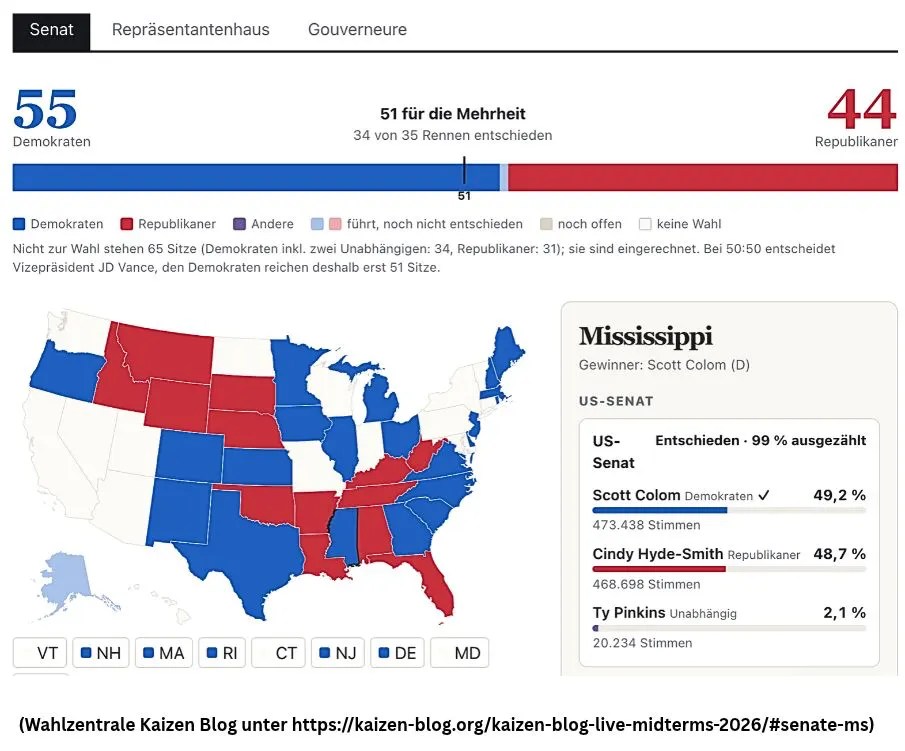
With Colom's victory, Democrats will hold at least 55 seats in the next Senate. The race in Alaska was still undecided, with Democrat Mary Peltola ahead of Republican Dan Sullivan. The larger majority will make it easier for Democrats to operate in Senate committees. It still won't be enough to reach the 60-vote threshold needed to end a filibuster on their own. Colom has already expressed doubts about whether Chuck Schumer should continue leading Senate Democrats. The fact that Schumer and House Democratic leader Hakeem Jeffries both come from Brooklyn is, to him, an argument for bringing a wider range of life experiences into the party's leadership. He's also concerned about access to healthcare and income inequality. He's taking the concerns of Mississippi's small farmers to Washington as well.

This election has produced one more number. The next Senate will have seven Black members, more than ever before. Julianna Stratton of Illinois is newly elected. Angela Alsobrooks and Cory Booker are already there. So is Lisa Blunt Rochester. Tim Scott and Raphael Warnock are among them, too. Colom takes his place in a legislative body that needed more than a century and a half to see another Black senator from Mississippi.
One color has changed on the electoral map. A single mark, nothing more. For people whose grandparents still had to fight for the right to vote, that mark carries a different weight. It reaches all the way back to Revels and his words about God's universal law.
Updates – Kaizen News Brief
Alle aktuellen ausgesuchten Tagesmeldungen findet ihr in den Kaizen Kurznachrichten.
To the Kaizen News Brief In English


Danke für diesen ausführlichen Bericht, inklusive Rückblick in der Geschichte Mississippis.
Das ist Karma as is best.
Ein verdienter Sieg für Colom.
Ich hoffe, dass er etwas bewegen kann in Mississippi, für Mississippi und für die USA.
Und das Jeffries sowie Schumer die rote Karte gezeigt wird.
… gerne, es ist historisch und man konnte vor Ort die ganze Aufregung richtig spüren, wie ein Aufbruch …