
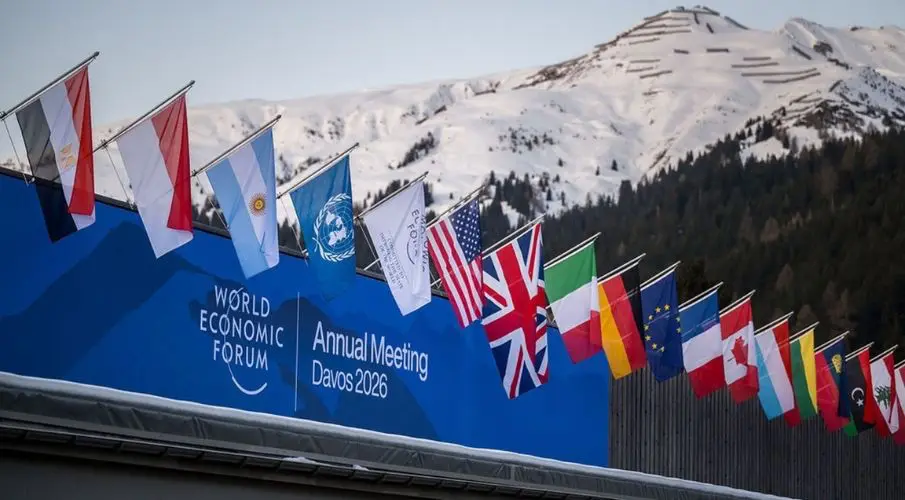
Davos is not a place for plain talk. At least it was not for a long time. This January, however, something has shifted. The threats from Washington to pressure Greenland and use tariffs as leverage have forced a reaction at the World Economic Forum that can no longer hide behind polite formulas. What was said there was no longer diplomatic choreography, but an open struggle over posture. At the center stands Donald Trump, whose second term has pushed international relations into a state of permanent alert. The claim to effectively control Greenland, coupled with trade policy threats, has crossed a line that in Europe was long considered theoretical. In Davos, it was named.
Gavin Newsom: “This guy is leading people on. It’s embarrassing. This is not diplomacy, it’s stupidity.” - “He is a T-Rex. Either you confront him directly or he devours you. Either way.” - “Everyone talks behind his back, they laugh at him, and at the same time they crawl up his backside. That is shameful.”
The sharpest tone came from California. Gavin Newsom openly said what many European heads of government have so far only formulated behind closed doors. He said Europe must stop making itself small. Whoever keeps giving in loses not only influence, but dignity. The practice of showing restraint in public and saying something else in private is shameful. He described diplomacy toward Trump as a relationship with a predator. Either one submits or one is devoured. His appeal was unmistakable: show backbone, now. From Paris came the historical framing. Emmanuel Macron warned of a return to colonial patterns of thinking. He spoke of a world in which rules would once again become meaningless and the law of the stronger would take their place. Trade, he said, was being used to force political subordination. New tariffs, maximal demands, the attempt to deliberately weaken Europe’s economic interests - all of this was unacceptable, especially when directed against territorial self-determination. This was not about a dispute, but about whether international law still applies.
Canada also took a clear stance. Mark Carney sketched a world in which great powers could afford to act alone, while medium-sized states could not. Those not sitting at the table would end up on the menu. For Greenland and Denmark, he articulated an unequivocal position. Their right to decide their own future was not negotiable. The defense of the American line in Davos was taken up by the Treasury Secretary. Scott Bessent tried to soothe. Relations were closer than ever, he said. The source of this certainty remained obscure. The outrage was exaggerated. One should take a deep breath and not react. Alliances were not in question, even if there were differing views on Greenland. It was an attempt to take speed out of a debate that had long since gathered momentum.
From Belgium, by contrast, came a sentence that lingered in Davos. Bart De Wever said Europe had allowed too many red lines to be crossed. Being a willing vassal was one thing, being a humiliated subordinate another. Whoever retreated now would lose their dignity. If Europe remained divided, an era would come to an end. Eighty years of transatlantic order would then be up for disposition. Whether this alliance would hold ultimately lay with the President of the United States. The institutional response came from Brussels. Ursula von der Leyen warned of a downward spiral. Additional tariffs between allies were a mistake, especially when a trade agreement already existed. A contract is a contract. If the pressure became permanent, Europe would have to respond permanently. The consequence could be a more independent Europe, not out of rejection, but out of necessity. Whoever weakens the West helps those forces that want to displace it.
Ursula von der Leyen did not proclaim a turning point in Davos, but delivered a sober assessment. At the World Economic Forum she spoke about how the geopolitical framework conditions had fundamentally changed and that Europe would be well advised to reduce existing dependencies and think more long term. Nostalgia, she implied, would not bring back the old order. Europe had to strengthen its own capacity to act and operate more independently. This was not a declaration of the collapse of the postwar order, but a political analysis of a world that is visibly shifting.
Mrs. von der Leyen’s speech felt less like a new departure than like a balancing act. Not the will to confrontation shaped her tone, but the effort to stay in the game. Where posture would have been required, caution dominated. Where clarity seemed possible, hedging prevailed. It was an address that recalled the preservation of her own position more than the courage to use her weight. In this field of tension, the question arises about the role of Ursula von der Leyen herself. Leadership is not exhausted by managing what is possible, it shows itself at the moment when the possible is expanded. Whoever binds themselves too closely to the continuation of their own position begins to skirt conflicts instead of engaging them. Then language becomes defensive and decisions are postponed.
Philosophically, this is the old tension between office and action. Office demands stability, action demands risk. Whoever feels exclusively bound to office confuses duration with significance. In times when power is openly challenged, it is not enough to preserve balance. Leadership is then decided by whether someone is prepared to lose something in order to defend something.
Leading voices from NATO openly warned that Trump’s aggressive approach toward Greenland was no longer merely a political conflict, but endangered the relationship between the United States and the alliance itself. If territorial threats and economic pressure became instruments of American policy, it would strike at the heart of the alliance. What was at stake here, several representatives said, was not a single territory, but the reliability of the United States as a partner.
This picture also includes what did not come about. A joint statement by the European Union on Greenland failed because Hungary blocked it. Budapest openly declared that it was a bilateral matter between Denmark and the United States and therefore not an EU issue. At the moment when an EU member state and an autonomous territory under European protection are threatened by economic pressure, a member state refuses solidarity. This is not an accompanying observation, but a political rupture. Whoever declares that territorial questions within Europe are not a European matter places themselves outside the core idea of the Union. Common foreign policy, mutual safeguarding, collective response to power politics - all of this is systematically undermined by Hungary. While others in Davos speak of dignity, red lines, and the possible end of an era, Budapest acts as an internal blocker.
This is no longer a matter of differing opinions. It is a question of belonging. A union that wants to be capable of action cannot afford a state that breaks ranks at every serious test. Whoever prevents Europe from responding cohesively works against Europe. Hungary does not only block statements. It blocks the EU’s ability to appear at all as a political actor. Davos shows this year that the time of polite silence is over. Greenland is not a trivial episode, but a point of no return. For the United States, for Europe, and for the European Union itself. Whoever still claims that everything is a matter of bilateral competencies refuses reality. And whoever refuses permanently cannot expect to remain part of this project.
Updates – Kaizen News Brief
All current curated daily updates can be found in the Kaizen News Brief.
To the Kaizen News Brief In English


