

Three freshly baked loaves of bread, beautifully lit. Katie Miller shows off online just how comfortable her family's life is. She says she bakes everything herself and won't allow processed foods in the house. Meanwhile, her husband Stephen Miller has other business to attend to: As Donald Trump's new chief of staff, he's expanding his power inside the White House. In American immigration detention centers, families complain about spoiled food being served to their children, and hundreds of detainees have gone on hunger strike. The distance between these two worlds fits into a photograph of a kitchen table. One gets to thrive. The fate of the other is decided by a man who wants millions of people removed from the country.

The Republicans have lost the midterm elections. Trump responded on November 6 by appointing Miller chief of staff. Immediately after the defeat, Steve Bannon demanded that mass deportations continue without a single concession. "Mass" meant everyone, and nobody was to back down from that. He enthusiastically welcomed Miller's rise. Newt Gingrich and Roger Stone are celebrating Trump's new right-hand man as a wartime adviser. The language of those involved has long since made clear who this war is supposed to be fought against.
During his first week in office, Miller ordered personnel changes designed to route more decisions through his desk. At the same time, federal agencies were instructed to obtain White House approval before testifying before Congress. The president's office went even further: In a November 9 letter, it warned lawmakers that their congressional investigations could cross the line into criminal conduct. It accused Democrats of making abusive and arbitrary threats since the election. A government that wants to shield its employees from elected representatives is inadvertently revealing which questions it fears.

Following the Republican defeat in the midterms, pressure on Stephen Miller is growing. The #OustMiller campaign is demanding his removal and testimony under oath once Democrats take control of their new congressional majorities in January. Miller must disclose how much influence he had over immigration enforcement operations and what responsibility he bears for the deadly operations against Renee Good and Alex Pretti in Minneapolis. The initiative is also demanding answers about his financial holdings in the technology company Palantir, whose programs are used by the Department of Homeland Security to track down migrants. The campaign also points to the website StephenMillerHatesYou.com. The demand for his removal is supposed to become a congressional investigation in which Miller must testify under oath and answer for his actions based on documents and witness testimony.

Democratic Representative Robert Garcia has already laid the groundwork. In his November 18 letter, he demands that Miller preserve all relevant records and communications. Garcia accuses him of directing violence and abuse by the Department of Homeland Security. The letter also raises allegations of corruption. These are allegations that must be investigated. Starting in January, Democrats could use their new majority to issue binding subpoenas. What today remains a request on paper could then require answers under oath.
Read also our article: Trump Threatens Criminal Prosecution, Garcia Fires Back With 12 Letters: The President's Family Business Deals and the Epstein Files Are Now Under Scrutiny
Meanwhile, Trump's supporters are demanding an even harsher crackdown. On November 7, Mike Howell of the Heritage Foundation called for a sweeping deployment of ICE. Miller, he argued, could unleash the agency without asking Congress for additional laws or funding. Millions of people should be deported. One report puts the money available in an additional ICE fund at $91 billion. John Knefel observed that, following the election defeat, even limited efforts toward a more moderate immigration policy had disappeared. A government official insisted this week that the deportation plans would continue throughout Trump's remaining two years in office.

For years, Miller has treated immigration as an attack on America's very existence. "We are being conquered," he claimed in 2023. He described the constitutionally guaranteed right to citizenship at birth as suicide for one's own civilization. He also argued that a president could suspend protections against arbitrary detention and send migrants to prisons in foreign countries. Under this view, the power of the state becomes limitless the moment it declares someone an intruder. After the election, Miller said at Mar-a-Lago that without Trump, the United States would no longer exist today.
Back in 2019, more than 80 members of Congress demanded his resignation. Previously released emails had exposed Miller's ties to white nationalist ideas. He stayed. After Trump left office in 2021, his organization America First Legal brought in millions. In 2026, the Justice Department brought criminal allegations against the Southern Poverty Law Center, which had published the emails. The starting point was complaints from right-wing organizations about being classified as hate groups. Those complaints were directed to Miller. An institution that once publicly scrutinized him thus found itself under investigation by the government.

Miller now lives with his family in military housing. Previously, protesters had written on the sidewalk outside his home in Arlington that he was destroying democracy. His new workplace offers a different kind of protection: Authority is being concentrated in his hands, and federal agencies are expected to coordinate their statements. Trump can sit back and leave more and more to his chief of staff, while Miller turns mass deportation into a political mission.
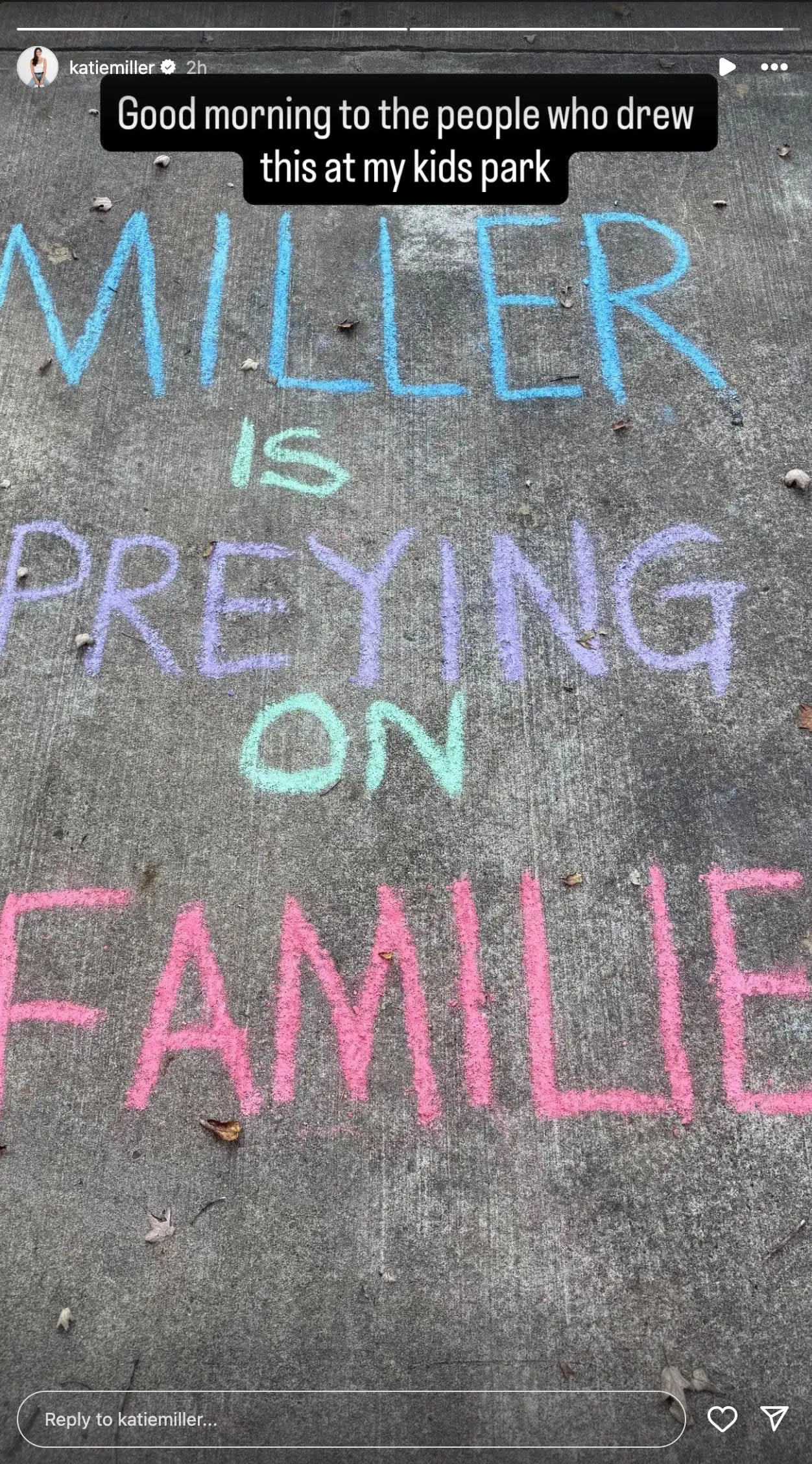
Good morning to the people who drew this at my kids' park."
“MILLER is preying on families”
The defeat at the ballot box has not yet persuaded Trump's administration to change course. But it has given Democrats the opportunity to ask questions in January that will be harder to fend off with a letter from the White House. Those questions will concern specific decisions and deaths. His financial interests are also set to come under investigation. Stephen Miller can continue to claim the power of a president. Under oath, he will have to answer for his own words.
Stephen Miller wants millions of people removed from the United States. His deportation policy is being carried out with a brutality that has long since spread through American prisons and courtrooms. People are abused, families are torn apart, and court orders are ignored. The government deports people to countries they have absolutely no connection to. Federal judges must intervene again and again because immigration authorities are violating existing law. As Miller gains ever more power in the White House, those affected bear the consequences of a policy whose cruelty has been evident for years in the lives of those locked away. Ongoing cases from November 17 through 19, 2026, add more names to this history. In the next 72 hours alone, 84 cases are scheduled before American immigration courts. At numerous hearings, the same judge has to handle ten or more cases at the same time.

Ernesto Martínez, from Cuba, walked into an American immigration detention center on his own two feet. Fifteen months later, he came out in a wheelchair. On November 19, 2026, he described what happened in between.
His journey through the system began at "Alligator Alcatraz," the controversial makeshift detention camp in Florida's Everglades that was permanently closed in June 2026. He suffered a heart attack there. When he asked for medical help, he was beaten. "I had a heart attack. I already had the heart attack when I got there. They brought me back to life at the hospital ... They carried me out of Alcatraz dead." In Texas, he refused to cross the border into Mexico. Officers beat him for it. "They punched me in the face. My whole face was swollen. They hit me in the head, hit me in the ribs, and broke my nose." In September 2025, he and another Cuban man were taken from El Paso to the Mexican border. The two streamed live until officers took their phones away. Shortly afterward, Martínez went on hunger strike. After twelve days, he suffered another heart attack in a punishment cell.
He was paralyzed in Arizona. Officers tried to force him into a van to deport him across the border into the Mexican state of Sonora. Four men carried him, his hands and feet tied behind his back, and threw him against the vehicle. "Four of them carried me. My hands and feet were tied behind my back, and that's how they grabbed me and threw me. I landed with my back against the steps of the van. Boom! And I fell again, and they picked me up again and threw me inside again." Afterward, he could no longer feel his legs. He told the officers. "All I could do was cry, but the damage had already been done, and I didn't know how to tell my wife that I was paralyzed."
He lists what he has been left with: "I have a blood clot in one lung from the kicks they gave me. The tissue in my abdomen is torn open, and when I try to stand up, it feels like I have the head of a child. I have four stents in my heart. They broke all my teeth."
At the Krome detention center in Miami, he was abused even while sitting in his wheelchair because he complained about the food and the way people were treated there. "They even beat me in my wheelchair. They beat me, threw me on the floor, and pepper-sprayed me." Eventually, he was released from Krome. Without identification, with an electronic ankle monitor as his only companion. "To them, I'm just a dog. They released me without ID, without anything. I'm here in shackles, hands and feet." Martínez wants to sue those he holds responsible for his paralysis. ICE did not respond to a request for comment on his allegations.

Read also our investigation: Hell on Earth – The Krome Deportation Center in Miami
Enrique Arias-Hierro had lived in America since he was two years old. The American government also deported him to South Sudan, even though he had absolutely no connection to that country. On November 18, he described how the locked facility where he was held sometimes ran out of food and water for days. Kyaw Mya, a member of Myanmar's Karen minority, was deported there despite a court order prohibiting it. As of November 18, he had been held in a locked house in Juba for more than a year. The United States has transported these people thousands of miles away. Its responsibility for their treatment does not simply end at the American border.
In California, ICE arrested landscaper Fredy Lopez Perez because of mistaken identity. He has lived in the United States for 22 years and has four children who are American citizens. The required warrant was not issued until 14 minutes after his arrest. On November 18, 2026, U.S. District Judge Noël Wise of the Northern District of California ordered his immediate release. Brisky Beletzuy Ochoa (see court documents below), a 21-year-old auto mechanic from Guatemala and father of two young children, was arrested outside his workplace. Judge Noël Wise of the same court found that the arrest without a judicial warrant was likely unconstitutional and ordered his immediate release on November 18. Adan Sierra Gutierrez, from Venezuela, was being held at the Otero County detention center without a warrant or any understandable explanation. That same day, U.S. District Judge Kea W. Riggs of the District of New Mexico found his detention unjustified and ordered his immediate release. José Guio Palacio, from Venezuela, had held Temporary Protected Status since 2021. After a traffic stop in Florida, he was arrested and taken to a detention facility in Brooklyn. U.S. District Judge Nina R. Morrison of the Eastern District of New York ruled his detention unconstitutional and ordered his release by November 18. Four people had to go to court to fight for freedom that the authorities had taken from them in violation of legal requirements.
On November 18, 2026, ICE officers arrested 21-year-old Guatemalan Brisky Jonatan Beletzuy Ochoa without warning in the parking lot of his workplace in San Francisco, without showing him a warrant. The auto mechanic has lived in the United States since 2019, has a work permit, and supports his partner and their two American children, ages two years and four months. U.S. District Judge Noël Wise of the Northern District of California found that his claim alleging violations of constitutional due process rights was likely to succeed and ordered his immediate release that same evening. She also prohibited ICE from arresting him again without a prior hearing or deporting him before a further court ruling. The case number is 3:26-cv-14129; the next hearing was scheduled for November 25, 2026.
The arrests also affect people who voluntarily report to immigration authorities. María del Rosario Torres Cervantes, from Mexico, is married to an American citizen and is the mother of three American children. She was arrested during a routine appointment with immigration officials. While detained, she was denied her medication. On November 17, 2026, U.S. District Judge Karen L. Stevenson of the Central District of California ordered her immediate release. Gurjant Singh had complied with every requirement imposed by the authorities since 2023. In October, he was locked up again without prior notice. On November 17, U.S. District Judge Dale A. Drozd of the Eastern District of California ordered his release because his due process rights had been violated. Mazen Farag Mahmoud Elsayed Rezk, an Egyptian asylum seeker, worked at his uncle's restaurant. Because he missed a required check-in due to illness, he was arrested and spent two months in detention. On November 17, U.S. District Judge Douglas F. McCormick of the Central District of California ordered his release. Virgilio García Martínez, from Mexico, had lived in the United States for 26 years without a criminal record. ICE arrested him outside his home. On November 17, U.S. District Judge Rozella A. Oliver of the same court ruled the arrest unlawful and ordered his immediate release. In one of these cases, missing an appointment because of illness was enough to make a man disappear behind prison walls for two months.
Vitalii Isaev, a Russian father, had applied for asylum in the United States in 2020 and lived with his wife and American child. In October 2026, he was detained again. On November 18, U.S. District Judge Timothy J. Corrigan of the Middle District of Florida ordered that he be given a bond hearing within one week or be released. Alexander Bosbeli Ortega Ordoñez, from Guatemala, was arrested during an ICE operation that was actually targeting someone else. Although he said he feared being tortured if returned, U.S. District Judge John D. Early of the Central District of California denied his release on November 18. Aziz Zoundi, from Burkina Faso and the father of two children, had already been released on bond. ICE arrested him again during a routine check-in in November. On November 18, his request for release failed before the U.S. District Court for the District of Nebraska, with Joseph F. Bataillon as the judge assigned to the case. Avtar Singh Sandu, an Indian truck driver, has lived in California for nearly ten years. He takes care of his wife, who is recovering from surgery and blood clots. ICE arrested him at a check-in appointment. On November 18, the U.S. District Court for the Central District of California, with U.S. District Judge Anna Y. Park assigned to the case, temporarily blocked his deportation. The authorities' violence affects people whose families depend on their daily support. The consequences reach all the way back into the homes where a father or husband is suddenly missing.

Even American citizenship does not reliably protect people from being seized by armed immigration officers. Domingo Vásquez, 40, is an American citizen who lives with an intellectual disability following brain surgery. On November 18, 2026, ICE officers pulled him out of his vehicle when he arrived at a construction site in Alamo, Texas. Authorities subsequently accused him of assaulting officers. A. Z., an asylum seeker from Kyrgyzstan with a work permit, had lived undisturbed in the United States for four years. ICE arrested her at Los Angeles International Airport. Her medical needs were inadequately addressed while she was detained. On November 18, the U.S. District Court for the Central District of California, with U.S. District Judge Kenly Kiya Kato assigned to the case, ordered her release because her due process rights had been violated. Also on November 18, ICE officers moved into Cardinal Lane in Vallejo, California, before dawn and arrested at least one person. His name was not released.

Even outside immigration detention centers, people are coming under pressure from this policy. Abdelrahman ElGendy, an Egyptian writer and National Book Award finalist, was denied a visa to attend the American awards ceremony. On November 18, 2026, he described how he had previously left the United States out of fear of immigration enforcement action because of his activism for Gaza. Authorities did not tell him why he had been denied entry. A writer whose work about political imprisonment in Egypt had been selected for a major American literary award was unable to attend the ceremony in the United States to receive a possible honor in person.
Stephen Miller helps determine the political direction of an administration that has made mass deportations a central function of the state. His personal involvement in the individual incidents of abuse and unlawful arrests has not yet been established. But his responsibility for the orders, the chains of authority, and the political enforcement of these measures must be investigated. That is precisely why the organizers of the campaign to remove him are demanding that he testify under oath. They want to know which decisions Miller made and how much influence he had over immigration enforcement operations. While the White House talks about millions of deportations, federal judges are having to free people from detention facilities where they are being held in violation of existing law. Some lose months of their lives. Others lose their health. Ernesto Martínez walked into detention on his own two feet. Fifteen months later, he left in a wheelchair.
Fascism rarely bothers with likes. It operates through deportation flights to Juba and arrest warrants written 14 minutes after someone has been taken into custody. It waits for people to get used to both and look away.
Standing against it are federal judges who are still signing release orders late at night and on weekends. Standing against it are all of us handling 84 cases in 72 hours. We get people out of this detention, one by one, with enormous effort, and it's never enough. Every single person who gets to stand before a judge again instead of disappearing into a locked house in Juba is a piece of the law that this regime had no right to take away.
Miller has the power of a president behind him. All of us have the case files for that. Starting in January, we'll see which carries more weight under oath.
Updates – Kaizen News Brief
Alle aktuellen ausgesuchten Tagesmeldungen findet ihr in den Kaizen Kurznachrichten.
To the Kaizen News Brief In English


Der ganze Artikel ist ein Graus. Das ist Naziherrschaft, nichts anderes. Wie ein Lichstrahl Richter die sich einsetzen, Menschen die diese Grauslichkeiten dokumentieren. Wohl auch im der Hoffnun das diesem Grauen ein Ende bereitet wird. Danke für Euren Einsatz und damit all das Leid nicht einfach verschwiegen wird.
Vielen, vielen Dank, dass Ihr all den „namenlosen“ Opfern ihre Namen und Stimmen wieder gebt.
Sie und diese unsagbare Grausamkeit sichtbar macht.
Personen, die diese Grausamkeiten willfähig durchführen, kann man nicht mehr Menschen nennen, da an ihnen nichts menschliches ist.
ich hoffe sehr, das es im Januar besser wird