
The death of Geraldo Lunas Campos in a deportation detention facility in El Paso is not an accident, not a medical incident and not a failed rescue attempt. The autopsy speaks clearly: the 55 year old Cuban died of suffocation caused by massive compression of the neck and upper body. The medical examiner has classified his death as a homicide. Lunas Campos was being held in solitary confinement at the ICE facility Camp East Montana, a sprawling tent complex on the grounds of Fort Bliss. After a conflict with guards, he was restrained. Witnesses report that he was handcuffed while at least five officers forced him to the ground. One is said to have wrapped his arm around Lunas Campos’s neck and increased the pressure until he lost consciousness. Shortly afterward, he stopped breathing.
The autopsy by the El Paso Medical Examiner’s Office documents abrasions on the chest and knees, hemorrhaging to the neck, and petechiae on the eyelids and neck skin - classic signs of severe oxygen deprivation. The cause of death is listed as asphyxia due to external force. The report contains no indications of a suicide attempt. Nevertheless, U.S. Immigration and Customs Enforcement initially tried to portray the death differently. The first statement made no mention of any physical intervention. Later, ICE claimed that Lunas Campos had attempted to take his own life and that staff had to intervene. Only after the family was informed of the medical examiner’s preliminary assessment did the government change its account again. Now it spoke of resistance, of a struggle during which the man lost consciousness.

After the final report was released, the tone shifted once more. A spokesperson for the Department of Homeland Security emphasized that Lunas Campos had been a convicted sex offender. His prior convictions from 2003 and 2009 were listed in detail. This said nothing about how a person dies while in state custody. Lunas Campos had lived in the United States since the 1990s, entered legally, had three children and lived for more than twenty years in Rochester, New York. In the summer, he was arrested as part of a targeted deportation operation and later transferred to Texas. He was among the first detainees of the newly built Camp East Montana facility.

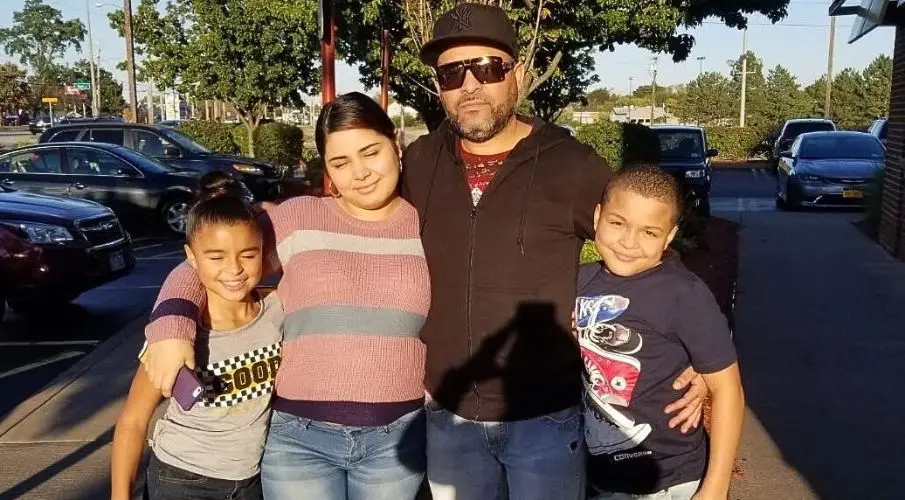
This undated photograph provided by Jeanette Pagan-Lopez shows Geraldo Lunas Campos with his three children. Lunas Campos died on January 3, 2026, at the Camp East Montana ICE detention facility in El Paso, Texas.
This camp has been under criticism for months. The billion dollar contract to build and operate it was awarded to a company with no experience in corrections, based in a single family home in Virginia. Who exactly staffed the guards involved in the fatal incident remains unclear to this day. Whether they were government officers or employees of a subcontractor is still unknown. The death of Lunas Campos is not the only one. Within a little more than a month, at least three people died at the same facility. A man from Guatemala died after a hospital stay, reportedly from organ failure. A 36 year old Nicaraguan died a few days later, officially by suicide. Unlike the previous cases, his body was not turned over to civilian medical examiners. The investigation is being conducted internally on the military base.
The fact that Camp East Montana is located on military property further complicates independent investigations. Jurisdictions blur, external oversight remains limited. It is unclear whether any law enforcement agency other than ICE is investigating. Democratic Representative Veronica Escobar is demanding consequences. She is calling for a full briefing of Congress by Homeland Security Secretary Kristi Noem and Acting ICE Director Todd M. Lyons. Evidence must be secured, witnesses must not be deported. Her goal is clear: the immediate closure of the camp and termination of the operating contract. The death of Geraldo Lunas Campos shows what happens when isolation, violence and lack of oversight converge. A man dies, restrained by those who were supposed to guard him. Then the rewriting of the story begins. This time, the medical examiner has pushed back. The question is whether there will be consequences.
Updates – Kaizen News Brief
All current curated daily updates can be found in the Kaizen News Brief.
To the Kaizen News Brief In English


Grauenhaft!
ja, ein ganz schlimmer Fall