
A banner in downtown Tehran asks in a foreign language who will be next, using the American president's initials like a scalpel. Beneath it, an Iranian flag waves while 2 women at the city's bazaar flash the victory sign toward the camera, as if it were a holiday instead of the sixth straight night of American airstrikes. These images from Tehran reveal more about the state of this war than any Pentagon press conference ever could.
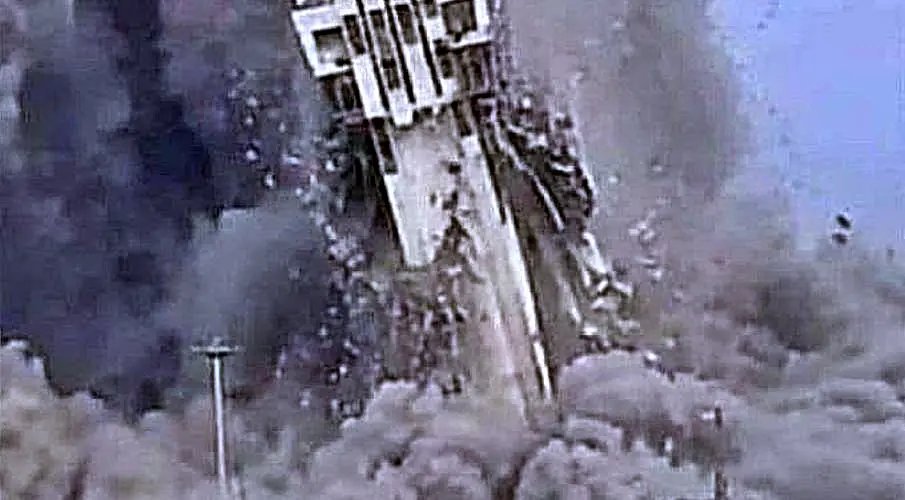
During the night into Friday, the U.S. military expanded its attacks, striking several bridges in Iran's Hormozgan Province near the coastal city of Bandar Khamir. According to Iranian state television, at least 7 people were killed. The road and rail bridges were apparently targeted to cut Bandar Abbas, Iran's most important port, off from transportation routes leading inland and toward Tehran. At the same time, an American strike brought down a surveillance tower at the port of Chabahar on the Gulf of Oman, a vital trade route for neighboring Afghanistan. Defense Secretary Pete Hegseth personally shared the image of the collapsing tower, a photo that had already been circulating among activists, apparently intending to showcase American control over the Strait. Iran described the tower as a monitoring facility for civilian shipping, but our investigation found that the Revolutionary Guard also operates its own bases inside the country's ports.
Tehran responded with missile strikes against several American allied countries. Qatar, which together with Pakistan has been acting as a mediator in the war, warned its population to seek shelter twice within just a few hours, while falling debris injured a child, according to the Interior Ministry. Bahrain and Kuwait also came under attack, and Jordan reported intercepting 3 incoming missiles. Air defense explosions were also heard over the Kurdish cities of Erbil and Sulaymaniyah in northern Iraq, although no damage was immediately reported.
The ceasefire agreed upon last month has now completely collapsed. Since the United States and Israel launched the war on February 28, Tehran has largely closed the Strait of Hormuz to commercial shipping, a move that sent oil prices soaring and gave Iran considerable leverage in negotiations. In a prime time address, Trump declared that America was winning this war in a big way and that the rewards of those efforts would become visible very soon.
The Prussian military theorist Carl von Clausewitz once described war as the continuation of politics by other means, but what is now unfolding in the Persian Gulf has long since become the continuation of economics through military force. According to shipping intelligence firm Lloyd's List Intelligence, weekly cargo traffic through the Strait had already dropped by nearly one quarter earlier this month, even before the latest wave of attacks intensified. Some shipping companies are switching off the tracking systems on their tankers out of fear of being targeted, while others have simply left their vessels where they are. Pipelines are absorbing part of the disruption, but nowhere near enough to offset the blockade. The U.S. military said it redirected 3 commercial ships that attempted to break through the blockade. Another vessel was disabled, while another was boarded for inspection.
What remains is a strait through which one fifth of the world's oil and gas trade once passed, now transformed into a narrow waterway of fear where every ship has become a hostage to a war that neither Qatar nor Pakistan has so far been able to end. The fog hanging over Hormuz is no longer made of smoke alone.
Updates – Kaizen News Brief
All current curated daily updates can be found in the Kaizen News Brief.
To the Kaizen News Brief In English


Und die Stastsoberhäupter von NATO und Europa schauen zu.
Kein Aufschrei, kein Entsetzen.
Trump bombardiert weiter und redet den gewaltigen Sieg herbei.
Im Iran sterben weiter unschuldige Menschen.
Die Weltwortschaft stockt wieder.
…das format der meisten politiker ist sehr, sehr klein