
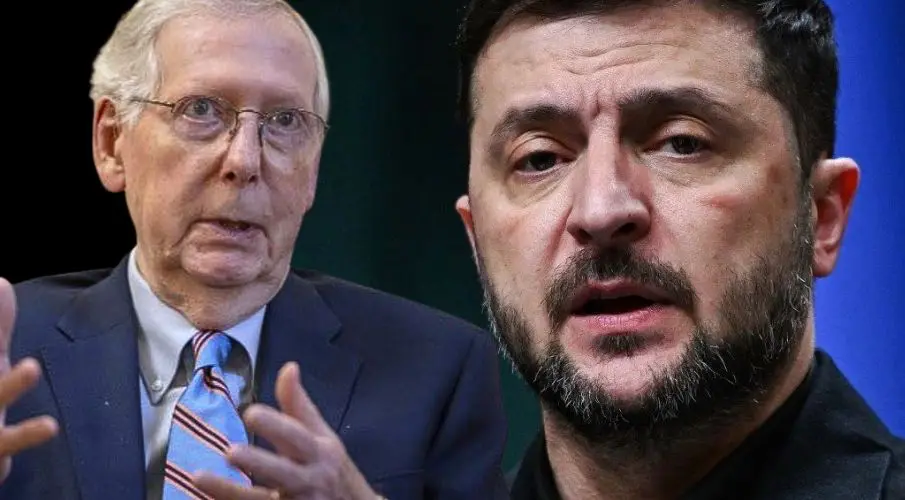
In Washington, a quiet but unmistakable fracture is emerging even within the Republican Party - a break Trump did not anticipate. Several prominent Republicans are openly opposing key elements of the US peace plan because it demands too many concessions from Ukraine and effectively rewards Russia. Marco Rubio, Secretary of State, says the draft is “alarmingly unbalanced” and endangers American interests. Mitch McConnell warns of an “illusory peace” that undermines the credibility of the United States and destabilizes Europe. Don Bacon stated that he rejects any agreement that gives Moscow more time to strengthen its position on the battlefield. And even representatives like Anna Paulina Luna and Nancy Mace, who have been mobilizing against further Ukraine aid for months, now criticize the plan from a completely different angle: it brings no peace, only new uncertainty. In this situation, it becomes clear how fragile Trump’s supposed unity has become - and how deep the concern runs in parts of his own party that a rushed deal will not end the war, but prepare the next crisis. Mitch McConnell, the gray eminence of the Republicans, says openly that Putin has “played Trump all year long”. If the president prefers to satisfy Moscow rather than seek a real peace solution, he must replace his advisers. For a Republican of his stature, that is a remarkable statement.
The message from Kyiv this Saturday is as clear as it is defiant: Ukraine will not bend. Not to an invasion, not to years of destruction, and not to a peace plan that sounds more like coercion than diplomacy. While President Volodymyr Zelenskyy assures that the country will “always defend our home”, concern is growing in Europe that Washington is taking a path that rewards Moscow and leaves an entire region in uncertainty.
In Switzerland, a Ukrainian delegation, supported by representatives from France, Germany, and the United Kingdom, is preparing for direct talks with the United States. The reason: a 28-point plan from Washington that widens political rifts rather than closing them. The draft stipulates that Ukraine give up parts of its territory, reduce the size of its army, and abandon its long path toward NATO membership - demands that sound as if they were dictated from the Kremlin. For Kyiv and its closest partners, this is a shock. The decision of whom one can entrust with one’s own security is one of the basic rights of a sovereign state. The reactions in Europe were swift. The leaders of the EU, Canada, and Japan welcomed the American initiative in principle, but made it unmistakably clear that borders must not be changed by force and that the planned weakening of the Ukrainian armed forces would open the door to new attacks. They also stressed that the question of possible NATO or EU membership cannot be decided from the outside, but only by the respective member states.
At the G20 summit in Johannesburg, Europe’s top politicians searched feverishly for a unified position. German Chancellor Friedrich Merz reminded everyone that “wars cannot be decided over the heads of those affected”. He insisted that Ukraine needs clear and reliable security guarantees, not a formula that makes it dependent on the goodwill of an aggressor. French President Emmanuel Macron reaffirmed that there can be no peace without respect for Ukrainian sovereignty. Ursula von der Leyen summarized the European position in a few words: “Nothing about Ukraine without Ukraine.”
British Prime Minister Keir Starmer also backed Kyiv. Russia pretends to want to negotiate, he said, but its actions show the opposite. Just days earlier, a Russian attack in western Ukraine had killed more than two dozen civilians. For Kyiv and its partners, it is therefore beyond question that Moscow continues to stall while trying to overwhelm the Ukrainian army. The talks in Geneva are meant to at least clarify how far the United States is willing to revise its own ideas. Donald Trump has given Ukraine a deadline: Kyiv must respond by Thursday. For European governments, this looks primarily like pressure being applied in the wrong direction. The war is approaching its fourth year, and the price the Ukrainian population pays is almost impossible to describe. Anyone who tries to force a quick agreement in this situation is not doing it to create security, but to push through their own political goals.
While diplomats negotiate in Geneva, Ukraine commemorates the Holodomor, the Stalinist famine of the 1930s. Zelenskyy recalled that millions died because a regime wanted to break the country. “We know how and why our people starved to death back then. And we are again defending ourselves against Russia, which has not changed and once again brings death,” he said. “We defended, we defend, and we will always defend Ukraine. Because only here is our home. And in our home, Russia will never be the master.”
These words describe not only a national trauma but also the essence of what is at stake today: the existence of a country that stands firm despite losing so much. The idea that this war can be ended with a few territorial concessions is an illusion that Europe would pay dearly for. Those who believe they can buy peace today will find tomorrow that they have set the stage for a larger conflict.
The coming days will show whether Trump is willing to listen to those who experience the war daily - or whether a decision will once again be made that another country has to bear the consequences for. For Ukraine, the situation is clear: a peace that disarms the country is not a peace. And a plan that weakens it is not one it can accept. Europe knows this. Russia knows it too.
Investigative journalism requires courage – and your support.
Help sustain our reporting and our work. Even a small contribution helps us continue every day. Kaizen operates without ads, without subscriptions, without corporations, without political parties.
Independent – Critical – For Everyone
Thank you for making independent journalism possible.
Updates – Kaizen News Brief
All current curated daily updates can be found in the Kaizen News Brief.
To the Kaizen News Brief In English
Man kann nur hoffen das Trump Mut seiner Erpressung endlich den Bogen auch in Amerika überspannt und endlich eine Reaktion kommt die diesem Trauerspiel ein Ende setzt. Hoffentlich noch vor dem Beginn des Krieges mit Venezuelas
…das hoffen wir alle
Es erscheint völlig absurd, dass die Ukraine ihre Armee beschränken soll, als wäre sie es gewesen, die auf Krieg aus ist. Wenn schon, sollte das aggressive Russland seine Armee verkleinern.
da hast du vollkommen recht, es ist absurd. europa muß nun richtig verantwortung übernehmen
Danke für die Infos.
gerne und vielen dank
Ich möchte Euch Danken für Eure Arbeit Euren mutigen Geist , welcher notwendig ist um Ungerechtigkeiten, Missstände Machtmissbrauch und Lügen, Menschen nah zubringen sowie Mut zu vermitteln sich diesen Herausforderungen zustellen und nicht wegzuschauen. 🙏💪
vielen dank, aber glauben sie mir, das ist nicht einfach, und jetzt kommt auf unsere schreibtische die notlage der geflüchteten ukrainer in den usa, wo wir jeden einzelnen fall, wie ice-fall behandeln müssen.
Wenn der Holodomor anderen Staaten nicht reicht zu verstehen, warum die Ukraine sich nicht kampflos einem Aggressor unterwirft, dann sind Ihnen Menschenrechte egal.
Stalin und Putin, da ist für nich jein Unterschied.
Beides grausame Diktatoren, die ein ganzes Volk auslöschen wollen.
Holodomor oder Butscha (inklusive aller weiterer Massenmorde) erfüllen klar die Definition von Genozid.
Und immer noch eiern Europa und die anderen westlichen Staaten rum.
Seid doch mal standhaft und unterstützt gemeinsam gleichzeitig die Ukraine. Taurus und was sonst noch mõglich ist.
Putin ist zu plug um sich mit der gesamten EU auf Krieg einzulassen.
Bisher haben ja seine Drohungen ausgereicht, dass Europa nicht in die Gänge kommt.
Es wird Zeit endlich richtig Nigel nit Köpfen zu machen.
Nicht nur zu diskutieren und im Inneren darauf zu hoffen, dass Trump weiter Unterstützer bleibt.
Wacht auf
Trump macht, was Trump nutzt. Wann bekommen Europa und die anderen westlichen Staaten das endlich in den Kopf?
Wahrscheinlich, wenn wir in Europa alle russisch sprechen müssen.