
The war around Iran is spreading ever further beyond the region. While people in Lebanon die under rubble, dozens of drones are shot down over Saudi Arabia and an American refueling aircraft crashes in Iraq, Washington is easing sanctions on Russian oil at this very moment. Military escalation, economic consequences and political reversals are intertwining and show how far this conflict has already expanded.
Saudi Arabia destroyed 28 Iranian drones after they entered Saudi airspace.
Saudi Arabia reported an unusually large aerial attack during the night into Friday. According to the Ministry of Defense several dozen drones were intercepted within a few hours as they flew toward the kingdom’s oil rich eastern province. Early reports spoke of 38 aerial vehicles, later reports mentioned 28 drones shot down after they had entered Saudi airspace. Possible targets included facilities of the oil industry, a military base with American soldiers and the US Embassy in Riyadh. Even for a country that has faced regional threats for years, such a large number of drones in such a short period of time is considered extraordinary.

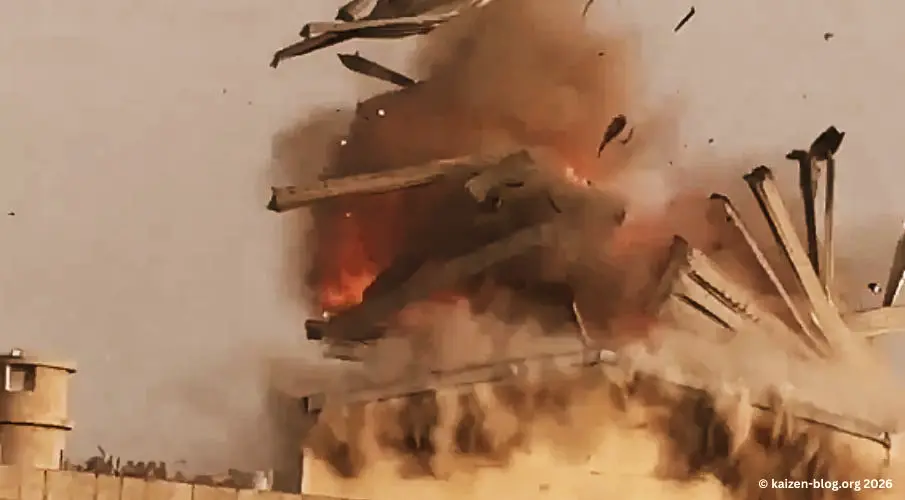
A US attack drone strikes a facility of an Iran backed militia in northern Iraq
The war is also having deadly consequences in Iraq. France confirmed that a French soldier was killed in an attack on the northern Iraqi city of Erbil. President Emmanuel Macron identified him as Staff Sergeant Arnaud Frion of the 7th Battalion of Mountain Troops from Varces. “To his family and his comrades I express the affection and solidarity of the nation,” Macron said. Several other French soldiers were injured. Earlier the French military had reported that six soldiers were wounded in a drone attack in the region. French units in Iraq are part of a multinational mission that supports local forces in the fight against the so called Islamic State.
A French soldier was killed in a drone attack on a military base in Erbil in the Kurdistan region of Iraq. Five other French soldiers wounded.
Almost at the same time it became known that an American KC-135 refueling aircraft crashed in western Iraq. The aircraft was part of operations against Iran. At least five crew members were on board. US Central Command said the crash was not connected to enemy fire or friendly fire. Rescue measures were initiated. A second aircraft involved in the mission was able to land safely. Tanker aircraft of this type are normally flown by three people. Why more crew members were on board initially remained unclear.

In Lebanon Israel continues its attacks with full force. According to the Lebanese Ministry of Health at least 15 people were killed in airstrikes in the south of the country. In the village of Erkay in the Sidon district nine people died, including five children. Seven other people were injured. Two additional strikes on other locations in the south caused six further deaths. Rescue teams are searching in completely destroyed buildings and rubble for survivors. Since the new escalation at the beginning of March, according to official figures 687 people have already been killed in Lebanon, including 98 children and 62 women. Eighteen paramedics and rescue workers were also killed, and more than 1,700 people were injured.
An Israeli airstrike hit a car on Friday morning in the coastal district of Jnah in southwest Beirut and killed one person according to the Lebanese Ministry of Health. Another strike destroyed an apartment in the Nabaa district in the densely populated Burj Hammoud area in the north of the city. The building was in flames and casualties were initially not reported. At the same time a rocket attack on the Israeli town of Zarzir injured around 30 people, most of them from shattered window glass.
Inside Iran part of the attacks is also directed specifically against structures of internal control. The conflict monitoring organization ACLED documented at least 18 attacks on checkpoints of the Basij militias in a single day. In total around 30 percent of the recorded American and Israeli strikes since the beginning of the war were directed at facilities important for the state’s internal control, including police stations and intelligence service locations as well as units of the Revolutionary Guards. Israel’s Prime Minister Benjamin Netanyahu openly said such strikes could create conditions under which Iranians rise up against their government.
Anyone who has even a little understanding of Iran’s structures knows that at least 350,000 people work within the Iranian security apparatus and that their loyalty is a decisive factor for the stability of the regime. We ourselves have produced enough documentation about Iran. Therefore this repeatedly presented justification for war is completely unrealistic or even more than that. The idea that airstrikes on checkpoints could casually trigger a political uprising therefore appears more like a retrospective justification than a realistic strategy.
At the same time, the U.S. military leadership itself is coming under growing pressure. The Pentagon confirmed that its structures for reducing civilian harm are currently undergoing a strategic reassessment. Critics argue that outdated intelligence likely led to an American missile strike on an Iranian elementary school that killed more than 165 people, many of them children. Investigations found that the school building had been listed among facilities designated for attack as a military target. The Defense Department did not directly respond to these reports, but acknowledged that an organizational restructuring is underway and that the relevant responsibilities are being more tightly integrated into military command structures.
Israel at the same time reported another strike against the Iranian nuclear program. Prime Minister Benjamin Netanyahu said Israeli attacks had killed a leading Iranian nuclear scientist and wounded several others. An earlier breaking report had initially spoken of several scientists killed and was later corrected. While military strikes shake the region, economic front lines are shifting at the same time. The government of Donald Trump has taken steps to partially ease sanctions on Russian oil. The US Treasury issued a license allowing the sale of certain Russian oil and petroleum products for one month. The measure concerns crude oil that is already on tankers at sea. Analysts estimate the volume at around 125 million barrels. For comparison under normal circumstances about 20 million barrels of oil pass through the Strait of Hormuz every day.
The step is directly connected to the war. Because of attacks on ships and the massive uncertainty in the Strait of Hormuz a central transport route for energy has effectively been blocked. The easing of sanctions is apparently intended to help compensate for the losses. Earlier the American government had already allowed India to continue buying Russian oil. The effects on markets are already visible. The price for a barrel of Brent crude temporarily exceeded 100 dollars and reached as much as 101.59 dollars. At the same time American stock markets came under pressure. The S&P 500 fell 1.5 percent, the Dow Jones Industrial Average 1.6 percent and the Nasdaq index 1.8 percent. Investors fear rising inflation and a delayed interest rate policy by the American central bank.
The war is also shaking political rhetoric in Washington. Only a few weeks ago Donald Trump had celebrated low gasoline prices as a success of his policy and highlighted a price of 2.30 dollars per gallon in his State of the Union speech. The nationwide average is now around 3.60 dollars per gallon according to AAA - an increase of more than fifty percent. Trump responded with a remarkable reversal. The United States is the largest oil producer in the world, he now said, and if oil prices rise the country makes a lot of money.

Other statements also reveal the political tone of this war. Speaking about Iran’s new supreme leader Mojtaba Khamenei in a recorded interview with Fox News host Brian Kilmeade, Trump said he believes Khamenei is probably alive. “I think he is damaged but probably still alive in some form,” the president said.
While politicians speak about leaders and oil prices, the human consequences of the war remain visible. In the Kurdistan region of northern Iraq, in the village of Sarkand, workers continue their daily labor while rockets strike a few hundred kilometers away. Men stack wood in earthen pits where charcoal slowly forms. During breaks some perform their Ramadan prayers. One kneels on a rock in the river, another prays next to a vehicle that has just been loaded with sacks of charcoal.

Cultural losses are also becoming visible. The Iranian American New Yorker Shabnam Emdadi reacted with shock to reports of damage to the Safavid palace Chehel Sotoun in Isfahan. She had visited the site several years earlier together with her father. “Those trips to Iran are among my most beautiful memories of him,” she said. When she now sees images of the damaged buildings she feels as if she is losing a part of those memories. The Pentagon did not comment on the allegations. The Israeli military only said it was not aware of reports about damage to UNESCO sites.
One of the central strategic questions also remains open. Iran’s UN ambassador Amir Saeid Iravani said his country will not necessarily close the Strait of Hormuz but did not rule out that step. Shipping traffic there is already massively restricted.
In Erbil a military base and its infrastructure were hit by drones, as can be seen in the background
While drones are shot down over Saudi Arabia, soldiers die in Iraq, cities in Lebanon are bombed and oil prices rise worldwide, it is becoming increasingly clear that this war has long grown far beyond Iran. Its consequences now reach from the Persian Gulf across the Mediterranean region into financial markets and political decisions in Washington.
Updates – Kaizen News Brief
All current curated daily updates can be found in the Kaizen News Brief.
To the Kaizen News Brief In English


