
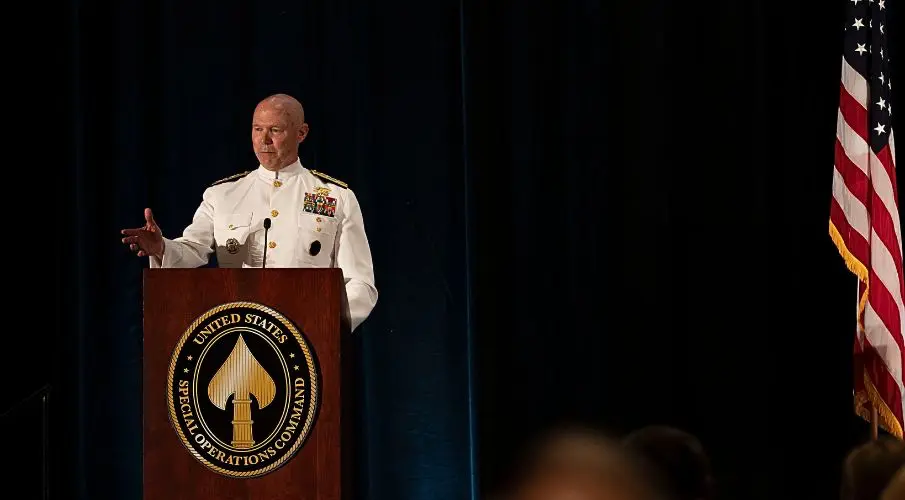
The truth about the strike on the alleged drug boat in the Caribbean will never fully come to light. Not because there are no witnesses or because political will is lacking. It is because this operation took place deep inside a sphere that even within the Pentagon is entered by very few. That sphere is the Joint Special Operations Command, or JSOC, a parallel world to the regular military, with its own structures, its own communications, and its own logic of secrecy. Anyone who wants to know something there is met with doors and silence - often both at the same time.
From military and intelligence circles it was confirmed that SEAL Team 6 carried out the strike of September 2, the attack that many in Congress now describe as a possible war crime. The controversy accelerated when it emerged that War Secretary Pete Hegseth personally ordered the operation and attached the instruction “Kill them all.” According to our information, the military interpreted this order to mean that after the initial attack, a second strike should be conducted to eliminate survivors. That would be a war crime. Now Admiral Frank Bradley is scheduled to testify before Congress, the man who led JSOC when the operation took place. That he is speaking instead of the commanders of the regular regions - SOUTHCOM for the Caribbean or NORTHCOM for homeland defense - shows what this is really about: not an operation, but a system. And this system follows its own rules, far outside any democratic control.
JSOC operates with special access authorizations that are classified higher than almost anything circulating in the Pentagon. Its own networks, its own execute orders, its own bases, often in countries that officially do not even know that U.S. forces are present there. Even within the apparatus the rule applies: those not briefed remain blind. This is why the notion that Congress could fully investigate this operation is little more than polite fiction. A few technical details, perhaps some images, along with assurances that everything is being reviewed carefully - that is all that will be disclosed. What truly happened remains under seal. Yet the country would have a right to know what is being done in the name of the United States. But political leaders show little courage. Senator Wicker announced that he intends to review “all recordings,” but once he sees them he will hardly be able to speak about any of it. Senator Kelly stated that the secret legal justification for the operation “cannot be justified” and must be made public. But although he could legally release it as a senator, he stays silent. His office did not respond to any inquiries.
The real problem therefore does not lie in the ocean but in Washington: a Congress that does not use its power. A security apparatus that has grown accustomed to releasing only what does not hurt. And a government that wages a shadow war without ever naming it as such.

In recent months it has become clear how the Trump administration is reinterpreting the old “war on drugs.” For Hegseth and those around him, it has long since become a new anti-terror war - only in the Western Hemisphere. Not Al Qaeda, but cartels. Not distant deserts, but the Caribbean. And suddenly an alleged drug boat looks like an enemy that supposedly poses a threat to national security. Hegseth himself put it this way: “A foreign terrorist organization that poisons our people with drugs is no different from Al Qaeda.” Anyone who speaks this way designates an entire region as a battlefield. And that is exactly what has happened.

NATIONAL INTELLIGENCE COUNCIL - Updated IC Gray Zone Lexicon: Key Terms and Definitions
Page 5 of 11
AREA: POTENTIAL GRAY-ZONE ACTIVITIES
Information
Foreign malicious influence (FMI)
Subversive, undeclared (including covert and clandestine), coercive, or criminal activities by foreign governments, non-state actors, or their proxies to influence the public or political attitudes, perceptions, or behavior of another country in order to advance their own goals. FMI can include efforts to sow division, undermine democratic processes and institutions, or steer political decisions in favor of the foreign actor.Legal area
Arbitrary detention
The detention of a foreign person solely or primarily to influence the policy of another state or to extract concessions, including fabricated allegations or disproportionate penalties for offenses. The U.S. Secretary of State may designate cases of “wrongful detention” that meet certain political and legal criteria.Lawfare
The intentional exploitation or manipulation of international law, international organizations, or national legislation to delegitimize another state or impede it from achieving its international military or political goals - such as through fabricated allegations of war crimes or appeals to international courts like the UN or the International Criminal Court.Weaponized international migration
The deliberate manipulation of migration flows to coerce another state.
In this context, “weaponized migration” means that the government tries not to understand migration as a humanitarian movement but as a deliberately deployed instrument of attack from abroad. The Trump administration uses exactly this thinking to justify the boat strikes and the massive militarization of the Caribbean: migrants and smugglers are not treated as civilians or criminals, but as hostile actors in an alleged “hybrid strike.” This creates a political concept designed to legitimize any act of force - even when the legal foundations are missing or human rights are violated.

The man leading this war is Admiral Bradley, now the supreme commander of all special forces worldwide. But instead of critical reporting he is showered with praise - from those very media that otherwise preach transparency. In a single article the New York Times unexpectedly celebrated him with a series of compliments that one would expect in a ceremonial tribute. An anonymous master chief called him “a top-notch fellow.” A former SEAL said Bradley was “as smart as he is ethical” and “above reproach.” Such sentences read like protective shields, not like independent observation. It is obvious why Bradley is treated this way: he is the face of an apparatus that has been expanding for years without anyone questioning its power. The discussion about the September 2 strike could expose that power. But instead many focus on the question of whether two men were deliberately killed after the initial strike. That is important - but it hides the larger picture. The real scandal is not the possible war crime. The scandal is that the United States is quietly waging a new war without debate, without mandate, without clear rules. A war that no one speaks openly about and that hides behind classifications understood by almost no one.
The account of events presented through further investigations by us raises additional questions: The two men who had survived the first strike were killed in the second strike, because they were still classified as “in the fight.” They had made radio contact with other boats nearby and had begun to recover parts of the cargo, it was said. The White House and Defense Secretary Pete Hegseth assign responsibility for this second strike to Admiral Frank Bradley. Hegseth himself had monitored the first strike from the Situation Room and insisted he had seen no survivors before leaving the room. In public he praised Bradley: He had “made the right decision” to sink the boat and eliminate the threat. According to his Navy biography, Bradley graduated from the U.S. Naval Academy in 1991, where he studied physics and was a member of the gymnastics team. Bradley, at that time a three-star admiral at the head of the Joint Special Operations Command, is considered in military circles to be a highly qualified officer with decades of experience – from the Afghanistan deployment immediately after the attacks of September 11 to research work that earned him a provisional patent. Former SEALs and generals describe him as smart, flexible, and morally grounded. When he sought confirmation before the Senate in the summer to become the four-star commander of SOCOM, he emphasized the obligation to avoid civilian casualties and to strictly adhere to the laws of war. His words sounded like a promise to the oversight bodies – and now stand in stark contrast to an operation that raises precisely these questions in their sharpest form.
If Congress wanted to change this situation, it could. It would only have to decide to tolerate less and control more. But that would require backbone. And that has been missing for years. Congress could change all of this, of course. It could amend the laws, limit secrecy, and force those responsible to come clean. But nothing indicates that. Senator Mark Kelly said of the secret legal justification for the boat strikes that he had read it, that it should not be classified, and that the government “should release it to the American people.” He could do this himself - thanks to the immunity senators enjoy. But when his spokesperson Jacob Peters was asked whether Kelly was willing to take exactly that step, he offered no reply. Several inquiries, no answer. That is precisely where the real silence begins.
Mark Kelly: “Pete Hegseth says he wants to court-martial me because I said exactly the same thing he did nine years ago. What has changed for Pete? Well, to start with, he spends his days thinking about how he can suck up to Trump. When Trump says jump, he only asks how high.”
As long as this zone of silence remains, nothing will change. The operations continue. The secrecy expands. Responsibility evaporates. And the public is fed fragments while decisions of enormous consequence are made in the background, largely unnoticed. In the end, the greatest danger is not Hegseth, not Bradley, not even the shadow fleets in the Caribbean. The greatest danger is a state that has grown accustomed to operating in the dark - and a political system that allows it. We will continue our investigations to uncover the full extent.
Anyone who thinks this has nothing to do with them is mistaken. Right-wing populist structures function everywhere according to the same pattern, and wherever they come to power, the same dangers follow: the devaluation of human rights, the transformation of the state into an instrument of aggression, and a politics that does not prevent violence but justifies it. That is why independent journalism is not a luxury but a necessity. We fight every day to make these developments visible.
Investigative journalism requires courage – and your support.
Support our work against right-wing populism, disinformation, and violations of human and environmental rights. Every contribution goes directly into our daily reporting – we operate without advertising, without subscriptions, without corporations, without political parties. Our journalism is meant to remain freely accessible. For everyone.
Independent – Critical – For Everyone
Thank you for making our independent work possible.
Updates – Kaizen News Brief
All current curated daily updates can be found in the Kaizen News Brief.
To the Kaizen News Brief In English


Ein Kriegsverbrechen wäre es in einem vom US Kongress abgesegneten bewaffneten Konflikt. Ein solcher liegt nicht vor, daher wird von „gewöhlichem“ Mord auszugehen sein (1st degree murder).
Der Punkt mit dem Kriegsverbrechen wird oft missverstanden. Ob ein Kriegsverbrechen vorliegt, hängt nicht davon ab, ob der US-Kongress einen Krieg erklärt hat, sondern ob ein bewaffneter Konflikt im Sinne des humanitären Völkerrechts existiert. In der Karibik war das nicht der Fall – deshalb greift hier nicht das Kriegsvölkerrecht, sondern das reguläre US-Bundesrecht.
Wenn nach dem ersten Angriff absichtlich Überlebende getötet wurden, wäre das nach US-Recht ein „unlawful killing“ und würde unter 18 U.S.C. § 1111 (First Degree Murder) fallen. Politisch mag man von „Kriegsverbrechen“ sprechen, juristisch wäre es eher ein Mord, der unter Missbrauch militärischer Gewalt begangen wurde.
Parallel dazu gibt es dennoch einen klaren Verstoß gegen die Charta der Vereinten Nationen, insbesondere gegen Art. 2 Abs. 4, der den Einsatz bewaffneter Gewalt untersagt, sofern keine Selbstverteidigung oder ein Mandat des UN-Sicherheitsrats vorliegt. Die von Präsident Trump verwendete Rhetorik – etwa die Gleichsetzung von Drogenkartellen mit „ausländischen Terrororganisationen“ – sowie seine Anweisungen, ohne völkerrechtliche Grundlage militärische Gewalt anzuwenden, bewegen sich außerhalb dieses Rahmens.
Kurz gesagt: Strafrechtlich wäre es Mord, völkerrechtlich ein unzulässiger Gewaltakt. Beides zeigt, wie problematisch der Einsatz war – unabhängig davon, wie die Regierung ihn bezeichnet.
Bei Kelly dachte ich eigentlich, dass er alles tut, um diese Verbrecher bloßzustellen. Aber wir können uns wahrscheinlich gar nicht vorstellen, unter welcher Bedrohungslage er steht 😟
…er hat viel gegenwirdn