
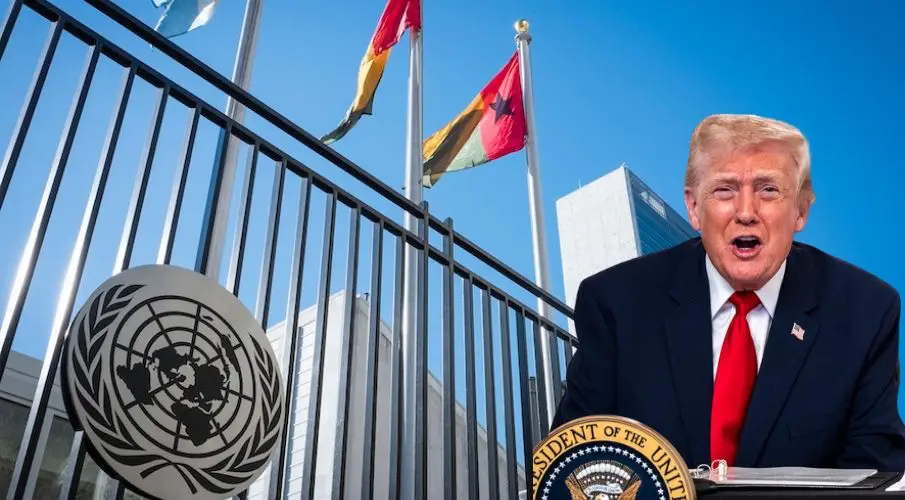
The United Nations reacted with unusual clarity. After the Trump administration announced that it would end support for more than 30 UN-affiliated bodies and a total of 66 international organizations, Secretary-General António Guterres made it clear: The United States remains legally obligated to pay its assessed contributions. Declarations of withdrawal do not change that. From the UN’s perspective, the situation is unambiguous, as is the legal framework. Contributions to the regular budget and to peacekeeping missions are decided by the General Assembly. They are binding on all member states – including the United States. This was stated not only by Guterres himself, but also by his spokesperson Stéphane Dujarric in unusually sharp terms. The UN Charter, he said, is not a construction kit from which states can pick and choose parts to suit them. Renegotiation is not on the table.
The conflict is the provisional peak of a tense year. Since Donald Trump’s return to the White House, his administration has pursued a systematic retreat from multilateral cooperation. Billions of dollars for international programs have been cut or called into question, humanitarian aid reduced, payments delayed. UN officials held talks for months, publicly and behind closed doors, to prevent a complete rupture. As recently as last month, an agreement on two billion dollars in humanitarian aid seemed to slow this course. The irritation was therefore all the greater when the latest decision came without formal notification – diplomats learned of it through media reports and the White House’s social media posts.
Assessed contributions are binding under international law
The United Nations bases its position directly on the Charter of the United Nations. Payment of approved assessed contributions is not a political courtesy, but a legal obligation of all member states – including the United States.
- Article 17 paragraph 2 – The expenses of the Organization shall be borne by the Members as apportioned by the General Assembly.
- Article 19 – A Member of the United Nations which is in arrears in the payment of its financial contributions to the Organization shall have no vote in the General Assembly if the amount of its arrears equals or exceeds the amount of the contributions due from it for the preceding two full years, unless the General Assembly is satisfied that the failure to pay is due to conditions beyond the control of the Member.
- Loss of voting rights in the General Assembly in the event of continued arrears
- Formal determination of a violation of the UN Charter
- Loss of political authority within the United Nations
- Weakening of its own position in budgetary and reform negotiations
- Signal effect for other states to withhold payments as well
Note: Assessed contributions cover both the regular budget of the United Nations and – separately – the financing of peacekeeping missions. Selective payment is not предусмотрed under the UN Charter.
Affected are numerous entities, including the United Nations Population Fund, which supports programs for women’s health worldwide, as well as the UN climate regime. Beyond the United Nations, Washington is also withdrawing from international groupings. In total, 66 organizations, commissions and programs are to have their funding suspended or terminated. Many of them deal with climate, labor, migration or development policy – areas that the Trump camp broadly categorizes as ideologically undesirable.
Some of these steps did not come as a surprise. The United States had already suspended its support for the World Health Organization, the UN Relief and Works Agency for Palestine Refugees, the Human Rights Council and the cultural organization UNESCO. What is new, however, is the scope – and the open stance of paying contributions only selectively. The Trump administration is effectively treating the UN budget like a subscription that can be canceled or adjusted on a monthly basis.
The break is particularly evident in climate policy. Withdrawal from the UN Framework Convention on Climate Change ends U.S. participation in the treaty framework that has formed the basis of international climate policy since 1992 and also underpins the Paris Agreement. UN climate chief Simon Stiell warned that this decision would not only weaken international cooperation, but also harm the United States itself – economically and socially – as extreme weather events continue to increase. At the same time, he emphasized that the door to a return remains open. Financially, the sums involved are significant. The regular UN budget is funded by all 193 member states, calculated according to economic capacity. The United States is required to pay 22 percent, China 20 percent. For peacekeeping missions, the U.S. share is even 25 percent. UN officials confirmed that Washington did not transfer its assessed contributions last year – a clear violation of the Charter. Any state that falls two years into arrears loses its vote in the General Assembly.
While the United States hesitates or blocks, all other permanent members of the Security Council have paid their contributions in full. China transferred more than 685 million dollars, as did France, the United Kingdom and Russia their respective shares. This constellation reinforces the impression in New York that Washington is not merely economizing, but deliberately exerting pressure. For the UN leadership, more than money is at stake. Guterres said through his spokesperson that the work of the affected organizations will continue – for those people who depend on support. But behind the scenes, it is clear: The American course has effects beyond Washington. European states are also reviewing their budgets, shifting funds from humanitarian aid to military spending. The U.S. withdrawal accelerates this trend.
The message from the United Nations is therefore not only legal in nature. It is political – and unusually direct. Membership means obligation. Those who helped build the foundation cannot simply detach themselves from it without violating the rules. In New York, there is readiness to confront this conflict. The Charter, the clear message goes, applies even to the world’s most powerful economy. And for Trump: Enjoy it when the voting rights are gone.
Updates – Kaizen News Brief
All current curated daily updates can be found in the Kaizen News Brief.
To the Kaizen News Brief In English


Selbst Russland und China zahlen.
Und Trump meint, dass die Regelungen für ihn nicht gelten. Da sieht man den Größenwahn und Realitätsverlust mehr wie deutlich.
Leider treten die Strafen erst bei 2 Jahresbeiträgen Rückstand in Kraft.
Das bedeutet die USA können dieses Jahr, ohne einen Cent gezahlt zu haben, wie jedes Vollmitglied agieren.
Ein langes Jahr… und wer weiß, ob es die UN dann noch gibt.
Denn wirklich nützlich ist Die UN schon seit Jahren nicht mehr.
Ein Papiertiger.
Viele Diskussionen, wenig Resolutionen, noch weniger Konsequenzen.