
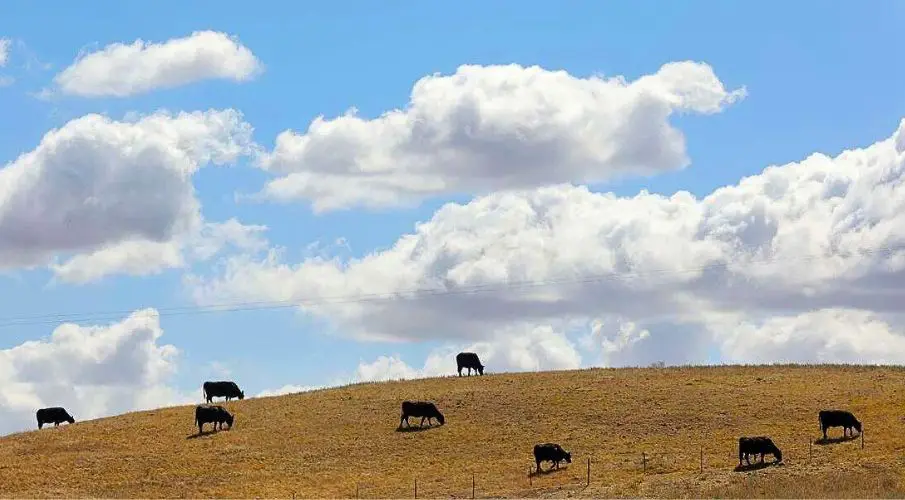
A label is a small confession. It tells the buyer what the seller would rather have kept to himself. Soon, a confession like that could be stuck on every package of ground beef in American refrigerated cases, and the man who set it in motion would be none other than Donald Trump. On September 29, the president signed an order directing the secretary of agriculture and the secretary of health to present options within 60 days. They are to examine whether foods and medications containing “significant amounts” of alpha-galactose should in the future be labeled like other allergens. The substance is known because of alpha-gal syndrome, an allergy to red meat that can develop after a tick bite. It is becoming more common. It can be life-threatening.

Alpha-gal itself is nothing threatening at first. The sugar molecule occurs naturally on the cells of nearly all mammals and is therefore present in their meat and milk. Gelatin can contain it too. Only humans and some primates do not produce it themselves. It becomes tricky only when the immune system develops antibodies against it after certain tick bites. The body then treats something completely ordinary like an intruder. Alpha-gal is not a poison, and it certainly did not come out of a laboratory. The danger lies solely in the misdirected immune response of a sensitized person. The steak has nothing to confess.

Most of the order is aimed at the pests themselves anyway. The administration wants to eliminate disease-carrying pests and give Americans back the joy of the outdoors, according to the White House fact sheet. In Washington, D.C., invasive mosquitoes are supposed to be reduced by 90 percent by 2028, ticks by 50 percent. The order calls for new control methods without chemicals or using biotechnology, along with research and prize competitions. A regulatory framework is to be created specifically for such technologies. Research into alpha-gal and Lyme disease is to expand under the president’s order, along with research into other diseases spread by ticks and mosquitoes. The departments are also supposed to examine possible immunotherapies for alpha-gal. A war on the tick, then, declared from the very top.
But suddenly an entire industry is hanging from that tiny creature. For now, the labeling is only under review, and there is no warning on any package yet. Taken to its logical conclusion, though, meat processors might eventually have to put an allergy warning on every mammal product. Ground beef and steaks would be affected. Pork loin and lamb chops too. Even milk and cheese would not escape. A burger stamped “May be deadly” would suddenly have official backing, and no satirist would have to invent it.
For allergy sufferers, such a warning would be a benefit. The illness can be serious enough, and from a public health standpoint the idea can absolutely make sense. What would be hit, however, is a product that the overwhelming majority of people tolerate without any problem. A warning label suggests there is something wrong with the meat itself. The farmer did not put anything in it, and the cow did not produce anything unusual.
For years, Republicans accused Democrats of waging a war on meat. Green lunatics, they said, wanted to take the American’s steak off his plate. Now the attack is coming from inside the house. It hits people who have been loyal to the party for generations: farmers and cattle ranchers, from the family farm to the ranch. Their patience with Trump was already wearing thin.
In August, the American Farm Bureau Federation criticized the president’s plan to allow farmers and ranchers to slaughter and process animals on their own. Until now, they have been tied to facilities inspected by the U.S. Department of Agriculture, the USDA. Farmers also sharply condemned Trump’s plan to bring beef into the country duty-free. So far, they said, that has not made meat any cheaper for consumers.
There is political insanity in the sequence. In August, Trump portrayed federal meat inspection as excessive regulation and wanted to pull ranchers out of the existing system. In September, he has the government examine a new warning label for their completely normal product. First, Washington was supposed to “free” them. Now Washington may slap the next label on them. None of that liberation has actually happened to this day, and the later order did not abolish inspections either. The freedom arrived as an announcement. The label may arrive as a rule.

Read also our article: Trump wants to scrap meat inspections, no matter who gets sick
Things already look grim behind the fence. America’s cattle herd is evaporating at breakneck speed and can barely keep up with high demand. Trump’s tariffs make farm machinery more expensive, while his military operation in the Middle East is driving up the price of fertilizer. In the Midwest, where farmers once ranked among his most reliable voters, many say they are stuck in the worst economic crisis in decades.
For 2026, Trump also added another 80,000 tons of lean beef from Argentina to a preferential tariff quota, explicitly so supply would increase and ground beef would get cheaper. The cow on the pampas is a mammal too. Under USDA rules, imported meat products generally have to carry the same labeling as domestic meat, and the order contains no exemption for Argentina. In the worst case, the rancher could get hit with both at once: more competition in the meat case and a warning label on his own product.
Read also our article: The President and the Beloved Cow – How Trump’s Argentina Deal Betrays America’s Ranchers
On imports, the revolt inside his own party is already underway. More than a dozen Republican senators have publicly criticized Trump’s import policy. John Barrasso of Wyoming pushed back that Americans wanted American beef on their tables. Tom Cotton urged the president to reconsider the move, and Steve Daines warned of harm to ranchers. Roger Marshall of Kansas said openly that this was not Trump’s best decision. Anger is growing in the House as well, where Republicans from farm states took the issue straight to the White House. Zach Nunn of Iowa said in early September that beef would be on the agenda for their meeting with Trump. The warning label would come on top of all that, for a condition no farmer caused.
Why does a president anger the very people who helped put him in office? Because this order came out of a different workshop. Trump signed it, but its spirit belongs to Make America Healthy Again, or MAHA, the movement of his health secretary. There is only 1 letter between MAGA and MAHA. For the cattle rancher, the next bill sits in between.

Robert F. Kennedy Jr. has been talking about alpha-gal for months without much coming of it. He has openly supported warning labels on all kinds of foods for a long time. Now there is an official review of exactly that in a document carrying the presidential seal, on the backs of the administration’s own base. How much of this is public health policy and how much is a power struggle inside the administration, no label will tell you. The supporters do not seem to care much. Under the Health Department’s announcement on X, commenters are arguing over a different question: where alpha-gal supposedly came from in the first place. The fact that the sugar has always been present in every cow does not seem to bother anyone there. Conspiracy theories grow more lushly than any pasture. Whether the burger gets a warning, whether the farmer pays, barely interests anyone in those threads.
People like to trust in the great enemy and overlook the tiny creature in the grass. The tick keeps biting. It has not noticed any of this.
Updates – Kaizen News Brief
Alle aktuellen ausgesuchten Tagesmeldungen findet ihr in den Kaizen Kurznachrichten.
To the Kaizen News Brief In English


