
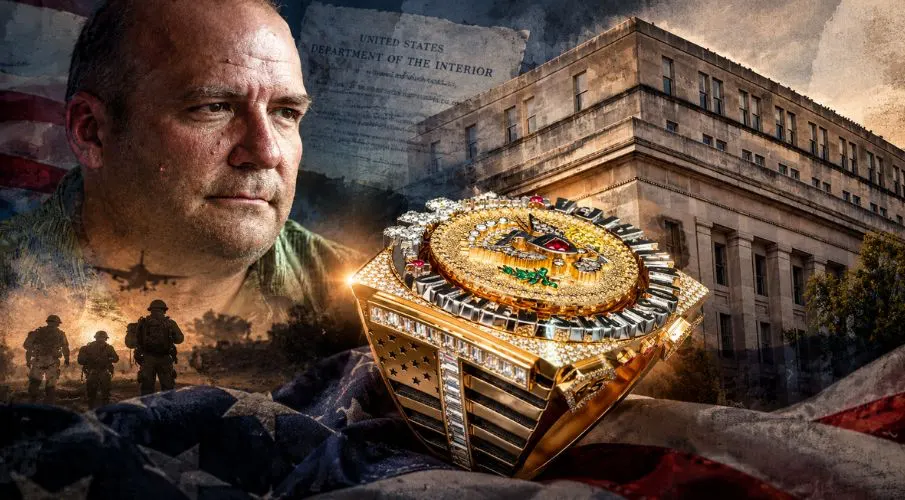
Three incidents, and together they paint a picture of what has become of this country. A ring made of 321 diamonds that disappears in the White House. A conservative lawyer who walks away after 18 years and speaks of an assault on the rule of law. Soldiers wounded in Trump’s war who had to piece together their own medical treatment. The same indifference runs through all three, from the very top all the way down.
In June, Donald Trump accepted a gift, an 18-karat gold ring set with 321 diamonds and 75 gemstones, estimated to be worth nearly $30,000. Since then, it has disappeared. Senators Elizabeth Warren and Richard Blumenthal are demanding to know where it went. They wrote to the White House Gift Office and the General Services Administration, and the Archivist of the United States got the letter too. To this day, the two say, there is no public report revealing where the ring is. A gift worth as much as a car, gone without a trace.

It had been handed over by the Antwerp World Diamond Centre, the trade association for Antwerp’s diamond industry, to the U.S. ambassador to Belgium, Bill White. A few weeks later, the White House exempted European diamonds from tariffs. Asked whether the gift had been a bribe for Trump, the response was that the ring had been intended for the American people, not the president, and had nothing to do with the tariffs. In August, the organization explicitly denied any connection between the tariff exemption and the ring. In July, the White House said Trump had never been given the ring at all. Under federal law, a gift to the government is registered and passed along, while a gift made personally to the president may be kept by him. Somewhere between those two statements, the ring disappeared, and with it the answer to the question of whether a tariff break was traded for diamonds. Trump is familiar with gifts like these, most recently the luxury jet from Qatar. Maybe the ring is sitting in some corner of the White House, maybe at one of his properties. Nobody who would know is saying.

John Murdock was a leading conservative lawyer at the U.S. Department of the Interior, 18 years on the job, and by his own account a conservative Christian. Now he is gone, and his resignation letter reads like an indictment. “We are headed in the wrong direction,” he wrote. Moving fast and breaking things was no solution. “Flooding the zone with shit is a strategy for producing a shitty country.”
What troubles him goes far beyond his own department. He listed the things that left his jaw hanging open: “Masked federal agents, abandoning Afghan allies, pardons and payments for rioters and their supporters, the rapid dismantling of USAID, our military probably committing war crimes, and a president who demeans the dead and sees himself as Jesus.” Inside his own department, he watched Matt Giacona, acting head of the agency overseeing ocean energy, talk about “the highest environmental standards” shortly after a major oil and gas deal in the Gulf of Mexico had been pushed through while bypassing endangered species protections. Giacona had lied without consequence. “I have watched my superiors behave in ways I never expected,” Murdock wrote.

The department rejected that, saying a former employee’s personal dissatisfaction did not turn lawful policy into an assault on the rule of law, and that his harsh words did not make his opinion correct. It said it stood firmly behind its work to carry out Trump’s agenda in accordance with federal law. Murdock is not the first to leave in protest. This department alone lost thousands of employees after Elon Musk’s DOGE campaign last year. He was giving up a secure salary and retirement benefits on top of it, he wrote, and considered that the cheaper price. “I will preserve my integrity. Fortunately, the calculation is easy.”
In the opening hours of Trump’s campaign against Iran, an Iranian strike hit a makeshift tactical operations center in Kuwait. Six American soldiers were killed, and more than 30 were wounded. First they lacked the means to defend themselves, then their own country left them alone a second time. Nine of the wounded say the military medical system simply failed after the March 1 attack.

Lieutenant Colonel Arturo Lincón, a veteran of Iraq and Afghanistan, suffered severe shrapnel wounds, including one to his left vertebral artery, putting him at risk of a stroke. For the military hospital at Landstuhl in Germany, that was not considered serious enough. He was discharged to the barracks and told to make outpatient appointments. “I was basically on my own,” he said. He was treated for weeks afterward at Walter Reed, and months later he is still fighting for the benefits tied to his injury. Major Stephen Ramsbottom waited more than four months for the results of an MRI after shrapnel had been removed from his head. “I had to build my own case for everything,” he said.
The most severely wounded were flown out within 2 days, while others waited. One group did not leave Kuwait until 10 days after the attack, strapped to the floor of a cargo plane. Among them was Rodney Bearman, with shrapnel in his face and legs, who learned in Germany that he and the others had not been listed as wounded in combat, a coding error that denied them treatment. “A sacred trust that I thought could never be broken was broken,” he said. Some did not learn until they were back home that they had suffered brain injuries. Disappointing, but not surprising, said James Kelly, the lead medical scientist at a foundation dealing with the military’s invisible wounds. In war, he said, this happens often.

The system is not failing by accident. It was built this way. The Defense Department has closed its major military hospitals in the Middle East and sends soldiers back into deployment after a mild brain injury. It played down the severity of the strike, with U.S. Central Command initially saying that only 5 soldiers had been seriously wounded. Defense Secretary Pete Hegseth described the deadly attack the next day as “just a little thing” and later complained that reports about the dead were meant to make the president look bad.
The same hand hangs over all three: Donald Trump. At the top, a diamond ring disappears, and nobody wants to know where it went. In the middle, a lawyer walks away because he will no longer go along with the lie. At the bottom, wounded soldiers are strapped to the floor of a cargo plane, and someone even forgets to record that they were wounded at all. This is what a country looks like when its government takes what shines at the top and leaves behind what bleeds at the bottom.
Updates – Kaizen News Brief
Alle aktuellen ausgesuchten Tagesmeldungen findet ihr in den Kaizen Kurznachrichten.
To the Kaizen News Brief In English


Die Idioten sind einfach gewissenlos und raffgierig. Leider überascht mich nichts mehr was dieses Pack macht. Ich hoffe immer noch, dass mehr rep. Abgeortnete erwachen und sich trauen zu widersprechen.
Mein Mitgefühl gilt allen Menschen die im Stich gelassen werden oder Opfer dieser Regierung sind.
… überraschen kann einen nichts mehr, und doch muss man das Ruder recht schnell herumreißen …