
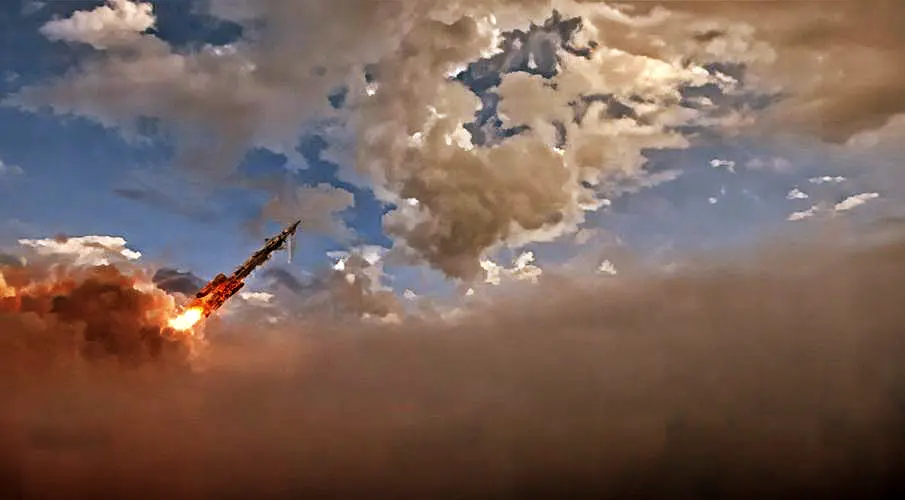
Weeks spent in Iran change the perspective. Not on the impacts, not on the headlines, but on what remains when cameras move on. What lies beneath the surface does not match the picture being drawn in Washington. There, officials speak of a destroyed missile program. On the ground, a different reality emerges.

We were also able to reach remote mountain regions in Iran
Pete Hegseth said this week that Iran’s missile capability had been practically eliminated, its launch systems decimated and barely operational. At the same time, internal assessments by US intelligence present a far more sober picture. Iran has lost a significant portion of its infrastructure, but not the ability to make it usable again. More than half of the mobile launch platforms have been damaged or blocked, many of them not destroyed but buried or sealed inside underground facilities. That is precisely where the decisive difference lies.
See our article: They bomb - and hours later the same systems are firing again

These facilities are built deep into mountains, protected by massive layers of rock. Airstrikes have been able to block entrances and seal tunnels, but not eliminate the entire system. What is blocked can be cleared. What is damaged can be repaired. American and Israeli officials assume that Iran can bring some of these systems back into operation. The infrastructure has been hit, but not erased.

More information can be found here
This pattern is also visible in stockpiles. Over the course of the war, Iran has lost about half of its missile arsenal through interceptions and destruction. Even so, thousands of short- and medium-range missiles remain. A significant portion of them is stored in underground depots. They are not visible, but they are available. The same applies to cruise missiles, which could still be deployed, for example against ships in the Persian Gulf or military targets in the region.

Losses are greater when it comes to drones. Less than half of the original capacity remains. Production sites have been hit, systems have been used up. But here, too, there is room to maneuver. US officials consider it possible that Iran could procure new systems from Russia to close the gap.
The military reality therefore sits between two narratives. On one side is the political message that objectives have been achieved. On the other are assessments suggesting that Iran is capable of restoring parts of its capabilities. This gap is decisive. It determines how stable any potential ceasefire actually is.
In Washington, work is underway precisely on that point. The goal is an agreement that fully reopens the Strait of Hormuz and prevents further attacks. At the same time, concern is growing within parts of the US government that Iran is using the time to reposition itself. In that case, a ceasefire would not be an end, but a phase of preparation.
Israeli assessments point in the same direction. Two-thirds of the launch systems are said to have been put out of action. At the same time, it is acknowledged that some of these systems remain intact underground and can be uncovered again. The ability to fire missiles has been reduced, but not ended. During the fighting, the number of daily launches dropped from several dozen to around ten to fifteen. A decline, but not a halt.
For Iran, the missile program has for years been the central component of its military strategy. Its air force was already weak before the war. Deterrence relied on range, not air superiority. That is exactly why this system was built, dispersed, and protected. And that is exactly why it cannot be completely eliminated within a few weeks.

The people of Tehran have turned the impossible, this adaptation, into routine: between impacts they live - not despite the hardship, but through it, with a quiet persistence that only decades of practice can teach. It is not bravery in a loud sense, but a refusal to stop breathing - an everyday mastery of continuing, as natural as the dust that settles again after each shock.
Iran can adapt quickly and rebuild lost capabilities. This assessment is supported by what becomes visible on the ground. Improvisation, relocation, recovery. Not a static system, but one that responds to pressure. At the same time, the economic dimension remains decisive. Sanctions, export controls, and potential support from Russia or China determine how quickly Iran can replace lost capacity. Without external assistance, reconstruction will proceed more slowly. With support, it can accelerate.
The political leadership in Washington points to military success. Anna Kelly, a spokesperson for the White House, said all objectives had been achieved. This portrayal is part of the negotiation strategy. The stronger one’s own position appears, the greater the pressure on the other side. But the actual situation is more complex. Jon Alterman, director of the Middle East program at the Center for Strategic and International Studies in Washington, puts it simply. Even with significantly reduced capabilities, Iran remains a central factor for security and stability in the Gulf. Every day without a clear decision does not shift the balance to zero, but keeps it in motion.

After weeks in the country, that is exactly the impression that remains. The war has struck structures, but not erased them. What appears destroyed is often only hidden. And what is hidden can become visible again.
Updates – Kaizen News Brief
All current curated daily updates can be found in the Kaizen News Brief.
To the Kaizen News Brief In English


So einen Bericht kann man nur schreiben, wenn man vor Ort war und alles live gesehen hat.
Danke für Euren Einsatz!
Keine Satellitenbilder oder Statistiken.
Sondern Realität.
Der Iran hatte jahrzehntelang Zeit sich auf genau dises Szenario vorzubereiten.
Bei dem die Frage nur das wann, nicht das ob war.
Israel hat Gaza monatelang bombardiert und trotzdem nicht alle unterirdischen Strukturen der Hamas zerstört.
Im Iran liegen viele Strukturen in schwer erreichbaren Bergregionen.
Ein Waffenstillstand ist heute, mit diesen Akteuren, leider auch kein Garant.
Was heute unterschrieben wird, kann morgen gebrochen werden.
Putin hat es vorgemacht.
Die Frage ist, inwieweit es einen echten Frieden geben kann?
Dazu müssen alle (!) Beteiligten an einen Tisch.
Auch der Libanon muss Thema sein.