
Europe and Ukraine are making it clear these days how little trust they place in Putin's supposed willingness to negotiate. He spent five hours in the Kremlin with Steve Witkoff and Jared Kushner, yet in the end everything remained as empty as before. While Trump says his envoys are "very certain" Putin wants a deal, European governments see only one thing: new attacks, new threats, new attempts to stall for time rather than seek peace. The British foreign minister called on him to "end the show and the bloodshed," and the Ukrainian foreign minister warned him "not to waste the world's time any longer." These sentences show the burden of a continent that has tried for almost four years to repel an invasion built on expansion rather than peace.

Putin, meanwhile, claims it is the Europeans who are sabotaging peace. At the same time, he declares that Russia is "ready for war with Europe" if challenged. His army launches drones at Ukrainian cities every night, and in Boiarka today a mother stood before the coffin of her fallen son. That image tells more about the reality of this war than any word spoken in the Kremlin.
Washington has shifted course under Trump. The United States is applying less pressure on Moscow and instead relies on a plan whose known elements Europe considers dangerous. The proposed concessions mean nothing less for Kyiv than being asked to surrender parts of its land while Russia would receive security guarantees. Such a deal would reward the aggressor, and this is exactly what European capitals warn against: if you hand something to a warmonger, he will come for the next piece. Witkoff and Kushner are now expected to meet Ukraine's chief negotiator, but the essential question remains the same: who is supposed to yield? Russia or Ukraine? For Kyiv it is clear that not a single square meter is up for negotiation. For Putin it is equally clear that without territorial demands there can be no agreement. And so the stalemate persists.
In Brussels, patience finally ran out. Estonia declared that Putin "obviously does not want peace." Finland called for an immediate ceasefire to create even the basic conditions for talks. NATO Secretary General Rutte stressed that Ukraine must remain strong during any diplomatic phase. Germany, Canada, Poland and the Netherlands pledged additional weapons - not as sales like in Washington, but as direct support.

Norway has significantly expanded its support for Ukraine's defense and announced an additional 500 million dollars for two new PURL packages that include urgently needed air defense systems, ammunition and other equipment. Since the initiative began in August, Norway has been one of its driving forces: already in summer Oslo provided 135 million dollars together with Sweden and Denmark, followed by another 200 million in October as part of a Nordic-Baltic package. Now Norway is joining Germany, Poland and the Netherlands to finance further deliveries. Through the PURL initiative, around 75 percent of all Patriot missiles and about 90 percent of the missiles for other air defense systems delivered to Ukraine have been provided. With the new packages, Kyiv will also receive 155 millimeter shells to hold the front, ammunition for HIMARS systems and guided aerial bombs for strikes on Russian positions and logistics. Foreign Minister Eide urged additional allies to join the financing and stressed that Norway will continue its high level of support in 2026.
At the same time, people keep dying. Two civilians were killed in the Dnipropetrovsk region by a drone strike and several were injured. In Russia, an oil depot burned after debris from a downed drone struck it. The front hardly moves, but the attacks continue. Any delay, any political hesitation can decide who survives the next winter.
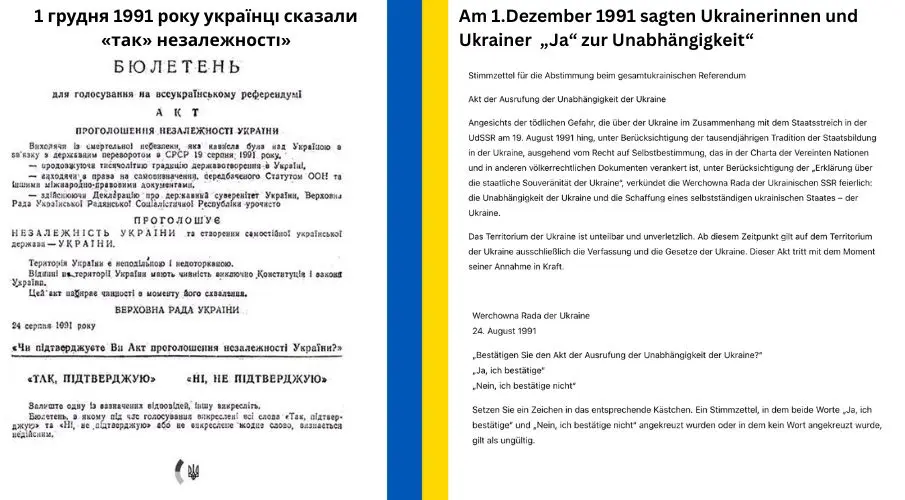
And in this moment, when the Kremlin and the White House talk about "peace," it is worth looking at something more incorruptible than any round of negotiations: the ballot from August 24, 1991. At that time a nation faced the question of whether it wanted to be independent. The Verkhovna Rada had declared independence months earlier, based on the right of a people to determine its own fate. The text made it clear that the territory of Ukraine was indivisible. On the day of the vote, 92.3 percent of citizens marked "Yes, I confirm."

Anyone speaking today about "territorial solutions" should read this ballot. It tells the story of a country that did not borrow its independence but decided it. A Russian victory would never be only a loss for Ukraine, but a denial of that clear will of 1991. Nothing more needs to be said to understand why Ukraine cannot yield - and why any peace that forces it to do so would not be peace.
Ballot for the vote at the all-Ukrainian referendum
Act of the proclamation of the independence of Ukraine In view of the mortal danger looming over Ukraine in connection with the coup d'état in the USSR on August 19, 1991, taking into account the thousand-year tradition of statehood in Ukraine, based on the right to self-determination as enshrined in the Charter of the United Nations and other international legal documents, taking into account the "Declaration of State Sovereignty of Ukraine," the Verkhovna Rada of the Ukrainian SSR solemnly proclaims: the independence of Ukraine and the creation of an independent Ukrainian state - Ukraine.
The territory of Ukraine is indivisible and inviolable. From this moment on, only the constitution and the laws of Ukraine apply on the territory of Ukraine. This act enters into force at the moment of its adoption.
Verkhovna Rada of Ukraine
August 24, 1991"Do you confirm the Act of the Proclamation of the Independence of Ukraine?"
"Yes, I confirm"
"No, I do not confirm"Place a mark in the appropriate box. A ballot on which both words "Yes, I confirm" and "No, I do not confirm" have been marked or on which no word has been marked is invalid.
On December 1, 1991, 92.3 percent of Ukrainians said "yes" to independence.
The oldest story about Ukraine does not begin with a war but with a decision. Three brothers - Kyji, Shchek and Khoryv - wandered the hills above the Dnipro many centuries ago. Each searched for a place where a community could grow without foreign rule, without coercion, sustained only by its own will. When they reached the ridge on which Kyiv would later stand, they decided to build their home right there. Not because it was easy, but because the place offered protection, community and room for self-determination.
The legend says the brothers agreed to be bound only to their own community. Those who came to the city were to live by shared rules, not by the dictates of a distant ruler. Early chronicles state that the city would stand only as long as its people stayed united and refused to be ruled from outside. This idea later became a foundation of Ukrainian identity.
In every version of the story, the message remains the same: Ukraine was never the product of foreign decisions. Its roots lie in a clear yes to its own freedom and in the conviction that a country endures only when the people who live in it decide its future themselves. That is why the legend of the three brothers remains the origin of an attitude that no empire has been able to erase - not then and not now.
"And that is the only truth one should speak about ..."
Investigative journalism requires courage – and your support.
Support our work against right-wing populism, disinformation, and violations of human and environmental rights. Every contribution goes directly into our daily reporting – we operate without advertising, without subscriptions, without corporations, without political parties. Our journalism is meant to remain freely accessible. For everyone.
Independent – Critical – For Everyone
Thank you for making our independent work possible.
Updates – Kaizen News Brief
All current curated daily updates can be found in the Kaizen News Brief.
To the Kaizen News Brief In English


Danke für diesen Artikel und eine sehr klare Sichtweise.
…dankeschön