
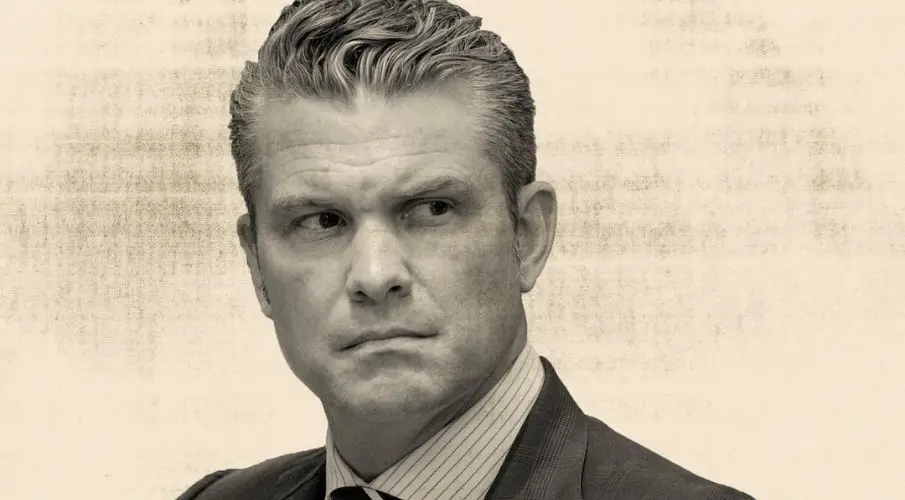
Donald Trump and his defense secretary Pete Hegseth presented the September 2 strike at the time as proof that their administration was acting decisively against violence in the region. One boat, eleven dead, a quick success - that was how it was meant to look. But the more details came to light, the clearer it became: this strike was not a clean hit against a cartel, but the beginning of an operation whose legal and moral foundations are more fragile than the government wants to admit. Trump circulated the video of the strike first himself and claimed that they had hit “clearly identified terrorists.” He provided no evidence. The suspicion that the boat had ties to Nicolás Maduro remained unproven. The images that were released showed only an explosion, no drugs, no cartel structures, no names. Nevertheless, the president spoke of “massive quantities” of contraband, as if his claim alone were enough to brush aside doubts.
Hegseth amplified this tone. In interviews he said they had “known exactly who was in that boat.” He insisted he had watched the strike live and portrayed the operation as a model of a new strategy. Within a few weeks twenty more strikes followed, 83 people died. The government presented these numbers as a balance sheet, not as the end of lives whose identities it did not even want to disclose. It then became known for the first time that two men had survived the initial strike. And that an admiral had ordered a second strike to follow a phrase that the defense secretary is said to have spoken beforehand: “kill everyone.” Two words that carry more weight in a military context than any political slogan. Two words that mark a line at which even long-time experts speak of murder. At the same time we were able to confirm that the Pentagon knew early on that there were survivors in the water after the first strike - and nevertheless carried out another attack to sink the boat completely.
A few days later it was confirmed that the two survivors did in fact die in a second strike. Who bears responsibility has since been the subject of fierce disputes. Congress reacted in an unusually unified way. Committee chairs of both parties announced investigations - a sign that the suspicion is no longer just political noise but a suspicion that strikes at the core of the administration.
Hegseth rejects everything. In his public statements he speaks of legal operations and of the “fog of war.” He says he did not see any survivors. The fact that he later admitted he had not followed the operation in full does not make the situation better. Trump, for his part, insists he did not know the details and says he believes his secretary. At the same time he says he would not have wanted a second strike. These two statements stand side by side like two contradictory versions of a story whose truth the government can no longer control. Meanwhile the pressure is growing. Senators speak openly of a possible war crime. Lawyers point out that there is no armed conflict that could justify such an order. Even if there were one, the targeted killing of defenseless people would be a violation that is forbidden under every legal framework. Some accuse the Pentagon of having fobbed off Congress with excuses, such as the claim that the wreck had to be sunk to protect shipping. No one takes this explanation seriously.
In the end a picture remains that can no longer be smoothed out: a defense secretary who claims to have an overview but at the same time admits he did not know what really happened after the first strike. A government that uses martial words to demonstrate strength while a video it refuses to release raises questions it does not want to answer. And an operation that was planned as a political triumph and now raises the question of whether the United States killed people who were already helpless in the water. It is a moment larger than a single operation. It shows how thin the line is that separates a government from arbitrariness. And it shows how dangerous it becomes when a secretary believes that toughness can replace responsibility.
Investigative journalism requires courage – and your support.
Support our work against right-wing populism, disinformation, and violations of human and environmental rights. Every contribution goes directly into our daily reporting – we operate without advertising, without subscriptions, without corporations, without political parties. Our journalism is meant to remain freely accessible. For everyone.
Independent – Critical – For Everyone
Thank you for making our independent work possible.
Updates – Kaizen News Brief
All current curated daily updates can be found in the Kaizen News Brief.
To the Kaizen News Brief In English


sie werden immer dreister. Ob es nun Drogenboote oder sonst etwas waren. Nicht rechtfertigt einen Militäreinsatz außerhalb der USamerikanischen Hoheitszone. Es ist nicht weniger als ein Angriff auf die Soveränität eines anderen Landes, so wie Putins Überfall auf die Ukraine. Was ist aus dieser Welt geworden, die so etwas zu lässt?
es ist klar, deutlich und begangen ein verstoss gegen völkerrecht, dass wissen auch die meisten im kongress, und der admiral, die aussage wird heiss, die bald kommen wird
Er ist Kriegsminister. Und würde aus der Armee geworfen.
…auch wenn er sich so nennt, lautet seine. ernennungsurkunde weiterhin verteidigungsminister, auch wenn er sich und wir alle ihn auch als kriegsminister sehen – sicherllich ist sein verhalten gegen jegliche norm, jedoch er in seiner militärzeit nicht unehrenhaft entlassen wurde
Das Trumphiratum Trump wird immer gewalttätiger und verlässt die Grundlagen der Menschenrechte.