
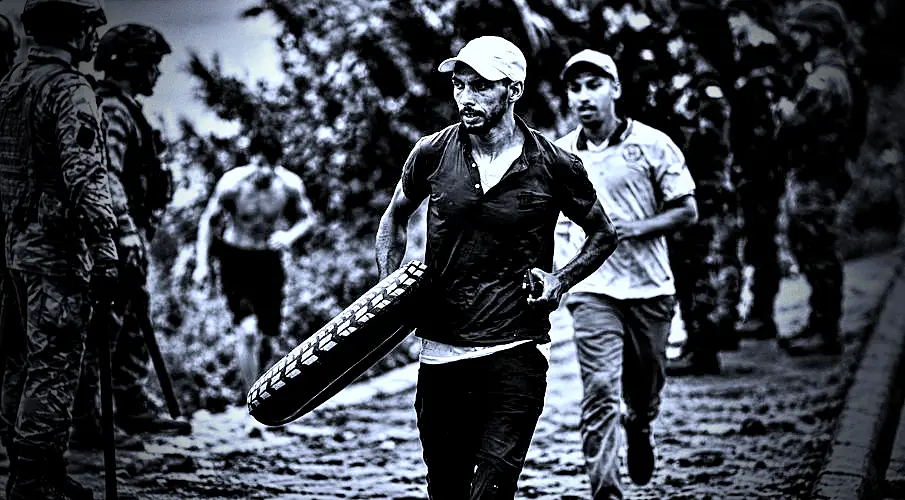
Ceuta/Tangier - At the Tarajal breakwater, where the border fence disappears into the sea, people were packed so tightly on Thursday that many could no longer move back because more kept pushing in from behind. Some drowned trying to swim the last stretch, while others were crushed to death against the breakwater. A union official representing Spain's border police called it a major humanitarian disaster and said people had literally been trampled to death in the crush. How many actually died depends on who you ask. The president of Ceuta initially spoke of at least 34 dead. A government official later put the number at 57. Within roughly 24 hours, Spain's Interior Ministry said about 50,000 people entered the Spanish enclave, while Ceuta's city government estimated the number at 60,000. In a city of just 85,000 residents, this was no longer a wave of migration. It was a second population that appeared almost overnight and without warning.

One Sentence, Read the Wrong Way
It didn't begin with an order. It began with a misunderstanding. Spain's Supreme Court had ruled that people arriving by sea could no longer be returned to Morocco without going through legal proceedings. The ruling, handed down on June 29, 2026, stemmed from a 2024 case in which a man intercepted in international waters challenged his immediate return. The justices held that the sea is not a physical barrier like a border fence, meaning immediate pushbacks at sea did not apply. Instead, arrivals must go through the regular legal process, with access to a lawyer and an interpreter, allowing them to apply for protection. On paper, that process is designed to take 72 hours, but during a mass influx it can stretch into months. Out of a narrow legal ruling that granted no one the right to remain, social media turned it into the message that the border was open. The prime minister later described it as wildfire spreading through migrant smuggling networks. Whether that was deliberate or simply the momentum of a rumor, he left unanswered.

Anyone who spoke with the people making the journey kept hearing the same chain of events. A 16-year-old said he and his cousin decided to try after traveling for 12 hours because they had seen videos on social media. "You trust in God," he said. A woman from Tangier said she woke up that morning, heard Ceuta had opened, and immediately left. She was turned back in Fnideq before she even reached the crossing. A 21-year-old from Tetouan put into words what many others were thinking. Back home, he said, there was nothing. Twelve-hour shifts for miserable pay. The conversations sounded almost identical, and that repetition became the real story. It was the combination of poverty that no longer offered a future and a smartphone promising one. Official figures show that one out of every four Moroccans between the ages of 15 and 24 is neither employed nor in education or training. Calm summer seas made the swim seem possible. A Moroccan human rights organization surveyed 500 young people in Tangier, Tetouan, and Al Hoceima. They overwhelmingly pointed to social media accounts glorifying successful border crossings as the driving force behind migration from northern Morocco.

Salad: "We don't have good teachers, and life in Morocco is bad.„
Ceuta Is Not a Gateway
What those who set out did not know became clear the moment they arrived. Ceuta is part of Spain and therefore part of the European Union, but it is a place with a second layer. From here, there is no way onto the Spanish mainland without passing another border check. The European Commissioner responsible for migration and Spain's foreign minister both confirmed that not a single one of those who arrived had reached the European mainland. The enclave that many believed would be a springboard into Europe turned out to be a dead end overlooking the sea.

Then came disappointment. The city could neither house nor feed tens of thousands of people. The authorities announced that they would provide neither food nor shelter. People slept in parks and on sidewalks, including unaccompanied children. The reception center, built for 512 people, had already been housing around 1,000 before the rush began. When hundreds tried to force their way inside, police secured the entrances. At the same time, the state responded with force. Floating barriers were placed in front of the breakwater as a visible obstacle. Water cannons and tear gas were used against people swimming toward shore. Soldiers and military divers entered the water. Those floating barriers were more than a symbol. The court had left open the possibility that immediate pushbacks could once again apply if a real physical barrier existed in the water. The floating line in front of the breakwater is an attempt to recreate that missing obstacle and regain, through legal means, the authority that had effectively been lost. A city counting its dead by the dozens became a stage for deterrence.

And so the movement reversed itself before Friday came to an end. By 6:00 p.m., official figures showed that 48,300 people had already returned to the Moroccan side, many of them voluntarily after realizing there was neither work nor any realistic future waiting for them. The contrast with recent history shows the scale of what happened. During the entire first half of 2026, only 2,698 people had crossed by land into Ceuta and the second Spanish enclave, Melilla. Even at the height of Europe's migration crisis in 2015, around 11,000 people entered the European Union in a single day. Here, several times that number moved within barely more than twenty-four hours. A rumor accomplished in hours what reality had failed to produce in months. By Friday evening, the city's second population had almost completely disappeared again. One 21-year-old simply said on his way back that he no longer really knew why he had come.
The Hand That Pulled Back
The question remains why tens of thousands of people suddenly managed to pass one of Europe's most heavily guarded borders. Several participants said Moroccan security forces barely intervened at first, only to impose massive controls later. Some even claimed officers had waved them toward Ceuta. Then, on Friday, Rabat ordered the crossings stopped, and by evening the return flow through Fnideq was almost complete. Some observers described what happened as a smaller version of the Green March - a mass movement without any visible order and without any publicly declared purpose. That abrupt shift, first looking the other way and then suddenly cracking down, is exactly why people began to speculate about a political motive.

The Moroccan ambassador said her country had always supported orderly and safe migration and insisted the events had unfolded against Rabat's wishes. Government-linked sources blamed criminal organizations and described cooperation with Madrid as exemplary. There is no evidence proving the operation was directed by Morocco, and both governments rejected that allegation. But the suspicion has a history. In 2021, Morocco relaxed border controls after Spain secretly admitted the leader of the Polisario Front for medical treatment without informing Rabat. Around 8,000 people crossed into Ceuta over two days. The dispute over Western Sahara, claimed by Morocco and by the Algeria-backed Polisario movement, lies beneath this border like groundwater beneath the earth. In 2020, the American president recognized Moroccan sovereignty over the territory, while the European Union still refuses to do so, fueling lasting resentment in Rabat toward Brussels. Regional experts believe allowing several thousand migrants to move toward the border can serve as a tool of diplomatic pressure. In 2022, Madrid abandoned decades of neutrality by backing Morocco's autonomy plan for Western Sahara, triggering a diplomatic rupture with Algeria. Sánchez's recent visit to Algiers reversed that direction. On July 20, Spain's prime minister traveled there for the first time in four years, marking a thaw with Morocco's regional rival. Whether the timing means anything more than coincidence cannot be proven. But a border that can be opened and closed like a valve is rarely just a geographical circumstance.

A Picture Becomes Ammunition
At the Tarajal breakwater, where the fence reaches into the sea, most of those who died were not killed by the water but by the crush. By Friday, one government official counted at least 57 dead on the Spanish side. The president of the city had previously spoken of 34, while others put the number at 60. The fact that the figures vary is part of the story itself. When the dead can no longer be counted with certainty, the event has already outrun the order meant to record it. Some drowned during the last few yards between Morocco and the enclave. Others were crushed against the breakwater as people behind them kept pushing forward while those in front could no longer move. Most were young men, but families and unaccompanied children were among the victims as well.

None of that reflected what was actually happening on the ground. By the time those statements spread around the world, the movement had already reversed itself. The footage circulated primarily through anti-immigration channels, where it was presented as proof of an unstoppable flood. While the images were shared as evidence of Europe collapsing, the wave had already receded. Not a single migrant had reached mainland Europe, and nearly all had already gone back. Pictures travel faster than numbers, and they remain long after the numbers have disproved them. Those who shared the footage did not need the outcome. They needed the fear.
Killed By a Sentence
At the Tarajal breakwater, where the fence disappears into the sea, most of the victims did not die in the water. They died in the crush. By Friday, one government official put the death toll on the Spanish side at at least 57. Ceuta's president had previously spoken of 34, while other estimates reached 60. The conflicting numbers are part of the story. When the dead can no longer be counted with certainty, events have already outrun the system meant to document them. Some drowned during the final stretch between Morocco and the enclave. Others were crushed against the breakwater as people behind them kept pushing forward while those in front could no longer move. Most of the victims were young men, but families and unaccompanied children were caught in the disaster as well.


Anyone who knew them could have warned them, because the survivors describe exactly what the dead believed. Ayoub El Abyad, 16, said he and his cousin decided to make the attempt after traveling for 12 hours because they had seen videos online. "You trust in God," he said. Abdulah Buji, 21, from Tetouan, said there was nothing waiting for him at home except twelve-hour shifts for miserable pay, and after finding nothing in Ceuta, he turned around and went back. Fatima Zahra, who left home that morning because she had heard Ceuta was open, never even made it beyond Fnideq. The same sentences. The same source. A rumor about a court ruling that gave nobody the right to stay, yet sounded like an open door. The survivors turned back. The dead had received exactly the same message. They simply learned the truth too late.

That shifts the question away from the border and toward those who put the message into circulation. A court ruling was shortened, passed along, shared over and over, until a narrow legal detail became what sounded like an invitation, and others turned that invitation into a route across the water for money. Between a social media post and the breakwater lies a chain that no court has yet managed to examine as a whole, and those who understand that gap know exactly how to profit from it. That is why, beginning today, we have launched investigations inside Morocco into those spreading these messages and into the smuggling networks behind them. Whatever evidence can be secured will be handed over to the authorities. There is a difference between those who swam because they saw no future and those who turned that desperation into a business. The first deserve to be counted. The second deserve to be identified.

What happened afterward to the dead belongs to the same finding. No sooner were the bodies lying on the beach than the political right in several countries held up the images, not for the sake of the dead, but against those who might still come. Anyone who turns drowned people into an architecture of fear takes even the last thing from them - the simple fact that a human being died here and that no piece of evidence was washed ashore. The real distance of that day lies between the use of the images and what can actually be seen in them.

Here's our fact check: Ceuta, or the Art of Turning a Border Surge Into a Narrative
We broke down more than 30 of the biggest claims because, frankly, some of the stuff circulating online is deeply concerning.
The Rift in Europe
In Europe, it was not the border that moved, but the Union itself. Italy suspended free movement with Spain and introduced checks at ports and airports for travelers from outside the Union, initially for one month. The prime minister in Rome had previously even demanded that Spain be excluded from the Schengen Area. Her foreign minister blamed a Spanish program that had granted temporary status to around half a million undocumented people and called it fundamentally wrong. Madrid summoned the Italian ambassador and spoke of partisan demagoguery.

The tone in the other capitals shifted between support and lecturing. Helsinki said Spain had abandoned the external border. Stockholm urged speed. Copenhagen called for Spain to be pushed out of the Schengen Area if necessary. The President of the European Council pushed back and assured Madrid of his solidarity. France increased the number of forces at the border fivefold from one day to the next - 334 officers, along with drones and aircraft - while at the same time offering help and giving Rabat credit for the fact that its cooperation had made the return of more than 40,000 people possible. The President of the European Commission called the images unbearable and repeated that no one should be allowed into the Union without rules, while her own Commissioner for Migration confirmed that there was no route from Ceuta into the mainland anyway. Brussels condemned a breach of the border and, in the same breath, had to admit that the border had held.
"The most urgent task now is to restore normality, guarantee security and, above all, not put peaceful coexistence at risk. With all due respect to the President of the Autonomous City of Ceuta: I believe that its diversity is one of its greatest strengths and, at the same time, one of its greatest assets." Bei allem Respekt gegenüber dem Präsidenten der Autonomen Stadt Ceuta: Ich glaube, dass ihre Vielfalt eine ihrer größten Stärken und zugleich einer ihrer größten Vorzüge ist.“
At home, the prime minister came under pressure from both sides. The President of Ceuta, who called the situation unbearable, accused Madrid of having acted too late and too weakly. The conservative opposition spoke of an occupied city. The program Rome pointed to applied only to people who had entered before the turn of the year and excluded anyone with a criminal record. The government said the incident had nothing to do with it and, on the contrary, had interrupted a trend of falling arrivals. Sánchez himself spoke of an attack on the integrity of the state and announced a temporary reception center intended to speed up the deportation of those with no claim to remain, if necessary through a change in the law.
And because no day is complete without a word from Washington, Ceuta, too, did not lack whatever the president has to say about everything and everyone.
On the global right, nuance was unnecessary. Spain's Vox called the event an assault and the prime minister a traitor whose fall was the only solution. AfD leader Alice Weidel declared, unsurprisingly, that the borders had to be closed and pushbacks enforced consistently. 2015 must not be allowed to repeat itself. In reality, however, Ceuta was not about an open border, but about people overcoming it despite the existing security installations. There were also clashes with police at the second enclave, Melilla. Hundreds gathered outside the Moroccan embassy in Madrid that evening, and footage from there showed Hitler salutes and symbols of the far right. Ireland's presidency of the Council called an emergency meeting for Saturday and a meeting of ambassadors for Monday. Within a single day, a misunderstanding online had turned into a European break with what could still be accepted, one that outlived its own cause.
The Big Question
What remains is something that cannot be answered with numbers. A philosopher of the 19th century, who feared the press of his own time, described the public as a ghost that comes into existence only through talk - a crowd without shape, nobody in particular, and yet one in whose name people act. He wrote those words before screens existed, yet he described them nonetheless. The internet has turned his ghost into a machine capable of gathering people within minutes, people connected by nothing more than a single sentence that none of them has verified. What happened in Ceuta was the condensed version of his idea. A message that nobody had verified set 50,000 people in motion, cost dozens of them their lives, and by the following evening had already been disproven, without the agitation it had created disappearing with it.

That leaves a question this day cannot answer. How deeply has a society been shaped by social media when an unverified rumor is enough to drive tens of thousands of people toward a deadly breakwater? And how easily could anyone who understands that dynamic steer such a movement in whatever direction they wanted - whether by looking the other way at the right moment or by releasing the right image at the right time? The line between a spontaneous movement and one that is quietly tolerated is thin, and anyone who understands that line does not have to cross it. It is enough to leave it open. Between 49,000 arrivals and 48,300 returns lies barely a single day, and within that short distance stands the full vulnerability of the many. Those who benefited are easy to see - the people already holding up the images before the migrants had even climbed back out of the water. Those who gave the first push are not. Our investigation in Morocco will continue to pursue that question.
Updates – Kaizen News Brief
All current curated daily updates can be found in the Kaizen News Brief.
To the Kaizen News Brief In English


Super Artikel. Endlich fundierte Informationen und nicht der übliche Verschwörungsmist.
Vielen Dank. Neutral, nicht belehrend, sachlich und auf den Punkt. Selten geworden.
„..Die Exklave war eine Sackgasse mit Meerblick.“ pointiert und nahe der Grenze.
Die Verbindung, wer warum Halbwahres streut, ist wichtig, DANKE, doch hier fehlt der Name des Boten:
„Der Staat setzte zugleich seine Härte ein: Bojen als sichtbare Sperre vor der Mole, Wasserwerfer und Tränengas gegen jene, die schwammen, dazu Soldaten
und Taucher im Wasser. Die Bojen waren dabei mehr als ein Symbol. “
Herr Sanchez erzählt frischrasiert, er habe das staatliche Unternehmen SASEMAR, der Marine und „natürlich der Guardia Civil beauftragt…“
Es ist dieser Chef Sanchez, der solche Natürlichkeit liefert, das fehlte im Beitrag.
hier zum hören und heulen:
https://www.srf.ch/news/international/spanische-exklave-warum-zehntausende-migranten-ploetzlich-nach-ceuta-schwammen
Vielen Dank für Ihren Hinweis, der aber auch im Artikel steht. Den Punkt haben wir bewusst anders gewichtet. Uns ging es an dieser Stelle nicht um eine Person, sondern um das staatliche Handeln. Wenn wir vom „Staat“ sprechen, ist damit selbstverständlich die politische Verantwortung der Regierung Sánchez gemeint. Wer sonst?
Würden wir jede Maßnahme mit „Sánchez ordnete an“, „Sánchez ließ“ oder „Sánchez erklärte“ versehen, würde der Beitrag unnötig personenzentriert. Das war nicht unser journalistischer Ansatz.
Da wir selbst vor Ort recherchieren, ergeben sich für uns fortlaufend neue Erkenntnisse. Entsprechend passen wir den Artikel dort an, wo zusätzliche Fakten eine Präzisierung sinnvoll machen.
ganz klar: ich bin Partei Sánchez. Er macht ausserordentlich viel, meine Hochachtung! gleichzeitig gehören die Namen der Halbwahrheitskurbler ebenso in Eure Recherche.
Während ich weder Euch noch Eure Berichte gefährden will.
Danke für diesen ausführlichen Bericht, der nicht von Ideologie und Verschwörungstheorien durchsetzt.
Stattdessen Fakten und Belege.
Es ist traurig, dass Menschen, Unglücke etc heute immer gleich von extremistischen Spektren missbraucht werden.
Es geht nur noch darum die eigene Ideologie zu stärken.
Menschen bleiben auf der Strecke.😞