
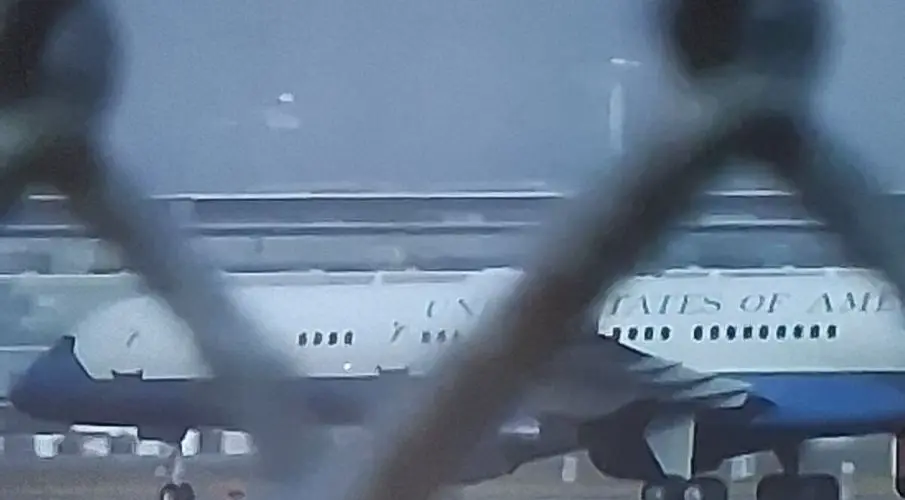
This year, Davos is not a place of self-affirmation, but a seismograph. When Donald Trump finally set course for the World Economic Forum on Wednesday after a technical malfunction aboard Air Force One, it was already clear that the political gravity had shifted. A minor electrical defect had forced the presidential aircraft to turn back, a precautionary measure, as it was described. Symbolically, the incident still carried weight, because politically this appearance is also marked by uncertainty and friction.

Trump arrives with an unusually large delegation, accompanied by several cabinet members. His appearance comes at a moment of open tension between the United States and Europe. Recent threats of punitive tariffs, the debate over Greenland, and increasingly confrontational rhetoric have already heated the atmosphere ahead of his speech. In Davos, it is palpable that this is no longer just about markets, but about political reliability.
Meanwhile, appearances by the global centers of power line up one after another. Jensen Huang speaks about technological dominance and economic futures, Jamie Dimon about financial stability in uncertain times. At the same time, Mohammad Mustafa uses the stage to draw international attention to the Middle East. All of this forms the backdrop for Trump’s central address, which is not perceived as a routine appearance, but as a possible turning point.
Away from the main stages, the real negotiations are taking place. Representatives of the United States and the European Union have met on the sidelines of the forum, seeking damage control. EU Trade Commissioner Maroš Šefčovič speaks of dialogue and mutual respect, but between the lines there is concern that transatlantic relations could slip into a downward spiral. The economic interdependence is deep, but trust is fragile. The political rupture becomes even clearer when looking toward Brussels. European Council President António Costa sees Trump’s threats against Greenland as a direct challenge to Europe’s security and prosperity. A special summit has been scheduled, the message clear: decisions about Greenland’s future belong solely to Denmark and the island’s population. That this basic principle has to be emphasized at all shows how much the coordinates have shifted.
Security concerns are also growing. NATO Secretary General Mark Rutte warns against losing sight of what matters most. While arguments rage over Greenland, a war continues in Ukraine that requires concrete military support. Air defense, equipment, reliability. Rutte makes it unmistakably clear that Ukraine must be the priority, not as an abstract principle, but as a real obligation. Markets are reacting nervously, but not in panic. After announcements of possible US tariffs, there were initially sharp swings, but the situation now appears stabilized. Gold, however, has risen to new highs, a quiet vote of no confidence in political predictability. In Davos, much is said about resilience, but the word rings hollow when the political course remains unclear.
Even the side notes of the meeting tell of a changed atmosphere. Celebrities stroll through the snow, cameras click, but the gloss feels incidental. In the background, Danish veterans speak of a sense of betrayal in the face of American threats against Greenland. People who fought side by side with US soldiers are openly questioning, for the first time, the reliability of their former partner. Davos 2026 is thus less a summit of visions than a place of open questions. Trump’s delayed arrival fits this picture. Nothing runs smoothly, nothing is taken for granted. Europe searches for resolve, the United States for leverage, and between them a space of uncertainty grows. What remains is the realization that this meeting will not end with warm words. The situation is too serious for that.
Updates – Kaizen News Brief
All current curated daily updates can be found in the Kaizen News Brief.
To the Kaizen News Brief In English


