
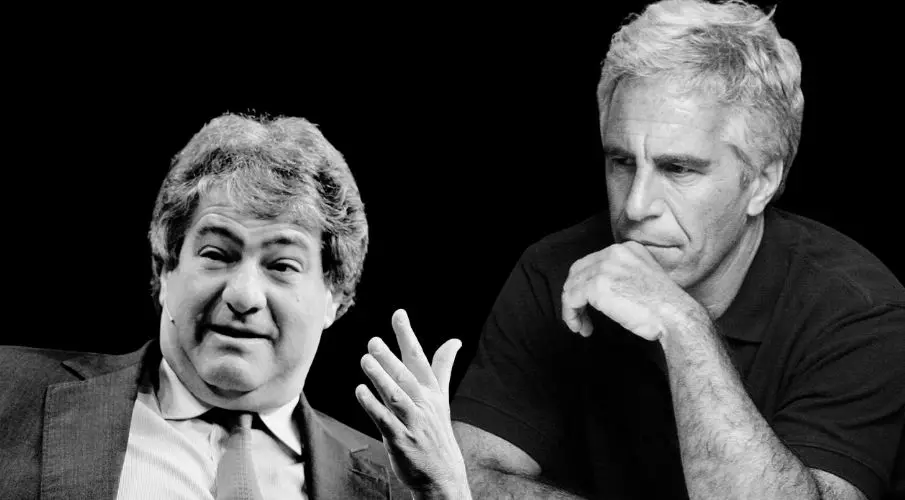
It began with a lunch in Manhattan and ended in a system of money, humiliation and moral extortion. Jeffrey Epstein, who had maneuvered his way from teacher to adviser of the super-rich, found in Leon Black his most loyal and at the same time most vulnerable ally. Over the years, the billionaire founder of Apollo Global Management paid the man whom many already considered disgraced sums of dizzying proportions - officially for "tax and estate planning," unofficially to get rid of him.
Between 2012 and 2017 more than 170 million dollars flowed - and the documents that have survived from that period show a relationship that began with closeness and ended in control. Black, brilliant and calculating, believed he could buy the shadow off his back. Epstein, on the other hand, understood that his greatest wealth was the knowledge of other people's sins.
Years earlier, the connection had already become more personal than was proper for a man of finance. In 2003 Leon Black wrote a poem for Epstein’s 50th birthday - handwritten, confidential, almost affectionate. It is a mixture of mockery, admiration and coded language from the world of the rich:

On the Occasion of Jeffrey Epstein’s 50th Birthday
A V.F.P.C. - that is what one should be,
a V.F.P.C. - that is what one should see.
A bon vivant, a lover, a Jeff, a Jeffrey,
let us all raise a glass - for today he turns fifty!
Five decades, L, half a century,
with birds and with bucks, C’s and M’s as key,
blonde, red or brunette, geographically spread,
with this net of fish, Jeff is now "The Old Man and the Sea."
He taught math, traded options and currencies,
with green eyeshade, plans and a unique tax strategy,
a wet dream on a designer sofa, a wild outing of the architect -
Moscow, Paris, Santa Fe, Alhambra East, an endless jamboree.
The poem is more than a whim - it is a window into a world where wealth and cynicism became indistinguishable. Black saw in Epstein a genius of systems, a man who opened doors that even billionaires hesitated to knock on. And Epstein understood that in Black he had found someone who confused influence with money.
Who was Leon Black? A son of Russian-Jewish immigrants, raised in New York, shaped by the myth of Wall Street. He made his career at the investment bank Drexel Burnham Lambert, where in the 1980s he earned millions with risky corporate takeovers before the bank collapsed in an insider trading scandal. From its ashes Black founded Apollo Global Management in 1990, one of the most powerful private equity firms in the world. Apollo bought distressed companies, restructured them and sold them for enormous profits. Black was considered a financial genius - cool, strategic, ruthless. He was the man who could control entire empires with numbers, and at the same time one who believed that nothing could happen to him.
After Epstein’s first conviction in 2008, almost everyone turned away - bankers, politicians, businessmen. Only Leon Black stayed. He later explained that the case had not particularly shocked him: "He was with a 17-year-old prostitute, was convicted, got a year in jail - that was it." It was the beginning of a second chapter in which Epstein turned his old network into a private business model.
Starting in 2012, he organized Black’s estate, his art purchases, his foundations. He designed trusts through which hundreds of millions of dollars flowed tax-free to the next generation, constructed fake transactions with artworks, planned deals through offshore companies. In internal memos he boasted that he had saved Black "up to two billion dollars" in taxes. But the more money flowed, the more aggressive his demands became.
On November 2, 2015, Epstein wrote to Black:
"I do not want any more uncomfortable money moments with you - I find that very distasteful. So to be clear: I will only work for the usual 40 million dollars per year. These must be paid - 25 million upon signing an agreement, then 5 million every two months for six months, that is March, May, June. I can start in January. I will immediately stop work if the payment is not received."
An email that sounds less like a service than like blackmail. Epstein knew that Black could not simply cut him off without shaking the entire façade of his tax structures.
Only a few months later, on March 20, 2016, he followed up:
"To accommodate you - I am very aware of your current liquidity situation. Therefore I will also consider payment in kind - real estate (Miami), artworks or the financing of my new plane (so you can stretch it over years) - or of course, preferably, cash."
It was the tone of a man who no longer negotiated but demanded. Epstein offered installment payments as if Black were a delinquent debtor.
Then, in the fall of 2016, came the email that summed everything up. On November 15, 2016, Epstein wrote:
"At least for a few weeks I cannot commit any time and cannot make any future plans to guide you in the reworking of your procrastination-produced mess.
That said, the tasks at hand are the following: You have a bomb of colored string that your disabled children have wound. It must be untangled very carefully."
A sentence like a blow. Crude, insulting, full of contempt - but spoken by someone who knew he could afford it.
Epstein was no longer the service provider but the enforcer. He insulted Black’s family, mocked his advisers, ridiculed his law firms, and yet millions continued to flow. In early 2017 Black granted him another loan of 30 million dollars - Epstein repaid only 10 million. Shortly thereafter, the contact broke off.
Yet even after that, in 2018, Black’s employees asked Epstein to perform a "review" of his tax returns - a final reflex of dependency. Weeks later, Epstein was dead.
Leon Black survived politically, but not morally. The relationship that began as a sober financial consultancy had turned into a power game that ruined them both: one outwardly, the other inwardly. Black paid to keep the peace. Epstein wrote to destroy it.
What remains are the letters and emails of a man who sold fear to the rich - and trapped them in their own guilt. And the poem that began as a joke now reads like a prophecy: an "old man and the sea" of money, lies and power - who at some point forgot which of the two was really the prisoner.

Investigative journalism requires courage, conviction – and your support.
Please also strengthen our journalistic fight against right-wing populism and human rights violations. We do not want to finance ourselves through a paywall so that everyone can read our research – regardless of income or origin. Thank you very much!


Zwei korrupte Männer, die sich gegeneinander ausspielten ….
Interessant, dass Epstein in so viel mehr als den furchtbsren Mädchenhandel verwickelt war.
Vielleicht fürchtet Trump auch diese Offenlegungen?
Durch sein „Flood the zone with shit“ spricht leider keiner mehr großartig über die Epstein Files.
Stattdessen wird der korrupte Ex-Abgeordnete der Republikaner von Trump begnadigt.
Der nächste wird wohl Puff Diddy sein
Gefolgt von Gishlaine.
Kriminelle halten zusammen.
👍