
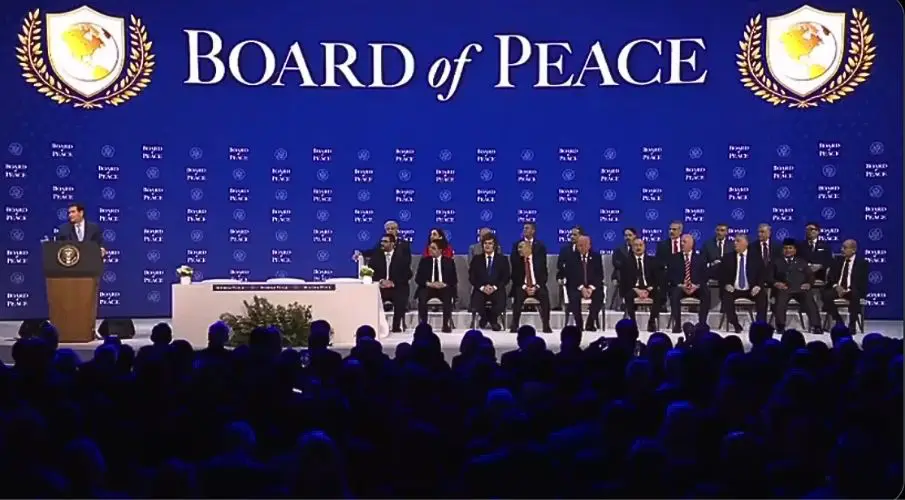
Donald Trump unveiled his latest creation in Davos: a “Board of Peace,” a peace council that, according to him, is meant to one day render the United Nations obsolete. Thirty five countries have already signed, sixty have been invited. But what this council is actually supposed to do remains largely unclear. The event at the World Economic Forum felt like a mix of state visit and sales show. Presidents, prime ministers and senior diplomats from more than a dozen countries came to be present as Trump launched his project onto the world stage. Originally, the idea had been part of his twenty point plan for a ceasefire in Gaza, approved by the UN Security Council. In the meantime, it has become something much bigger – or at least something meant to sound bigger.

Ali Shaath, head of the US backed committee of Palestinian technocrats for Gaza, announced during the ceremony that the Rafah crossing to Egypt would open next week. The border is a “lifeline” for the people of Gaza, he said. The crossing has been closed for a long time, most Palestinians in Gaza are trapped, and those who fled the war cannot return. After the ceasefire, Israel was obligated to open the border. But Israel has resisted doing so as long as Hamas does not return the remains of the last hostage in Gaza.

This document, obtained through research and marked as unclassified, is in our possession. It outlines in detail the establishment of a future controlled Palestinian residential and administrative zone. The title “Municipality” obscures its actual character: it is not about municipal self-government in the classical sense, but about the administrative restructuring of a population under comprehensive security supervision. The selection of residents is to be strictly controlled. Priority is given to Palestinians from the areas of Shaboura and Rafah — but only under clearly defined criteria. Preferred are intact families and certain professional groups such as teachers, medical personnel, administrative staff, and merchants. All residents are to be subjected to a security screening, explicitly aimed at excluding weapons or alleged Hamas connections.
Freedom of movement is formally assured, but remains tied to constant controls. Access to the area – as well as leaving it – is permitted only after security checks. In parallel, the document provides for the full biometric registration of all residents. The basis is to be Palestinian ID numbers issued in coordination with COGAT. This describes a system in which civilian administration and military control are effectively interwoven. Politically particularly sensitive is the section on local governance. Initially, a non elected, temporary directorate is to be installed. Democratic elections are mentioned only as a later option – without a timeline, without guarantees. The body is to organize essential services such as water, electricity and sewage, while the question of cost sharing by the population is explicitly left open.
Property issues are also addressed – but from an alarming perspective. Since the land is defined as public property, private rights are to be reviewed only retroactively, including possible compensation mechanisms. The fact that even this point is marked as “subject to discussion” shows how secondary property and return rights are treated. Projects are to be financed through external donors. Direct handling through Palestinian institutions is explicitly excluded. Instead, an overarching supervisory model is envisaged, since existing funds of the Palestinian Authority cannot be used. Here too, it becomes clear: sovereignty is not intended, but administration under reservation.
Iran was also discussed. “Iran wants to talk, and we will talk,” Trump said, claiming credit for last year’s air strikes on Iranian nuclear facilities as his idea.
The ceremony in Davos had everything a Trump show needs: a new logo, signatures from friendly heads of state and grand promises. The “Board of Peace” is now officially an international organization, White House press secretary Karoline Leavitt announced from the stage. What exactly that means remains unclear. But there is now a seal: a shield with a globe showing North America at the center, framed by olive branches. It looks like the UN emblem – except that it shows not the whole world, but only the western hemisphere.
The appropriate group is already sitting together – a board where one can be sure that no one has accidentally ended up at the wrong table.
There is no shortage of skeptical reactions. Traditional US allies initially demurred before committing themselves. Details about the council’s mandate remain thin. At least one thing: Kosovo’s president Vjosa Osmani, whose small Balkan country is among the signatories, shared a few details after the ceremony. Decisions would be made by simple majority, she said. Trump would be “founder and chair,” and the United States would have “more power.” What exactly that means, she left open. The White House has so far not published the founding charter. Osmani used the opportunity to take a jab at the UN. Its decision making procedures were “very complex,” she said, referring to the veto power of the five permanent members of the Security Council. “Is it better to be in an international organization where Russia has a veto and wages wars it never wants to end by using that veto?” she asked. “Or to be in an international organization where Russia has no veto and where we can rely on proven leadership – American leadership – when it comes to creating peace in the world?”

That is the sales pitch: faster decisions, no Russian blockades, American leadership instead of UN bureaucracy. How this is supposed to work in practice remains speculative. Trump himself said he wanted to “end the terrible killing in Ukraine.” The talks with Volodymyr Zelensky – behind closed doors – have just ended a few minutes ago. No cameras, no questions, no photo opportunity. Journalists waited outside.
Zelensky leaves Davos without a signature – Trump’s interest in Ukraine remains cool
The meeting between Trump and Zelensky in Davos lasted just under an hour, then it was over. No cameras, no joint statements, no signature on a framework agreement for the economic reconstruction of Ukraine. A Ukrainian spokesperson called it a “good meeting,” nothing more. Zelensky was scheduled to give a speech in Davos later, Trump left the World Economic Forum. For Ukraine, this is a setback. Kyiv’s strategy was to keep Trump engaged by making business opportunities in Ukraine attractive to him. The idea: if American companies can profit from reconstruction, Trump will remain engaged in peace negotiations. But none of that was visible in Davos. Ukrainian officials had raised hopes ahead of the meeting that there could be an agreement on economic cooperation. It did not materialize.
Trump had said he wanted to stop the dying in Ukraine. His envoys Witkoff and Kushner are scheduled later in the day to go to Moscow to speak with Putin. But Zelensky was given no comparable stage, no joint statement, no commitments. The message is clear: Trump’s attention lies elsewhere – in Gaza, in his new peace council, in the big show. Ukraine has to see how it can keep up in this game.
The entire affair is overshadowed by Trump’s recent escapades over Greenland. First he threatened eight European countries with tariffs to bring the island under US control. A day later came the reversal, accompanied by a wild story. Europe breathes a sigh of relief, but the chaos of the past few days has hardly lent credibility to the new peace council. What remains is another Trump promise: to create peace, to reorder the world, to put America at the top. How that is supposed to work with a body without clear rules, without transparent structures and with the United States as the de facto veto power remains to be seen. For now, the Board of Peace is above all one thing: an announcement.
The event once again showed how Trump wants to reshape the post World War II world order. After days of attacking European heads of government and disparaging their values, he now stands on the stage in Davos with Orban and Milei. Traditional US allies are conspicuously absent. What Trump is doing here is more than just window dressing. He is creating a parallel structure to the United Nations, with himself as chairman, with North America at the center of the logo and with friends who do not contradict him. Whether this will actually produce peace remains doubtful.
Updates – Kaizen News Brief
All current curated daily updates can be found in the Kaizen News Brief.
To the Kaizen News Brief In English


Oh man!
Der „Friedensrat“ ist die größte Farce.
Ein Club von Mördern, Autokraten, Diktatoren und ein paar Ländern, die sich gerne Mal groß fühlen wollen.
„Beschlüsse werden mit einfacher Mehrheit getroffen. Aber die USA hat mehr Macht.
Übersetzt: Wenn was beschlossen wird, was Trump nicht gefällt, bringt er den Beschluss zu Fall“
Merkt die Präsidentin aus Kosovo nicht, was das bedeutet?
Wahrscheinlich nicht.
Aber einlullen konnte Trump die Leute schon immer. Wobei ich mich frage, wie er das mit seinem jetzigen geistigen Zustand noch schafft.
Und was für Beschlüsse überhaupt?
Wer gibt ihnen das Recht überhaupt etwas zu beschließen?
Vielleicht für die unterzeichneden Länder.
Aber darüber hinaus ganz sicher nicht.
Ich hoffe, dass Europa und auch andere demokratische Länder standhaft bleiben und bei dieser Farce nicht mit machen.
Und Europa sollte sämtliche Verhandlungen mit Beitrittskandidaten zur EU auf Eis kegen, wenn sie sich der Trump Show angeschlossen haben.
Kosovo ist, soweit ich weiß, eines der Länder.