
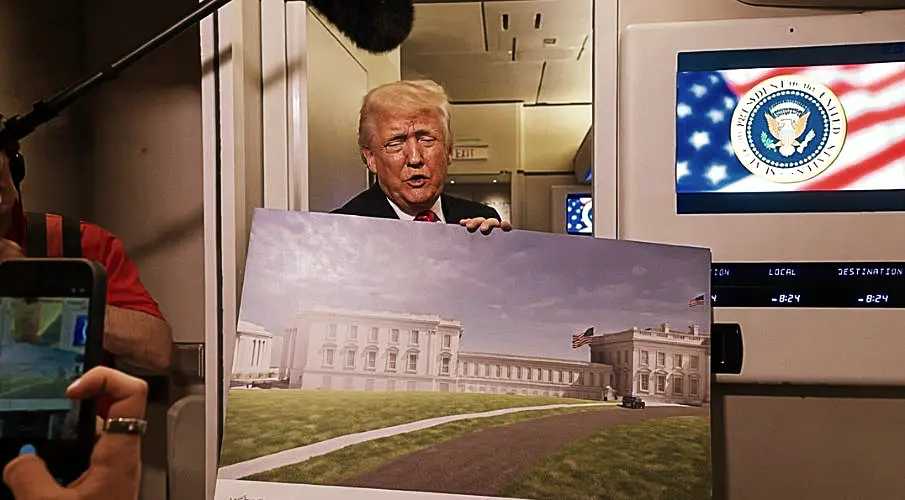
A construction project that has long been underway is abruptly halted. In the middle of Washington, a federal judge stops the work on Donald Trump’s planned ballroom at the White House, turning a prestige project into a tangible power conflict. This is not about taste, not about architecture, but about authority. Who is allowed to decide how the most important building in the United States is changed.


Judge Richard Leon draws a clear line. For a ballroom of around 8,360 square meters and costs of about 400 million dollars, the president lacks the legal basis. No law grants him this authority. That is exactly what Leon writes in his decision, thereby calling the entire project into question. The construction halt applies for now, two weeks remain so that security-related work can be completed. After that, construction may only continue if Congress approves.

The path to that would be open. Leon explicitly points out that the president can obtain approval at any time. But that has not happened so far. Instead, financing is being carried out through private donations, organized via the National Park Service. Large corporations such as Nvidia, Apple, Microsoft, Amazon, and Meta are among the donors. A model that raises political and legal questions because government structures are being linked with private interests.

The conflict has a history. An initial attempt to stop the construction work had still failed. At that time, the court considered the plaintiffs’ argument insufficient. But Leon made it clear where the decisive point lies. The question of congressional approval. The plaintiffs, led by the National Trust for Historic Preservation, addressed exactly this point in a new lawsuit and have now prevailed. At the site, facts have already been created. The East Wing was demolished within a few days in October. Foundation work is complete, the visible structure was supposed to begin in April. A project that is not only planned, but already being implemented, now suddenly stands still.

Trump responds to the lawsuit with a sharp counteroffensive. He describes his ballroom as under budget, ahead of schedule, and built at no cost to taxpayers. He explicitly refers to the National Trust for Historic Preservation as a “radical left group.” Central to his argument is an accusation of a double standard. While his project is being stopped legally, far larger construction problems are, in his view, being ignored. As examples, he names the Federal Reserve and a rail project in California, both billions over budget and with uncertain completion.
He also presents himself as someone who is merely restoring a neglected building when it comes to the Kennedy Center. He rejects the lawsuits against it. His central message: successful projects are being blocked, while real problems are being ignored.
The administration had relied on far-reaching powers to modernize the White House. But in court, this claim was significantly limited. Maintenance and technical adjustments are permitted, meaning heating, lighting, supply systems. A complete new construction does not fall under this. The distinction is decisive and cannot be argued away. Politically as well, the ballroom is more than a construction project. Trump personally accompanies the project, speaks publicly about it, shows designs, intervenes in planning and execution. For him, the hall is one of the central projects of his second term. At the same time, he is pushing further renovations, for example at the John F. Kennedy Center, which is to be closed for two years after he associated his name with the building. Lawsuits from the same circle of preservation and architecture organizations are already underway there as well.

Trump directly contradicts the judge’s decision and calls it wrong. Congressional approval has never been required for construction projects at the White House in such cases, regardless of size or scope. He also emphasizes again that the ballroom is financed exclusively through private donations and that no taxpayer money is being used. Precisely for that reason, approval by Congress is, in his view, not necessary.
The Department of Justice has announced it will challenge the decision. Not surprising. The dispute will therefore continue, likely through several levels of courts. But it is already clear that this ruling is more than a construction halt. It forces a president back into a system that sets clear limits. Even where power is most visible, it does not extend to personal plans.
Updates – Kaizen News Brief
All current curated daily updates can be found in the Kaizen News Brief.
To the Kaizen News Brief In English


