
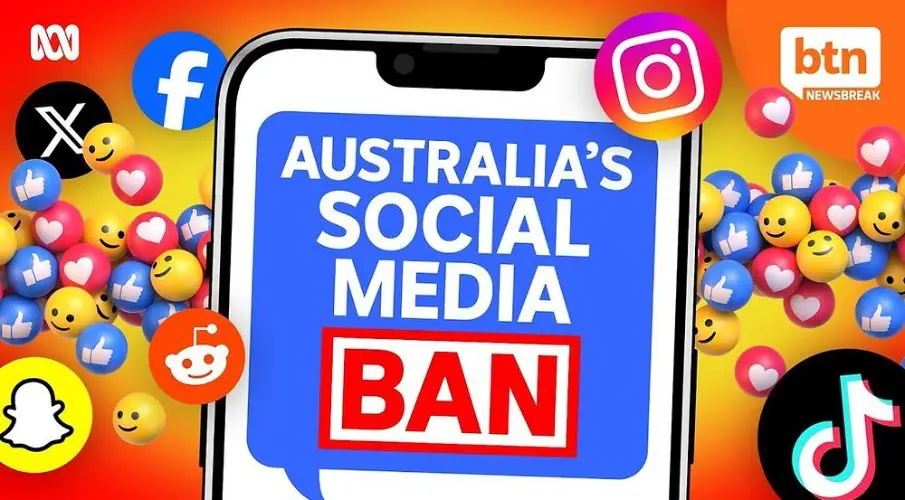
Australia has become the first country in the world to enact a law that bars children under 16 from accessing social networks. A step that rearranges the entire debate over the influence of major technology companies. And a step that showed its impact immediately: in Sydney, Melbourne and Brisbane, thousands of children posted farewell messages before being locked out of their accounts. Some tried improvised tricks, such as drawing on facial hair to outwit the automated age checks. Others turned to older siblings, who in turn helped them bypass the restrictions. For many families, the morning felt like a rupture with what had been normal until now.
Prime Minister Anthony Albanese presented the ban as a moment in which families take back control over their children's digital world. He said it was about allowing children to keep their childhood and giving parents renewed peace of mind. At a gathering in his official residence, he praised the parents who supported the law, including families who lost a child to online extortion and for whom this day is more than a political decision. Albanese said other countries were already watching to see whether this model could be applied elsewhere. The law requires platforms such as Facebook, Instagram, TikTok, X, Reddit, Snapchat, YouTube, Twitch and others to delete accounts belonging to minors. Those who fail to comply risk fines of almost 49 million Australian dollars. Responsibility lies with eSafety Commissioner Julie Inman Grant. She announced that on Thursday she would formally demand that the platforms disclose how many accounts have been closed and what measures have been implemented. By Christmas, the public should know whether the companies are taking the rules seriously or merely doing the bare minimum.
Communications Minister Anika Wells emphasized that the platforms are not required to ask for identification documents. Instead, they must use the data they already have about their users. She warned children who have so far evaded age checks that this is only a matter of time. Photos of Australian beaches, dialogues about school holidays or posts about local events would expose any supposed VPN trick. Wells made clear that the companies must continuously verify who is behind an account and how old the person actually is. Many parents welcome the law, others see economic disadvantages, and right-wing populists are furious because they can no longer recruit children as pre-shaped young voters. One mother described how her 15-year-old twins work professionally as actors and models and rely on social networks for visibility, meaning they could now lose jobs. For these families, the step is not protection but an intrusion into a working world that starts early and in which visibility plays a decisive role. Still, she said she understood the goals of the law, even if her own children are affected differently than most.
The privacy authority says the platforms must delete data collected for age checks and may not reuse it. That is an important safeguard, because the state cannot require millions of people to upload official documents. Yet it remains unclear how reliable age estimation can be and how often it will produce errors in both directions. For Albanese, the challenge remains to enforce the law in practice. He said openly that it would not work perfectly. But for him, the point is to hold the major platforms accountable. It is time, he said, for companies to recognize their responsibility and not continue treating children as advertising space, data sources or targets of algorithmic incentives.
Australia has created a global test case. Supporters see urgently needed protection from psychological pressure, manipulation and digital violence. Critics warn of surveillance, overstretched authorities and a new inequality between those who can circumvent the law and those who cannot. One thing is certain: this day marks a turning point not only technically, but socially. Millions of children were lifted out of their digital worlds overnight, and no one today can say how lasting this intervention will shape their future. We will keep following it.
Investigative journalism requires courage – and your support.
Investigative journalism is important because it researches where others no longer go and thereby ensures that what is decisive for the understanding of reality becomes public. - for that we need your support.
Independent – Critical – For Everyone
Thank you for making our independent work possible.
Updates – Kaizen News Brief
All current curated daily updates can be found in the Kaizen News Brief.
To the Kaizen News Brief In English


Ich hoffe, es werden andere Länder nachziehen, zu groß ist der Einfluss von Facebook, X, Tiktok & Co auf Kinder.
Und wenn die Kinder dann auf Soziale Medien dürfen, müssen sie gut darauf vorbereitet sein und Medienkompetenz gelernt haben, dies kann ja als Unterrichtsfach gelehrt werden.
…es ist auf jeden fall ein schritt, den man genau beobachten sollte