
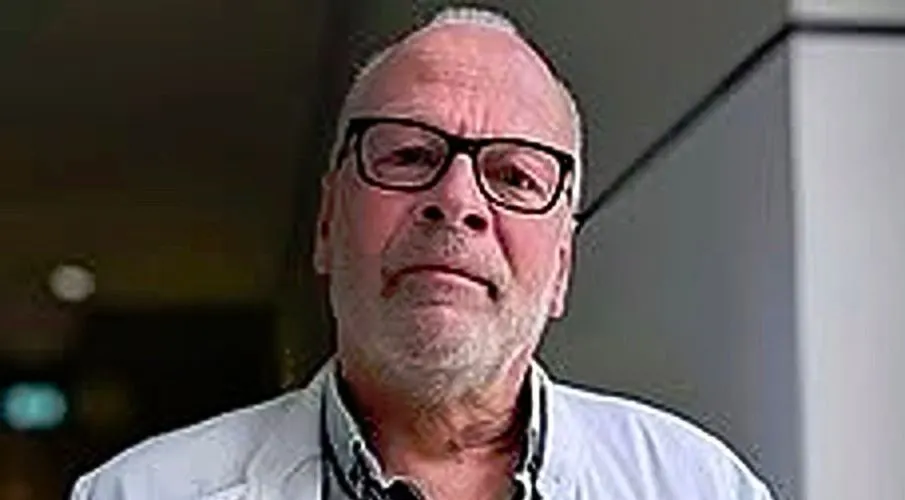
An ordinary face, glasses on his nose, the calm look of a man you would trust with your life. Behind that face were sentences you would never expect from someone whose profession is healing. In Rostock, it has become clear just how far the hand that writes can move away from the hand that examines sick bodies, until only the white coat still connects the two. A senior physician at Rostock University Medical Center has been suspended with immediate effect after his comments online became public. Dr. Ronald Siems, confronted with the statements, admitted that he wrote them. No relationship between people demands as much trust as the one between a patient and a doctor. The patient takes off their clothes and with them every layer of protection, placing themselves in a stranger’s hands with the quiet certainty that those hands mean only good. That trust is the foundation of medicine. A doctor who describes people online as “fuel for the furnace” tears that foundation out from under everyone who has ever placed themselves in his care.

What he wrote is almost impossible to say out loud without the language itself recoiling. People were, to him, “fuel for the furnace” that could “solve our energy problem,” to be disposed of through “remigration or camps.” “Remigrate or cremate,” he wrote elsewhere, and colder still, “Cremation would be more economical.” These words carry their own weight in German, and everyone knows which period of history that weight comes from.
A word like “fuel for the furnace” does its work long before any act follows. It takes the face away from a human being and turns that person into fuel, a mass to be burned. This kind of language is the first act of every extermination, the quiet preparation in which a person becomes an object. The decisive step has already been taken long before a weapon enters the picture. The language of the camps was followed by the language of the gun. He wrote of a “final rescue shot,” of putting “6×6 into someone’s forehead.” He weighed his own illegal possession of a weapon against the harm he feared he might otherwise suffer. Spread over more than half a year, these lines sat openly on the internet, signed with his name next to his photograph.
The addition “Cremation would be more economical” is the coldest line of all. In it, one human being calculates the value of another in terms of cost, and Germany has made that calculation before, in files and folders kept by bureaucrats who considered themselves sober and rational. That it now comes from a doctor, from a man who knows the oath to put his knowledge in the service of life, strips away the last solid ground beneath the horror.

Coming from a German mouth in particular, calculations like these carry a history that needs no footnote. Doctors once surrendered the language of medicine and economic efficiency to organize the killing of the sick, people they had declared “life unworthy of life.” They sorted and signed. They left the burning to others. That a casual phrase about the “economical” burning of human beings can once again be written almost in passing in 2026 measures the distance a society can travel in just a few generations - and how quickly it can lose that ground again.
Nothing in these lines reads like an outburst. They sit there in the same flat tone as a comment about the weather, typed without the hand appearing to tremble. What is monstrous lies less in the words themselves than in how casually they are delivered, in the ease with which the unthinkable is written down and sent.

Rostock University Medical Center responded the way an institution has to respond when it still understands what is at stake. It suspended the doctor and began employment-related proceedings. It also filed a criminal complaint. The state government of Mecklenburg-Western Pomerania and the state medical association were informed as well. The University of Rostock was notified, as was the German Foundation for Organ Transplantation. That the German Foundation for Organ Transplantation stands at the end of that list gives one pause. In a system that helps decide how life is passed from one person to another, talk of wiping people out carries double the weight. The two outermost possibilities of the medical profession, giving life to a stranger or wishing death upon one, come together here in a way that is hard to bear.
The title of these lines was chosen quickly and yet is difficult to carry. A low point assumes there was once a higher ground from which the fall began, and the question forces itself forward: how high was that ground ever really? Perhaps that height was always only a thin ceiling of decency, easy to punch through once enough voices start declaring the unspeakable speakable again. What makes a senior physician write about “fuel for the furnace” under his own real name cannot be understood from the outside. What can be seen is the climate in which he did it, a time in which words like these move through comment sections until some begin to treat them as just another opinion among opinions. The line a society draws between what can be thought and what cannot be said is not a wall. It is an agreement, and agreements can be broken.
The word “remigrate” presents itself like an administrative term, as though it were only about a return trip. Placed next to “cremate,” it loses every bit of camouflage. The comment spells out what the friendlier expression hides and shows where the supposedly matter-of-fact language about returning entire groups can lead when no one reaches out to stop it. For months, these sentences remained online, read and applauded by an unknown number of people, deleted by no one. The silence around them is part of the picture. Hatred that is allowed to sit out in the open for that long counts on approval and finds it in the silent followings where the horrifying no longer fears contradiction from its own kind.
Elsewhere, he wrote of a forehead “you couldn’t miss,” half mockery, half threat. The sentence falls back onto his own photograph, onto the ordinary face with glasses that gives none of this away. That ordinariness is precisely what is disturbing. Evil does not need a monstrous face. The calm look of a colleague in a white coat is enough.
Dr. Ronald Siems stopped being a doctor the moment he decided these lines were acceptable. The suspension only formalizes what he had already done himself. What remains open is the question of how many sentences like these are still sitting unread in comment sections, typed by steady hands that will reach for a stethoscope again the next morning.
Updates – Kaizen News Brief
Alle aktuellen ausgesuchten Tagesmeldungen findet ihr in den Kaizen Kurznachrichten.
To the Kaizen News Brief In English


Liebes Kaizen Team,
danke für diesen Beitrag.
Es ist perfide und unglaublich! Es wird mir immer unbegreiflich bleiben, wie Menschen, noch dazu dieser “ gebildete“ Doktor so menschenverachtende Dinge von sich geben können!
Hoffentlich wird auch nachgeprüft, inwieweit er seine ärztlichen Pflichten gegenüber Patienten*innen verletzt hat. Es ist ja nicht auszuschließen, dass er seine rassistischen Gedanken nicht schon in die Tat umgesetzt hatte? Ich hoffe, dass da jetzt ganz genau hingeschaut wird. 😥
…. man ist schlicht sprachlos und fragt sich: was ist paqssiert?
ich hoffe nur das die Staatsanwaltschaft gründlich arbeitet. Die Tätigkeiten und Entscheidungen dieses Mannes in seinem Beruf müssen durchleuchtet werden. Wer sich wie ein neuer Mengele sieht gehört entsprechend bestraft. Verwunderlich ist nur wie lange diese Sätze niemandem aufgefallen sind. War seinen Freunden und Kollegen das noch nicht aufgefallen oder haben alle weggeschaut? Viel schlimmer, sind diese seiner Meinung? Es bleibt viel arbeit für die Justiz.
… das ist ein Muss und der gesamte Fall aufgearbeitet werden. Leider sind in diesen Zeiten viele schlechte Gedanken zur Gewohnheit – darum wehren wir uns so gegen Rechtspopulismus und erleben es mit Herrn Trump täglich
Mengele 2.0 🤬🤬🤬
Wie konnte das so lange unbemerkt bleiben.
Diese Volksverhetzung stand monatelang, frei zugänglich mit Klarnamen, im Netz.
Und wirklich Niemand will was bemerkt haben?
Niemand hat es der Krankenhausleitung, der Ärztekammer (vielleicht zum Selbstschutz anonym) gemeldet?
Nicht eine Person?
Oder wurde es gemeldet und es gab ein kollektives Wegsehen?
Ohne investigative Recherche wäre es wohl nie richtig in den Fokus gerückt worden.
Jetzt ist es an den Ermittlungsbehörden das sorgfältig aufzuarbeiten.
Hieran wird sich die Justiz in MV messen lassen müssen.