
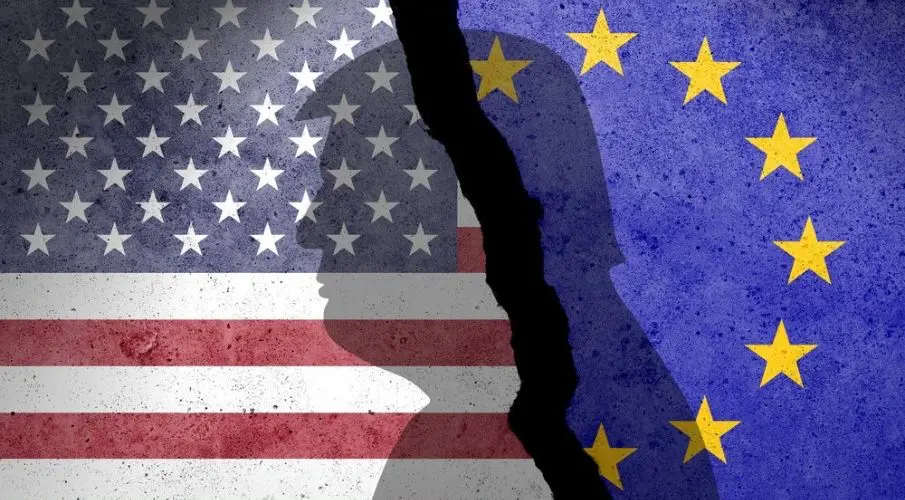
We wrote a few days ago about Trump’s new strategy paper and published the complete documents. For months we have been warning about the political direction from Washington and the roles of Russell Vought and E. J. Antoni, whose strong influences in this paper are unmistakable. For us, both were never names on the margins, but the central ideologues behind a course that openly challenges Europe. In Europe, this had been taken lightly, the media remained silent, research costs money after all. You can find the detailed article “America’s New Attack on Europe - Trump’s Strategy Paper Is a Declaration of War on an Entire Continent” at the link: https://kaizen-blog.org/en/amerikas-neuer-angriff-auf-europa-trumps-strategiepapier-ist-eine-kriegserklaerung-fuer-einen-ganzen-kontinent/ - and our articles: “The ‘Project 2025 Man’ Who Is Dismantling the State and the World - An Investigative Inquiry” - at the link: https://kaizen-blog.org/en/der-project2025-mann-der-den-staat-und-die-welt-demontiert-eine-investigative-recherche/ as well as our article: “Our Research Shows: The Project 2025 Architect With the Nazi Art Is Supposed to Control America’s Numbers” - at the link: https://kaizen-blog.org/en/unsere-recherchen-zeigen-der-project-2025-architekt-mit-der-nazi-kunst-soll-amerikas-zahlen-kontrollieren/
António Costa chose his words carefully, and yet there was an alarm tone in every sentence. The President of the European Council made it clear that Europe will not allow Washington to dictate which political forces will shape the continent in the future. The new security strategy of the Trump administration, a paper that Russia explicitly welcomed, attempts a balancing act between supposed partnership and political influence - and Europe knows exactly what is happening. Costa said it without detour: “Allies do not threaten each other with interference in domestic political decisions.” But that is exactly the common thread of this document. It portrays European states as wavering, as incapable of self-protection, as a project that can only survive with US correction. And between the lines is what is spoken in Brussels only with caution: a subtle alignment with Europe’s extreme right.

The strategy, which Russia immediately praised as “fully in line with our view”, is not a technical paper. It is a political signal. It criticizes Europe’s civil liberties, pokes at migration policy and claims that the continent faces “civilizational extinction”. It is exactly the wording that nationalist parties in Europe have used for years to sow doubt, divide societies and attack democratic institutions. Costa therefore warned that the United States has no right to tell European voters which parties are “good or bad”. The history of Europe knows the consequences of such interference. Those who want to protect freedom must resist the attempt to influence political decisions from Washington.
Fabian Zuleeg of the European Policy Centre put it even more clearly: the strategy will strengthen Europe’s nationalists - precisely those forces that want to weaken the EU from within. His assessment is not exaggerated. If Washington questions democratic institutions and at the same time supports political groups that work against the rule of law in Europe, then the transatlantic balance shifts. And Zuleeg put it in a sentence that will linger in Brussels: “Trump’s America is not an ally of Europe, but an opponent of its freedoms.” For many this may sound like an exaggeration. But those who read the strategy understand why this sentence is spoken.

The reaction from Berlin also left no doubt: the spokesperson for the federal government made it clear that the sharp tones against Europe are rejected. The talk of lacking freedom of expression is ideology, not analysis. Germany emphasized that political freedoms are core values and that Europe’s protective mechanisms are not to be judged by Washington. And yet the impression remains that the Trump administration prefers a Europe that is weaker - and more dependent.
At the same time, the war in Ukraine continues. Almost four years after the invasion, Washington is looking for a way to end the conflict. But in the strategy paper, something else takes priority: the United States wants to improve relations with Russia in order to restore “strategic stability”. For Moscow, this is a gift. For Kyiv, a warning sign. Costa expressed it clearly: this strategy is not aimed at a just peace, but at an end to the fighting - and at calm in relations with Russia. The problem is only this: Russia remains a threat, no matter how kindly the paper is worded. European intelligence services warn that Moscow could be ready in a few years to target another European country if Ukraine falls. The paper no longer even calls Russia a threat - a view that Berlin clearly rejects. Germany instead points to NATO’s joint assessment, which still classifies Russia as a long-term danger.
This leaves one conclusion: Europe sees a shift in American foreign policy that creates risks rather than reduces them. While the United States speaks of “stability”, Europe sees a power vacuum that Russia would gladly fill. While Washington speaks of “freedom threats” posed by Europe, European states face a real danger - in the form of a war happening on their doorstep. And while Trump claims in his strategy to want to strengthen allies, he mainly strengthens those forces that seek to undermine Europe’s cohesion.
The political situation is complicated. But one thing is clear: Europe has set boundaries for interference from Washington. And this step was necessary. Because the fight for the future of the continent will not only be decided in Kyiv - but also in the political spaces where Europe determines who speaks for it and who does not. Willingness to talk yes - but not at the price of its own sovereignty. Europe said it clearly today. And Washington should listen carefully.
Investigative journalism requires courage – and your support.
Support our work against right-wing populism, disinformation, and violations of human and environmental rights. Every contribution goes directly into our daily reporting – we operate without advertising, without subscriptions, without corporations, without political parties. Our journalism is meant to remain freely accessible. For everyone.
Independent – Critical – For Everyone
Thank you for making our independent work possible.
Updates – Kaizen News Brief
All current curated daily updates can be found in the Kaizen News Brief.
To the Kaizen News Brief In English


Vielen Dank für diesen Artikel. Leider sind die deutschen Medien mit vielen Informationen hinterher, oder machen sich nicht die Mühe, Dingen richtig auf den Grund zu gehen.
…dankeschön