
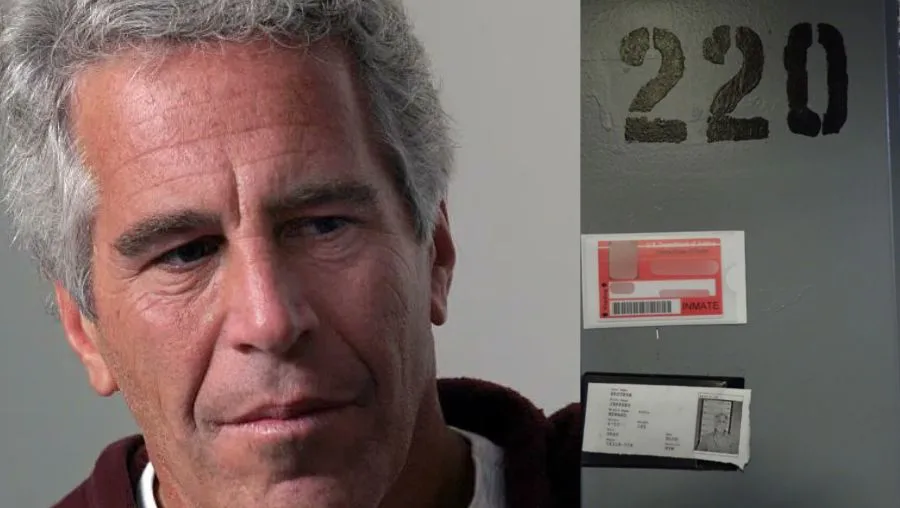
Editor's Note: Of the hundreds of autopsy photos of Jeffrey Epstein in our possession, we have deliberately chosen to publish only five images. Out of respect for the deceased and to protect our readers, we have decided not to publish the remaining photographs. Even in the five images we selected, we have covered the eye area with a black bar. The other autopsy photographs contain extremely disturbing details, some of which are very difficult to look at. Journalistic investigation does not justify publishing everything. Even the press's responsibility to inform the public has its limits. We respect those limits.

A deep mark on a dead man's neck cannot be questioned after the fact. It remains while authorities close their reports and the years go by. In Jeffrey Epstein's case, scientist Michael Freeman has identified an injury that has troubled him since he first examined the autopsy photographs: The ligature mark did not run evenly upward at an angle, as would be expected in a typical hanging. It was deep, irregular, and branched into a Y-shape on one side. Seven years after Epstein's death, an old question has taken on a new and uncomfortably precise shape.

Also read our major investigation: The release of new Epstein files confirms our investigation – Death in Cell 9 – Anatomy of an incident that never was an accident?
On August 10, 2019, the financier and convicted sex offender was found dead in his cell at a federal jail in New York. He was awaiting trial on sex trafficking charges. The medical examiner ruled his death a suicide by hanging. Several official investigations found no evidence that anyone else was involved. The overall circumstances that are known also point overwhelmingly to suicide. Freeman now challenges that conclusion using the very records on which the official determination was based.
For a full year, he examined the complete autopsy file that Epstein's brother Mark had given him in November 2025. On November 16, 2026, he presented his conclusions in London: The pattern and nature of the injuries could not be convincingly explained by a suicidal hanging. Strangulation by another person, probably from behind, was a better fit for the findings. Freeman does not identify a killer. Nor does he claim to have established who that person might have been.

His reconstruction is based on three-dimensional calculations, Epstein's body measurements, and photographs of his body. Freeman also used the belated account of the jail employee who discovered Epstein: The employee said Epstein's buttocks had been suspended approximately one inch above the floor. The man did not tell investigators this until two years after the death. Freeman interprets what he believes may be fingernail marks above the ligature mark, an abrasion at the base of the neck, and a fresh, deep hemorrhage in the left shoulder muscle as signs of a physical struggle. He considers the failure to test Epstein's fingernails for someone else's DNA a serious investigative failure.
The original investigation left behind a series of questions that can no longer be reliably answered. There are no photographs showing Epstein still hanging in his cell. The piece of cloth believed to have been used was not properly preserved as evidence; a different piece was provided for the autopsy. The medical examiner responsible, Dr. Kristin Roman, was not allowed to inspect the scene herself. The jail employee initially refused to speak with investigators. Evidence essential to a reliable reconstruction was missing from the very beginning.

Roman nevertheless reached a definitive conclusion. She told federal investigators there were no signs of a struggle. The body was pristine; neither bruises nor debris under the fingernails indicated a physical confrontation. The injury pattern did not look anything like strangulation, she said. Roman has since retired. Her former office continues to stand firmly by its determination that Epstein died by suicide.
Freeman's objection is therefore serious, but it is not proof of murder. Other forensic pathologists who examined some of the photographs also recognized that the mark on Epstein's neck was unusual for a hanging. Some nevertheless considered the images consistent with suicide. A single mark cannot tell the story of what happened on the night someone died. When the scene was poorly documented and crucial evidence has been lost, uncertainty grows in both directions. The investigations conducted so far have not identified a killer.
Freeman himself is not board-certified as a forensic pathologist in the United States. He does, however, hold advanced academic degrees in epidemiology and forensic medicine, teaches at universities, and has spent years studying errors in death investigations. He participated in a review of deaths in police custody in Maryland and consulted in the prosecution involving George Floyd's killing. His work on the disputed diagnosis known as excited delirium helped challenge its scientific foundations. His methods also drew sharp criticism.

Freeman worked on the reassessment with neuroscientist Itiel Dror and Swedish forensic pathologist Anders Eriksson. Dror studies how expectations can distort professional judgments. Eriksson participated in a government review of problematic expert findings in cases involving allegedly shaken infants. No scientific journal has yet accepted their Epstein research for publication. The researchers are still seeking publication following independent peer review.
Even the presentation of their findings became a controversy. Freeman was originally scheduled to speak at University College London. The day before the event, the university canceled the in-person presentation, citing possible implications for student well-being. The lecture was moved to Middle Temple, a legal society in London. Mark Epstein had previously shown the records to other specialists, whose names he declined to disclose. Their assessments had been inconclusive. Freeman gained access after journalists drew his attention to the unusual neck injury. That points to another weakness in the original investigation: Years later, a family member had to hand over the material so the official conclusion could finally be subjected to another thorough examination. Forensic medicine in the United States is also not a uniform process that produces infallible results. Even experienced specialists can reach different interpretations of the same injuries.
In London, Freeman called for his calculations to be examined against the evidence. That is precisely where the challenge for the authorities lies. They do not have to accept the certainty of a scientist whose conclusions make them uncomfortable. They do have to explain why their own certainty should still stand despite the absence of photographs from the death scene, a lost piece of evidence, and statements that remained incomplete for years. Stamping an official conclusion on a file does not make the truth about a death any more accurate.
Updates – Kaizen News Brief
Alle aktuellen ausgesuchten Tagesmeldungen findet ihr in den Kaizen Kurznachrichten.
To the Kaizen News Brief In English


