
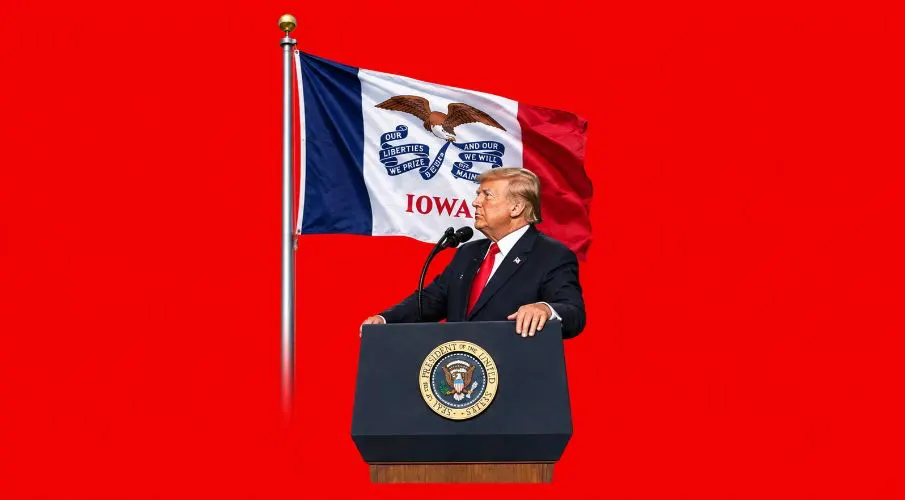
Dubuque (KB) - Donald Trump walks into the arena in Dubuque, Iowa, on November 1, 2026. The crowd cheers, and the president soaks up the applause. In 2 days, Americans will elect a new Congress. Republican candidates are fighting to keep their seats, gas prices are putting a strain on household budgets, and the war with Iran has long since become part of everyday life in America. Trump has other priorities this afternoon. He's going to talk about a war he supposedly could have won in 1 week. He's going to claim he got an island without its residents ever hearing about it. And he's going to explain why his own rambling is actually a sign of genius. The cameras are rolling.
Compilation of Donald Trump's at times disturbing appearance in Dubuque, Iowa. Almost all the statements and scenes described in this article can be seen in the video, in the order presented here.
The opening footage is filled with exclamations and a drawn-out noise that sounds like "Boom" in the clips provided. Trump turns the speech into a performance. His voice rises, his hands move along with his words. Then he delivers his verdict on his presidency so far: "I've done a great job. Prices are coming way down." America at the gas pump has its own way of measuring that. The price of a gallon of gas is displayed on an illuminated sign, and the money comes out of people's bank accounts afterward. Somewhere in between sits the satisfaction of a president who grades his own performance.

Iran comes up early. "At some point we're gonna have to give them the hammer," Trump declares. A hammer is a tool when you're building a house. In the hands of a president who commands airstrikes, the word takes on a different meaning. When that strike might happen, what targets he has in mind, and what the political consequences would be, Trump doesn't say in this clip. Just hours earlier, at Mar-a-Lago, he had already talked about being able to take out Iran's remaining targets in 10 minutes. Now he's standing in Iowa, where the consequences of the war have already reached the gas pumps. According to Trump, people should be patient about the higher prices. It's a small price to pay for the security of the United States, he says.
American farmers know the difference between a political speech and the cost of running their farms. They need diesel before they can even work their fields. At another appearance, Trump had mocked complaints about high oil prices: "They're gonna say, President Trump is bragging about how much money they're making while people are suffering at the gas pump. I don't give a damn. We're making a freaking fortune." The remark came from an earlier appearance and is not part of the video shown here. In Dubuque, he once again praises his economic policies. The fact that high prices mean profits for some and hardship for others gets lost somewhere among the enormous sums he throws at his audience.

Then the speech reaches Greenland. "Our acquisition for 0 dollars of Greenland. You know we got Greenland?" Trump asks the question as though he's talking about a purchase agreement that's already been signed and sealed. There is, however, no evidence that the United States has acquired the island. Greenland is an autonomous part of the Kingdom of Denmark. Its residents have political rights that cannot be erased by a particularly confident claim coming out of Washington. An island with its own people and history becomes, in the president's telling, a business deal in which the buyer didn't even have to pay.
He goes even further: "You know how long my deal is with Greenland? Infinite. Forever. What a deal." Even time itself has lost its usual limits in that sentence. A contract with no documented agreement, an acquisition with no purchase price, a term that never ends. For a real estate agent, that would be an extraordinary offer. For a president making claims that touch on another country's sovereignty, it carries foreign policy consequences. A government in Copenhagen cannot be replaced by applause from a crowd in Iowa.
"I called him Mohammed. I did it for certain reasons. I have the right to call you whatever I want. He's a disaster. He's a nasty guy. And hopefully he gets his ASS KICKED because that's what he needs." Exactly whom Trump is referring to in this passage cannot be established with certainty from the isolated clip alone. The words themselves are enough. The president claims the freedom to call a political opponent whatever he pleases and immediately connects that freedom to a wish to see the person humiliated. An office that represents the dignity of an entire nation to the outside world suddenly sounds like an argument in a parking lot.
Trump turns to American domestic politics. "Transgender for everybody," he shouts before warning about the Democrats. Then it's the farmers' turn. "Your farmers are dead if the Democrats get in. They hate farmers. Nobody has done more than farmers than Donald Trump." He refers to himself in the third person. This afternoon, that seems to be the appropriate distance from which to appreciate the full extent of his own accomplishments. Iowa is an agricultural state. Its farmers live with fluctuating prices and political decisions that can affect them well into the next harvest cycle. Trump offers them a simple equation: Without him, they're doomed. With him, prosperity is guaranteed. The war and current energy prices remain inconvenient factors in that calculation.
Next up is a flagpole. "I have a lot of flagpoles. I have them all over my place in Los Angeles. On the ocean, magnificent place. I call him Flagpole Jim. His whole life, that's all he does." The man Trump describes is given something resembling a royal title for a very specific line of work. The president is clearly delighted with his own flagpoles. The story goes on long enough for you to picture the property on the Pacific, complete with an ocean view and a man whose life's work apparently consists of putting up poles.
Then come those noises again. "Biiiing! Biiiing! Biiiiing! Hear yeeee! Hear yeeee! Hear yeeee!" Trump stretches out syllables, sends his voice through a series of strange turns, and gives a campaign speech the soundtrack of a carnival. On its own, that would be a harmless quirk of a speaker who likes putting on a show. Coming after Greenland and Iran, it leaves a different impression. Just moments earlier, the possible use of military force was the subject of the speech. Now a drawn-out ringing noise takes over. The same people applaud. Nobody asks for an explanation of where the thought actually went.
The president himself considers that question settled. He calls his method "The Weave," weaving stories together. "You tell a story, and while you're telling it, other stories come in that are connected to it," he explains. Then there might be the king of Saudi Arabia, some airplanes, a sequence of "ba, ba, ba," and eventually everything comes back to where it started. "There will be a time when I don't get to the end. Then you can say that's rambling. But the way I do it is fucking genius, okay?" Later he adds: "This isn't rambling. This is genius." A speaker awards himself the highest possible praise for a speech whose structure he just had to explain.

Mike Johnson, the Republican speaker of the House of Representatives, joins him. With Trump standing right beside him, Johnson talks about phone calls in the middle of the night. "The man calls me at 1 o'clock in the morning and also at 5 a.m." Then he imitates the president's voice: "Mikey, you sleeping?" He supplies the answer himself: "No, sir, of course not. Sleep is for sissies." The crowd laughs. Johnson realizes who's standing in front of him and apologizes: "I'm not going to do the impression in front of you now. I'm sorry, I didn't plan that." The powerful speaker of the House plays an exhausted employee who dreads the late-night phone call from his boss. Trump stands beside him. In Washington, Johnson needs the votes of his party's lawmakers. In Dubuque, a joke is enough to make the pecking order clear.
Then the camera turns back to Trump. He stretches out sounds, goes "Ahhh," and moves his body in ways that look peculiar in the footage. Nothing more can responsibly be concluded from the visible gestures. The president is at a campaign rally, and his movements are part of his performance. Any medical explanation would be made up. Still, the scene can be described without making excuses for it or exaggerating it afterward: A man who can make decisions about war spends part of his public speech making noises and contorting his body.
More Republicans are now on the stage. Zach Lahn is running for governor. Ashley Hinson is running for the U.S. Senate in Iowa. The candidates praise Trump and his policies. Hinson had previously become the subject of one of his digressions. "I've known Ashley for a long time, and she was a little heavier," he had remarked before praising her weight loss. He acknowledged that the comment might be inappropriate. The candidate faces a tough race against Democrat Josh Turek. The president nevertheless finds an opportunity to talk publicly about her figure. Later, the 2 exchange an awkward kiss on the cheek.
The election is closer than Iowa's Republican tradition might suggest. Trump won the state in 2024 by 13 percentage points. Republicans have about 180,000 more registered voters. Even so, the Senate seat and several congressional districts are fiercely contested. Zach Nunn and Mariannette Miller-Meeks are also campaigning for votes. Both have now backed a resolution intended to limit Trump's powers in the war against Iran, after previously opposing similar measures. In Dubuque, they nevertheless appear at his side. Mike Johnson praises the Republican candidates. Voters are supposed to see a united party, even though its lawmakers have already publicly fought over the president's authority.
The candidate praising Trump onstage had herself warned against a Democratic Senate under Chuck Schumer. In front of the television cameras, Republicans try to portray election night as a decision about the country's future. Outside, protesters stood holding signs. "Elect a clown, expect a circus," one read. Inside the arena, protesters were repeatedly shouted down and escorted out. Trump claimed, without presenting evidence, that they were paid agitators. "I could use a little love," he said. Behind him sat a man wearing a T-shirt that read "I love ICE." When Trump addressed one protester, he followed up with an insult: "You're a stupid person." The dissenting voice disappeared beneath the shouts of the rest of the arena.
Toward the end, Trump turns his attention once again to Kamala Harris. "Caaaameealaaa, Koomaaala, Kamaleeee, Kumalaaaa." He twists her name until the former vice president has been reduced to a string of sounds. It's a tactic familiar from schoolyards. Twisting someone's name is supposed to belittle them without having to engage in any actual discussion. In Dubuque, it happens in front of cameras and people who are about to decide the future makeup of the American Congress. Harris isn't standing on the stage that afternoon. Her name is still enough to get another round of applause.
Then the speech is over. Trump dances on his way out, as he has at previous appearances, moving his arms in front of his body to the music. The clip ends with a president saying goodbye to his audience. He had already delivered his own verdict on the speech. Genius. Not rambling. In between came the supposed acquisition of Greenland for 0 dollars and the threat against Iran. The audience got to hear how a political claim with no evidence behind it becomes a certainty the moment the president says it loudly enough.

Outside the arena, the president's advance team had attempted another intervention. On the exterior wall of the Five Flags Civic Center is a mural called "Solidarity" by artist Shelby Fry, measuring roughly 105 feet in length. It features 10 raised fists in different skin tones alongside the word "Solidarity." The city commissioned the artwork in 2020 following the protests over George Floyd's death. 80 volunteers helped paint it. Ahead of Trump's visit, a tarp was placed over it. According to the venue operator, the order came from Trump's advance team, which wanted to put up an American flag. City officials said no request had been submitted or permission granted for such a change to the building's exterior. They ordered the tarp removed.

The history behind that mural goes back much further than the latest election campaign. In the late 1980s and early 1990s, Dubuque experienced racist intimidation, including cross burnings surrounding the appointment of a Black school principal. Former Mayor Roy Buol recalled that history when the mural was created. The raised fists were meant to remind people that a city is made up of human beings whose dignity does not depend on the applause of a majority. The mural could be covered temporarily for a campaign event. The visitor was not allowed to remove it permanently.
While Trump spoke inside the arena about his administration's supposed successes, high gas prices remained a campaign issue. The president pointed to the security interests of the United States and promised falling prices. Many Americans associate the costs with the war against Iran. His approval ratings also put limits on his self-portrayal: A published polling average showed 37% approval and 60% disapproval. Trump countered with his packed arenas. In his calculation, people who want tickets to see him somehow make up for the people who disapprove of him.
The president had also claimed that the press should face criminal prosecution for unfavorable polls. He described media outlets reporting on his unpopularity as a major danger to the country. Such demands raise a more serious question than where his sound effects come from. A democracy has to tolerate the publication of numbers that those in power don't like. Elections test precisely their ability to accept the result. Trump demands trust in his own claims and threatens those who present different numbers. The space between those 2 things is the freedom to criticize him.
On November 3, Americans will decide who represents them in Congress. In Iowa that Sunday, real seats were at stake, along with the cost of the war and the question of just how far a president can extend his power. Trump talked about the infinite duration of a Greenland deal that never happened. He declared his noises an art form and his speech an act of genius. Then he danced out of the arena. Outside, the 10 fists were visible on the wall again. Above them was the word someone had tried to cover up before his visit: Solidarity.
Midterms: As of November 2, 2026
With 1 day to go before the American congressional elections, Democrats are leading in national polls. The RealClearPolling average puts Democrats at 51.8% and Republicans at 43.3%, a lead of 8.5 percentage points.
Among the most closely contested Senate races are Alaska, where Mary Peltola faces Dan Sullivan, and Iowa, where Josh Turek is running against Ashley Hinson. In Texas, Democrat James Talarico holds a narrow lead over Republican Ken Paxton in the latest polls, while Sherrod Brown is ahead of Jon Husted in Ohio. Maine, with Susan Collins and Janet Mills or the Democratic challenger, Michigan, with Abdul El-Sayed and Mike Rogers, and North Carolina, with Roy Cooper and Michael Whatley, are also among the key races.
Republicans currently hold a 53-47 majority in the Senate. Under the current balance of power, Democrats need a net gain of 4 seats to take control. In the House of Representatives, control will be determined by the distribution of its 435 seats. The polls show a clear nationwide lead for Democrats, while the battle for the Senate is much closer.
To be continued…
Updates – Kaizen News Brief
Alle aktuellen ausgesuchten Tagesmeldungen findet ihr in den Kaizen Kurznachrichten.
To the Kaizen News Brief In English


