
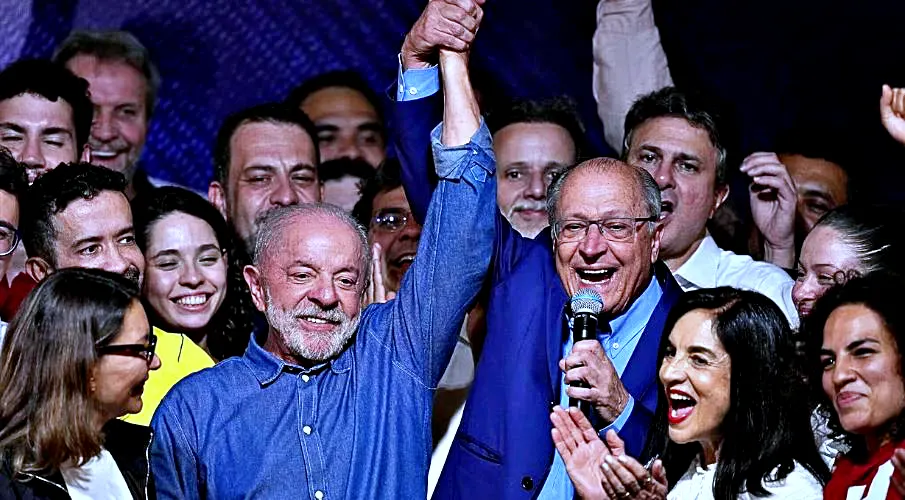
Brazil's Superior Electoral Court has spoken. Luiz Inácio Lula da Silva has been reelected, the votes have been counted, and the margin is nearly 4.4 million. Lula received 51.8 percent, Flávio Bolsonaro 48.2 percent. The officially certified result stands. Yet the defeated senator steps before the public and demands that the election be annulled. The people voted, the state counted. Now the verdict is supposed to disappear because the loser doesn't like it. Paper can be torn up. Millions of votes cast still carry their weight.
The reasoning offered by Jair Bolsonaro's son is particularly contradictory. On October 25, 2026, polling places were kept open for an additional 2 hours at short notice. Bolsonaro calls the decision unprecedented, describes it as an improper intervention, and refuses to recognize Lula's victory. His own campaign team had also requested the extension. When heavy rainfall in the south of the country made voting difficult, his camp demanded more time for voters. Lula's team pointed to bus problems in São Paulo and Salvador. Both sides wanted the extension. Only 1 side declared it grounds for throwing out the entire result after losing.
The judge responsible, Cristiano Zanin, ordered the additional hours 3 minutes before voting was scheduled to end. That created logistical problems. In Brasília, election workers were temporarily unsure which instructions applied. In Rio de Janeiro, voting machines had already been shut down and could not be restarted after the last-minute decision. How many polling places actually stayed open longer was initially unclear. The vote count was delayed by 2 hours. These events demand a thorough investigation. But it does not follow that millions of valid votes should therefore be declared meaningless.

Bolsonaro's ally Nikolas Ferreira pointed to Zanin's previous work as Lula's attorney. The point is politically explosive, but it is no substitute for evidence of a manipulated vote. When demanding an annulment, the crucial question remains which errors supposedly affected the result and to what extent. A mere allegation does not overturn an officially certified election result. The defeated candidate has legal avenues available to him. Until a competent authority decides otherwise, Lula remains the president-elect. Bolsonaro's refusal changes nothing.
At the beginning of the month, the political landscape looked very different. In the 1st round, Flávio Bolsonaro had finished more than 2.2 million votes ahead of Lula. The president had to fight for reelection, and the polls left the outcome uncertain. He changed his campaign strategy, worked harder to win support among young people, and called for the defense of democratic rights. Large rallies marked the final days before the runoff. In the end, for the first time since Brazil's military dictatorship ended in 1985, the candidate who had finished 2nd in the 1st round won the election. Voters have the freedom to make a different choice the next time around. Political family inheritances cannot be claimed at the ballot box.

In São Paulo, people celebrated on Avenida Paulista as fireworks lit up the night. Car horns could be heard all the way down the side streets. Lula kissed his wife, Rosângela da Silva, while supporters cheered his victory. On the streets of Rio de Janeiro, a woman dressed in red shouted at men wearing the yellow and green colors of the Bolsonaro movement that they had lost and should keep crying. The scene was crude. The statement was accurate. At the ballot box, neither family traditions nor ties to foreign presidents count for more than the vote of a single citizen.
Lula's victory comes at a time when Donald Trump is aggressively expanding his political influence in Latin America. In several countries, right-wing candidates with close ties to Washington had recently won elections. Flávio Bolsonaro would have brought another ally into the presidency. His father, Jair, has been a political ally of Trump for years. The American president put pressure on Brazil, including through higher tariffs. Lula openly stood up to him. Brazil's economy generates around $2.6 trillion a year. This country has enough weight to decide for itself what place it wants to occupy in the world.

With Lula, Latin America's other most populous nation, alongside Mexico, remains under left-wing leadership. For Trump, that means a defeat for his political allies. For Brazil, the election result determines its own future. Washington may expect political obedience. Brazilian voters never signed up for any such obligation.
The campaign itself was bitter and shaped by very real fears. High food prices weighed on millions of households. Crime remained a major issue. Bolsonaro promised tougher security measures and a lower cost of living. Lula emphasized government assistance programs and his experience as president. Both political camps also had to contend with corruption allegations involving relatives or allies. Rodrigo Valentim, a 51-year-old businessman and Bolsonaro supporter, said after the result that he could not understand the decision to vote for Lula; the country was falling apart. His voice represents those millions of Brazilians who reject the winner. Their right to object remains intact. That does not give them the right to invent their own election result.
Lula began his political career in the 1970s as a union organizer and later helped found the Workers' Party. After several unsuccessful attempts, he first won the presidency in 2002 and won again in 2006. He was succeeded by Dilma Rousseff, who was elected in 2010 and 2014. She lost office in 2016 following impeachment proceedings over alleged violations of budget laws. The sweeping corruption investigations of those years also reached Lula. He spent 580 days in prison. Brazil's Supreme Court later overturned his convictions; messages that came to light had raised serious doubts about the impartiality of the judge who had presided over his case.
In 2022, Lula narrowly defeated Jair Bolsonaro. The former president was later convicted of attempting a coup in connection with that defeat. Now his son Flávio entered the race. The family name promised political continuity, and Trump's support gave him an additional boost. But the attempt to return the family to power failed to win a majority. Flávio Bolsonaro's demand for annulment now gives this election night a troubling historical edge. In a country that only left military dictatorship behind in 1985, accepting an election result should not be a matter of personal generosity.
Lula is heading into a 4th term, beginning January 5, 2027. He will be 81 years old by then. Along with Donald Trump and Nicaragua's President Daniel Ortega, he ranks among the oldest heads of state in the Americas. During his upcoming presidency, 4 seats on the 11-member Supreme Court could also become vacant and need to be filled. The next few years will therefore have consequences reaching far beyond ordinary government policy. Economic worries do not disappear with an election victory, and public safety cannot be delivered through applause. Lula bears responsibility for the challenges facing the country.
Flávio Bolsonaro, meanwhile, has still not acknowledged his defeat. His demand for annulment remains a political demand that can be reviewed in court; the official certification of the winner remains unaffected. What makes his position particularly serious is that he is attacking an extension of voting hours that his own camp had previously requested. A democratic process can contain errors that are for the courts to address. It does not lose its validity simply because a candidate finds the outcome unbearable. Lula won the election. The Superior Electoral Court certified his victory. Flávio Bolsonaro wants Brazil to forget that decision.
Updates – Kaizen News Brief
Alle aktuellen ausgesuchten Tagesmeldungen findet ihr in den Kaizen Kurznachrichten.
To the Kaizen News Brief In English


