
A signature is the smallest expression of free will a person can put on paper. A name, a line, a yes. Refuse to sign, and you hold on to something that belongs to you. At least, that's how it was supposed to work. At 3 a.m., an officer wakes Dolores Freixa at the Eloy immigration detention center in Arizona. Pack your things. Nobody tells her where she's going. The desert is still dark when the bus pulls away, carrying about 40 men and 1 other woman. The men say they've voluntarily agreed to return to Mexico. Freixa, the only Cuban on board, hasn't signed anything. The bus heads for the border anyway. There, a trip with no stated destination is supposed to become a voluntary departure.

At the border, she refuses to get off the bus. An officer shows her a voluntary departure form and asks whether the signature on it is hers. She says no. The document already bears a signature that, according to Freixa, isn't hers. Again and again, she demands to be taken back to Arizona. Eventually, they take her back to Eloy. Not everyone held out. Immigration attorney Liudmila Marcelo describes a client who refused to get off the bus. Others got off and, by doing so, accepted their deportation. People were repeatedly asked to sign documents. Yet in February, a court in Massachusetts had prohibited deportations to third countries without prior notice and an opportunity to challenge the removal. Despite that ruling, ICE continued attempting to take people to the Mexican border without adequate warning, according to consistent accounts from detainees and attorneys. Transfers from one detention facility to another. Documents nobody understands, accompanied by warnings of worse consequences if someone refuses. On nights like these, the meaning of voluntary comes down to how much pressure a person can withstand.
Freixa's return to Eloy remains an exception, and her protections are growing weaker. The United States Supreme Court has allowed deportations to third countries to resume. The Department of Homeland Security expressly denies pressuring people to leave voluntarily. Investigations paint a very different picture. When asked about specific cases, a spokesperson for the U.S. Department of Homeland Security (DHS) demanded the names and dates of birth of those involved. When that information was withheld, he attacked the journalists' work. We were threatened with severe legal action.
How did a woman end up on that bus? Freixa came to the United States in 1980 at age 11 during the Mariel boatlift. In 2015, she was arrested on charges including burglary and theft, with fraud-related offenses also on her record. After serving her sentence, she went straight into immigration detention in early 2026. Like many Cubans, she had been allowed to live in the United States under government supervision because Cuba would not take her back. She had to report to ICE. As long as she followed the rules, she could apply for a work permit. For decades, a known address and regular visits to the authorities were part of an orderly life. Today, that very address makes her easy to find. Obedience leaves a trail, and that trail leads straight to the door.
Cuba refuses to take back many of its own citizens. Washington has found a way around that: Other countries are supposed to take in people whose lives have been rooted in America for decades. More than 25,000 people have already been deported to 29 countries, often to places they don't even come from. Among the cases recorded through May, Cubans made up the largest group. Most were sent to Mexico. Their relatives live predominantly in Florida. At the border, a son in Miami carries less weight than a form. Between June 2025 and July 2026, the United States deported 427 Cubans over age 60 to Mexico, according to figures obtained through Freedom of Information Act requests. A country where they grew old sends them to one that owes them nothing.
Our Investigations Since April 2025: The Invisible Exodus Continues
"From the edge of an America that no longer recognizes itself - and sent a cold shiver down our spines."
It doesn't begin with a bang. No marching music or television footage of sections of a wall. It begins in the dust. In the barely visible imprint of a bare foot disappearing into the sand along the border. In the changing routes of desperate people who can no longer pass through official crossings - because those crossings have long since become places where they fall prey to others. Donald Trump's second presidency has created a humanitarian vacuum measured in cold logic and dry dust. The tragedy is marked not by the screams of its victims - but by their disappearance.
Since February 2025, the movement of Central American refugees has entered a new phase. The old routes - through Tapachula, Reynosa, Ciudad Juárez - have become traps. Migration agreements with Mexico, once labeled "cooperation," now function as a system of automated deterrence. Migrants are no longer simply fleeing - they are fleeing from the act of fleeing itself. A silent catastrophe with a deadly geometry.


Beyond the official routes, beyond the bus lines, NGO directories, and border stations, new paths slither through the hellscape of the Sierra Madre, through jungles, riverbeds, and industrial zones – often without water, without direction, without destination. These paths are no longer trails, but calculations of death.
According to independent observers, the mortality rate along these so-called "alternative routes" exceeds 70 percent. Exhaustion. Dehydration. Violence. Disappearance. Refugees die before they ever get the chance to whisper the word "asylum." Yet while Trump's America boasts that it has "the border under control," people on the other side who refuse to stand by are organizing: international journalists, courageous NGOs, a network of migrant advocates that pulses like the last living nerve through a dead body of government. Together with individuals in states such as Oaxaca, Chiapas, and Baja California, they save whoever they can. They warn, they hide, they provide help.


Often at great personal risk. Because in Trump’s America, offering help has long been criminalized – and increasingly so in Mexico as well.
The murderous efficiency of Washington’s migration policy rests on a quiet complicity with Mexican authorities. Officially, Mexico denies any "active participation" – but the reality at bus terminals and checkpoints tells a different story.


Buses carrying migrants are routinely stopped in Guadalajara, Monterrey, or San Luis Potosí, allegedly for "identity verification." Many of the passengers then vanish without a trace. What happens to them, no one knows. Some resurface in camps, others no longer appear in any database at all.
Villahermosa
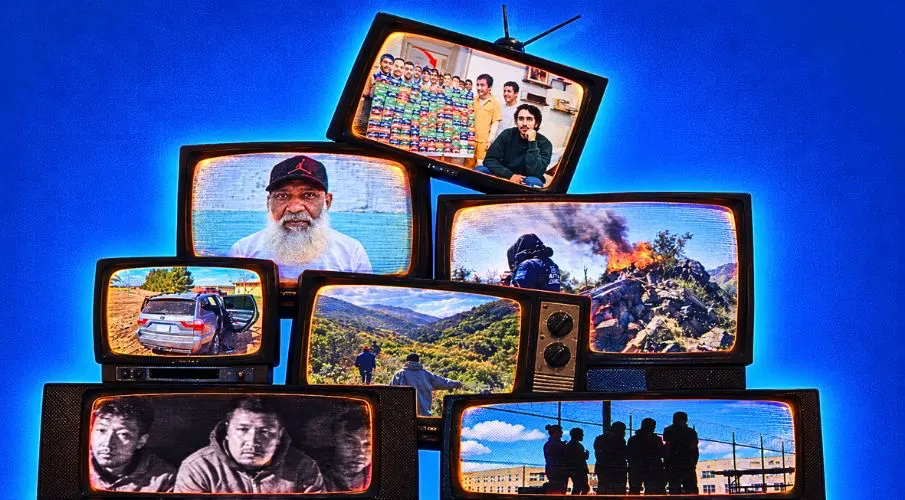
One of them is sitting in Villahermosa, more than 1,800 miles south of the American border, outside a shelter for sick people and migrants. Fidel Forten García, 66 years old. His long white beard has been growing since the day he was arrested. A calendar that doesn't lie. He lived in Phoenix for more than 40 years and worked as a mechanic. His 2 children were born there in 1987 and 1989. Following earlier convictions, he had been living an orderly life again since his last release from prison in 2016. Once a year, he reported to the Department of Homeland Security. He had just begun his retirement. His retirement benefits hadn't yet been paid.

In June 2025, he encountered local officers in a parking lot. The accusation: a baggie containing cocaine residue. After a week in the Maricopa County Jail, the case was dismissed. ICE was waiting at the door to freedom. He then spent 90 days in Florence without seeing a judge. He, too, was supposed to sign a document, this time agreeing to deportation to Mexico. He refused. They put him in a vehicle anyway, his hands and feet shackled. One fellow detainee, he said, had been chained naked to a metal pipe so tightly that he could barely breathe. In Nogales, the shackles came off. Mexican authorities transported the men by bus to Tabasco. Nobody needed his consent.
According to its director, Josué Martínez Leal, the Amparito shelter in Villahermosa has already cared for 294 elderly Cubans since March 2025. Many suffer from chronic illnesses. Few have valid identification, and hardly any have money they can actually access. None of the 12 men interviewed still had regular access to their American bank accounts. Cuts to aid programs and U.S. development assistance have reduced already scarce services even further. In this heat, even a glass of water has to be arranged.
A Cuban man with pancreatic cancer waited months here for treatment. He died in the hospital on February 24. Martínez Leal called his family. Filiberto García, 61, speaks of bipolar disorder and high blood pressure. He says he suffered a stroke while detained at the Krome detention center in Miami. He arrived in Mexico in a wheelchair that he had received back in Florida. He says he can no longer access his bank funds or Social Security benefits. He believes he was deliberately deported to save the government the cost of retirement and health benefits. That has not been proven. The fact that he has been left without the means he depended on is devastating enough.

Read also our article: Hell on Earth – The Krome Deportation Center in Miami
Paperwork also determines life and death in a more literal sense. In 2025, at the urging of the Department of Homeland Security and the government cost-cutting agency under Elon Musk, living people were entered into America's death records. In April of that year, 6,300 such entries became known. Once someone is entered into that file, access to government benefits can disappear. The White House defended the measure by referring to migrants with criminal convictions and people it called suspected terrorists. A connection to the frozen accounts of deported Cubans has not been established. A person can die on paper while still breathing.
Forten García knows what long journeys mean. Born in Havana after the revolution, he trained as an automotive electrician. His criticism of the lack of job opportunities reportedly brought him under government suspicion. In 1980, he left through the port of Mariel with approximately 125,000 others, passing first through reception camps in America and eventually making his way to Phoenix. His convictions are part of his history. So are more than 40 years of work and 2 grown children. Yet his face appears on a list of supposedly dangerous immigration detainees. Authorities also include people on that list whose risk had previously been assessed as low or moderate. A list knows nothing about a life. It knows columns.
His sons send money to pay for a small room near Amparito. He also uses it to buy the medication he has needed since his thyroid was removed in 2009. Mexico initially allows some deportees to remain for 10 days. After that, they must begin an asylum process on their own. Nothing is guaranteed; according to the available figures, only about 3 percent of asylum applications there lead to permanent residency. Regular check-ins are required, and travel outside the state where the application was filed is restricted. Checkpoints block the route north. Forten García wants at least to move closer to the border so he can see his sons. His way home consists of documents nobody will issue.
People taken to Mexico often have no reliable shelter or medical care. Human rights observers describe dangers from extortion and human trafficking. In August, Cubans from South Florida were even deported to Africa, in some cases to countries the U.S. State Department itself warns against because of violence and insecurity. Immigration attorney Andrea Jacoski points out that U.S. law permits deportations to third countries, but the receiving country must be safe. Washington also talks about safe countries. According to the Department of Homeland Security, those who voluntarily return to their home countries receive a free flight and $3,000. The agreement with Mexico remains hidden from the public.

Demonstration outside Richmond International Airport in Henrico County, Virginia, September 19, 2026
While Forten García waits for Mexican documents, Yang Jie (a pseudonym used to protect his identity) is waiting in Virginia for a Chinese passport. The government that demands signatures has lost his document. He came from Shanghai in 1998 with his parents when he was 11 years old. He became a cook, then a computer science student. Later, he worked as a computer engineer and bought his own house. Earlier convictions were behind him after he had served his sentences. When he returned from a family visit to China in 2023, border officers at Washington Dulles Airport confiscated his green card because of his criminal history and initiated deportation proceedings. In July 2025, he was arrested outside his home.
ICE has held him at the Farmville immigration detention center for more than 450 days. He lost his case in July 2026, and according to the agency, his final deportation order is dated July 1. Yang Jie prepared himself for a country he has barely known since childhood. His parents, both over 70, sold his house and closed his American bank accounts. He started learning Chinese again. Then, he says, ICE told him his Chinese passport had been lost. Without valid travel documents, he could not leave. The agency remained silent about what happened to his passport, stating only that he would remain detained until his deportation. He isn't allowed to stay. He can't leave.
88 men sleep in his room, on 44 bunk beds. They share 9 telephones, and every call has a time limit. Still, every Sunday, Yang Jie calls his friend Patrick Beverly. The 2 have known each other since 2015, when they worked at a restaurant in Richmond, and for years they've played in a fantasy football league in which each participant builds a team of real players. Beverly sends handwritten player lists to the detention center, now running more than 10 pages before the season begins. At least those papers make it through. On Tuesdays, they go over the results. Yang Jie is missing from the screen, but he's kept his place in the league.

In Patrick Beverly's apartment on September 24, 2026, a handmade board displays photographs of the participants in his fantasy football league and the players they've selected.
Beverly visits him as often as he possibly can. He has a life-size cardboard cutout of his friend at home. He has preserved an image of a man whose passport, according to the authorities, has disappeared. Yang Jie says other detainees have to leave their children and spouses behind. He considers himself lucky.

Dolores Freixa was supposed to sign a declaration she had never agreed to. Fidel Forten García refused to sign and was taken away anyway. He measures the time he's lost by the length of his beard. And in Virginia, an engineer remains locked up because the agency trying to deport him has, according to his account, lost his passport. A signature was once supposed to be the smallest expression of free will. For this government, it's a form it fills out even without the person.
Our investigations reveal what happens behind these deportations. People who have lived in the United States for decades are taken to countries with which they have no personal connection whatsoever. Some lose access to their own money, while others remain in detention because essential documents are missing. Seriously ill elderly people end up in Mexican shelters, far from their families. Washington can move people across borders. That doesn't mean the decades they spent building their lives somewhere simply disappear.
Updates – Kaizen News Brief
Alle aktuellen ausgesuchten Tagesmeldungen findet ihr in den Kaizen Kurznachrichten.
To the Kaizen News Brief In English


