
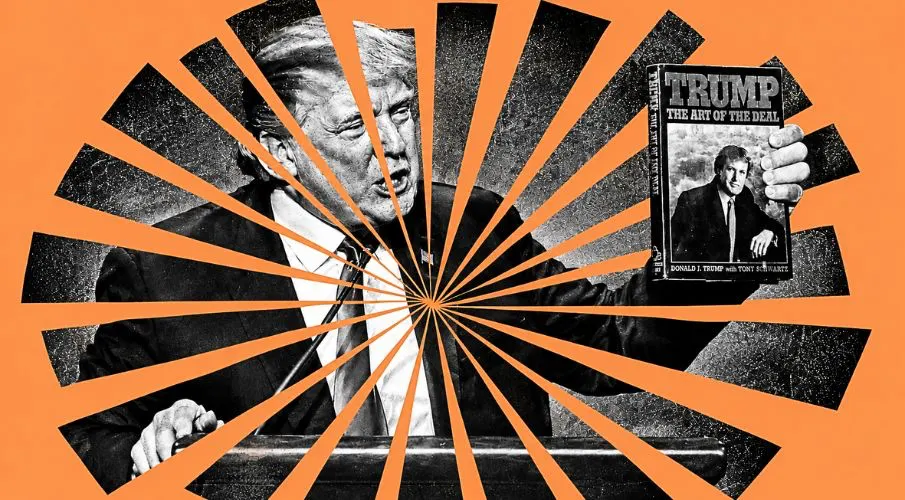
In 1984, Donald Trump figured he needed just 90 minutes to learn everything there was to know about missiles. After that, he believed he could negotiate better arms control agreements with the Soviet Union than Ronald Reagan. Trump was 38 at the time. His tower was already standing, but his book "The Art of the Deal" wouldn't come out until 1987. His certainty that he was fundamentally superior to everyone else was already fully built and ready for occupancy. Today, 42 years later, the same man is still explaining the world to everyone. The trouble is, missiles don't disappear just because someone waves a real estate brochure at them.
His most famous promise concerned Ukraine: He would end Russia's war in a single day. Instead, Trump announced a ceasefire covering energy facilities in October, which, according to Ukrainian officials, Russia failed to honor. The agreed-upon pause never happened. Trump insisted the agreement stood and essentially argued that it was valid because he had said so. While Washington celebrated an agreement, Russian weapons kept striking. Paper can put up with anything. Electrical substations, not so much.

Iran, too, was supposed to be defeated within a matter of weeks. Trump later boasted about a "great" ceasefire that quickly fell apart. Tehran was desperate to reach an agreement, he repeatedly insisted. That supposed willingness to negotiate never materialized. Christopher Preble of the Stimson Center considers Trump far less skilled than Trump himself believes. Presidential power can make threats credible. It doesn't automatically make the other side give up its own interests willingly.
Trump's tariff policy provides another receipt. He promised the best trade agreements ever and slapped unilateral import duties on large parts of the world. Canada was hit, too. Trade disputes followed, and American consumers paid higher prices. By September, more than $83 billion had flowed into the Treasury this year, considerably less than Trump had promised. Even the Reflecting Pool in front of the Lincoln Memorial turned into an expensive lesson. A supposedly outstanding contractor was going to fix it for a little over $1 million. The cost has since climbed closer to $20 million.
The origins of this self-assurance lie among the gambling tables of Atlantic City. In 1991, the Trump Taj Mahal sought bankruptcy protection. Trump Castle and Trump Plaza followed in 1992, along with the famous Plaza Hotel in New York. In 2004, Trump Hotels and Casino Resorts had to seek court protection, followed by Trump Entertainment Resorts in 2009. Six corporate bankruptcies in less than 20 years. Trump himself never filed for personal bankruptcy. His companies used Chapter 11 of the U.S. Bankruptcy Code to renegotiate their debts and keep operating. That distinction is legally important. It does little to change the story of the supposedly infallible businessman.

By 1992, the Plaza Hotel in New York had accumulated roughly $550 million in debt. Trump handed creditors a 49 percent ownership stake. The Taj Mahal had barely opened before its financing collapsed under the weight of its debts. By 2004, the hotel and casino company was carrying around $1.8 billion in liabilities. Trump lost a substantial portion of his ownership stake. He had learned how to spread losses around in negotiations with creditors. His reputation as a winner survived an astonishing number of defeats.
Trump himself later spoke with surprising openness about how bankruptcy laws had helped him shed debt. In business, he left bills unpaid and took disputes to court. Over 40 years, he was involved in more than 4,000 legal proceedings. Negotiation expert Marty Latz describes this approach as a deliberate use of power: A financially weaker opponent might accept a bad settlement simply because they cannot afford to fight a lengthy court battle. Barbara Res, formerly responsible for Trump's construction projects, describes how lawsuits could financially grind down his opponents. Even a questionable bill can turn into a good deal for the stronger party if the weaker one is forced to give up first.

On October 16, 1973, the New York Times reported on a lawsuit filed by the US Department of Justice against the Trump Management Corporation. The allegation: systematic discrimination against Black rental applicants in housing complexes in Brooklyn, Queens and Staten Island. More than 14,000 apartments were part of the company’s portfolio at the time. The defendants were Donald Trump, then president of the company, and his father Fred C. Trump as principal responsible party. The government accused the company of denying apartments to Black applicants or imposing different conditions than on white tenants. The basis was the Fair Housing Act of 1968, which prohibits discrimination in the housing market. Trump rejected the allegations and spoke of unfounded accusations.
In 1975, the case ended with a settlement. There was no admission of guilt, but a commitment to refrain from future discrimination and to implement measures to ensure equal treatment. The date remains documented. The allegations as well. It is part of the early history of a man who later became president. Anyone who today speaks about rhetoric, about “Law and Order” and about alleged fairness cannot ignore these files.
Res also recalls a more subtle technique. Before negotiations, she would ask business partners to start by quoting a slightly higher price. Trump could then talk them down and feel superior. His need to come out on top every time, she said, prevented him from making necessary concessions. He was particularly successful when the other side had little room to maneuver. Of course, countries and their wars are harder to control than a contractor whose invoice has been sitting unpaid for months.
In 2004, the television show "The Apprentice" gave this business career a glossy new setting. Trump got to play the wealthy businessman who decided other people's fates. Media scholar Joel Penney explains that some viewers hoped Trump's success would somehow rub off on America. Television showed the man in charge of making decisions. His creditors were usually somewhere outside the camera frame.
The president himself described his approach in remarkably simple terms. He would set his sights as high as possible and keep pushing until he got what he wanted. A businessman can always switch to another negotiating partner. A president negotiating with Russia over Ukraine or with Iran over a war cannot simply swap out reality when it raises the price of his demands. Latz points out that military superiority does not necessarily guarantee negotiating power. Trump once understood that distinction quite well. Now he occupies the most powerful office in the world and treats its authority as though it has already bought him every signature.

It is an unassuming sheet of paper, little more than a few lines, hastily noted, almost casual. Yet within these lines lies a political detonation. The United States Department of Justice could no longer avoid releasing a handwritten note by then-FBI Director James Comey, dated September 26, 2016 – six weeks before the election that brought Donald Trump into the White House. The document, now filed as “Government Exhibit 13” in an ongoing case on November 3, 2025, shows that U.S. authorities already had indications at that time of two explosive facts: possible financial ties between Trump and Moscow – and coordinated Russian attacks on American voter databases.
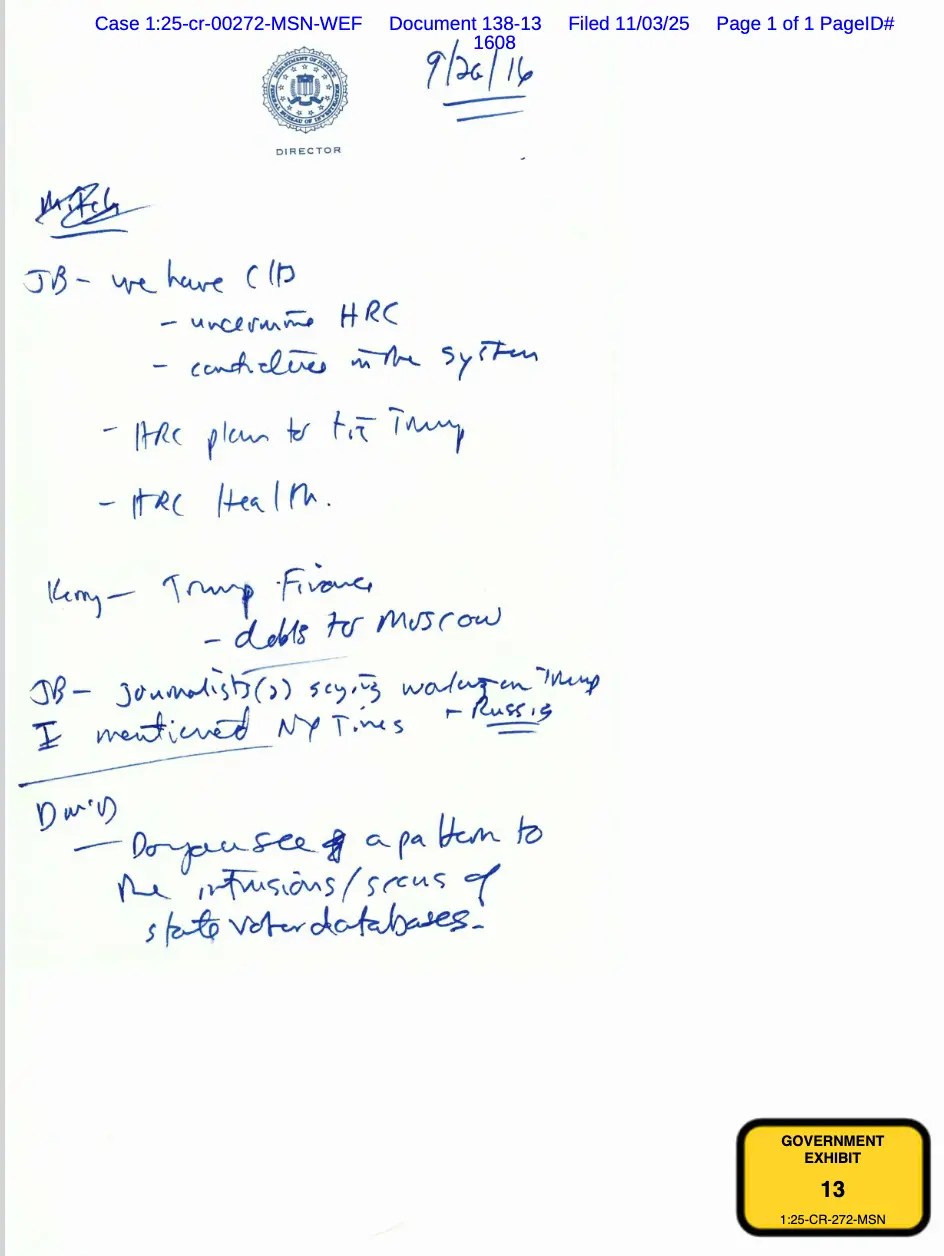
JB – We have CID (likely the Counterintelligence Division)
– Uncertainty about Hillary Clinton
– Contractors have access to the system
– Hillary Clinton plans to hit Trump
– Clinton’s healthKerry – Trump finances
– Debts to MoscowJB – Journalist(s) say they are working with Trump
I mentioned the New York Times – RussiaDurbin – The Department of Justice should examine a pattern in the intrusions and scans of state voter databases
Inside the White House, the old reputation continues to be polished. Spokesman Matthew Middleton points to nearly 20 trade agreements and announced investments worth trillions of dollars. Trump claims credit for successes in prescription drug prices and American manufacturing. Even Republican Senator Tim Scott celebrated the short-lived ceasefire with Iran as yet another triumph for the great dealmaker. Karoline Leavitt and Commerce Secretary Howard Lutnick publicly promoted that title as well. Interior Secretary Doug Burgum joined in the praise. Trump's actual record does include the Abraham Accords and a ceasefire agreement between Israel and Hamas, even though violence in Gaza continued. Talks on civilian nuclear energy cooperation with Saudi Arabia are still in their early stages. An agreement to develop Venezuela's oil reserves may take years before its promised benefits can be demonstrated. Announced investments are not factories that have actually been built.
Tim O'Brien, who has examined Trump's business career, describes unpredictability as a negotiating method: Trump creates disorder and then offers to bring it to an end. The book that made him famous was written with Tony Schwartz. Schwartz later even questioned whether Trump had read it. Negotiation expert Latz now sees a president who confuses the power of his office with actual influence at the negotiating table. On November 3, Americans will also pass judgment on that record. What will be decided then is how far a reputation can carry someone when the results have long been telling a very different story.
Updates – Kaizen News Brief
Alle aktuellen ausgesuchten Tagesmeldungen findet ihr in den Kaizen Kurznachrichten.
To the Kaizen News Brief In English


