
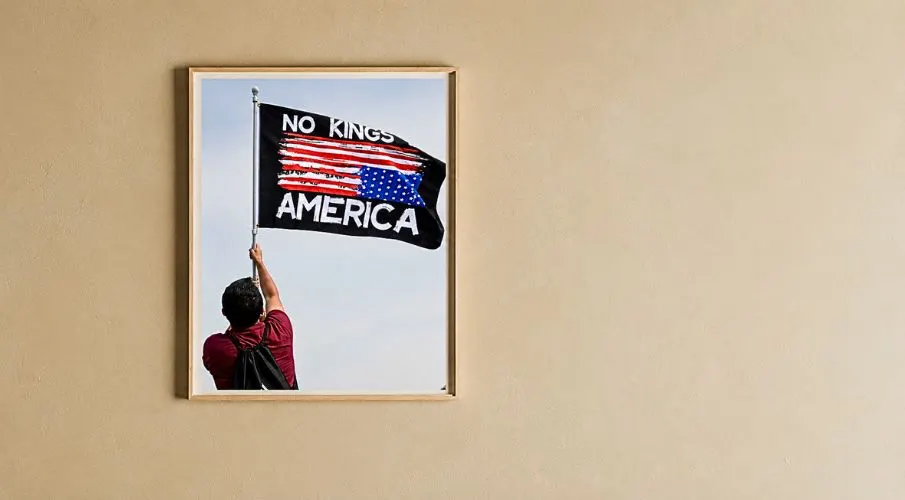
Los Angeles, October 17, 2026, 1:00 PM. About 100 people are standing in Gloria Molina Grand Park. They're supposed to show just how big the resistance to Donald Trump has become. An hour later, there are several hundred. Later reports put the number in the thousands. America's protest movement has seen more powerful afternoons. Jessica Denson, one of the speakers, says what everyone can already see outside City Hall: The crowd is considerably smaller than at previous events.

On the very day of nationwide protests against Trump, the size of the gathering itself becomes the news. And yet that small number is precisely the political story: Part of the movement has stopped measuring its strength by the size of its crowds. A story that begins with "Once upon a time" can count on having an ending. The other one, the one that begins with "Once again, there will come a time," has no ending. It demands courage and a willingness to live with the consequences.

On December 10, 2010, a faceless voice spoke up. "Don't let governments, corporations, or the media decide what you're allowed to see, hear, and think." That was the message Anonymous delivered to the world. It had been written largely by the inner circle that had held the collective together since 2006. The occasion was Operation Payback. Companies had cut their business ties with WikiLeaks after the whistleblower platform published its disclosures, and Anonymous went after them. The authors were a collective that wanted to protect freedom of speech and information worldwide. They wanted to protect the internet from the tyranny governments and corporations were trying to impose on it. Causing disruption for no reason wasn't their thing, or so their explanation went. They explicitly asked for support for the rights of every individual. They wanted nothing for themselves.

The statement justified this with an image from the civil rights movement. Back then, activists had staged sit-ins, peacefully blocking access to businesses in protest against racial segregation. People had been angry, but without those protests, there would have been no Civil Rights Act. Today, many businesses operated on the internet, so the protests had to move there too. The attacks were "virtual sit-ins," using up nothing but bandwidth, just as demonstrators had once occupied the stools at Woolworth's lunch counters.
16 years later, the protest is moving again. Its new destination is the ballot box. Another is the courtroom
By now, word has gotten around that the rituals of the 1980s through the early 2000s accomplish very little in 2026. Loud public outrage often does more to strengthen the opponent than the cause itself. Every scene on the street appears 20 times over on the platforms, and the opponent feeds on it until he comes out stronger. The movement's own message is essentially delivered straight to its adversary. The digital front seems impossible to defeat, something Trump and his followers figured out early on. Propaganda has always been the sharpest weapon of right-wing populists and the Nazis. The devices change, from the Volksempfänger radio to the screen in your pocket. The intention remains. Whether in 1935 or 2026, resistance itself has barely changed in many respects. What's new is the weapon of the courts. Verdicts haven't been handed down in the streets for a long time. Resistance to governments like these is organized in secret, just as it was in the darkest times. Investigations are conducted covertly until the very last second, and silence is maintained until the documents are filed in court. Demonstrations were romantic. They still are.

Romance has one advantage: It looks good. You notice the price later. Between a shouted slogan on the street and a judge's ruling lie months of quiet work on documents and evidence. There are no pictures of that work. It doesn't belong on a protest sign. Yet it accomplishes more than any march. Once again, the slogan was "No Kings." This time, though, people were supposed to head to the polls, preferably before November 3. Millions can demonstrate without changing a single balance of power afterward. An election doesn't count cheers. It counts votes. The protest movement is trying to turn its anger into something that has consequences in Washington.

California provides the occasion as well. Two days before the rally, the Trump administration sued the state's election authorities. It wants a court to prevent mail-in ballots from approximately 20,000 people from being counted until their citizenship has been verified. The federal government considers those affected to be suspected non-U.S. citizens. A suspicion hangs in the air, and the government reaches for votes that have already been cast or soon will be. Their weight is to depend on an additional examination. For a president who talks incessantly about election fraud, the timing is striking, less than 3 weeks before the midterms.

In 2010, Anonymous was fighting for freedom of information. Powerful institutions were trying to destroy WikiLeaks' credibility and wipe it off the internet entirely. They were doing so in the name of national interests, but in reality, they were protecting those who wanted to hide their own wrongdoing from the public. There was no evidence that anyone had been harmed by the disclosures. WikiLeaks was working with several news organizations and had tried unsuccessfully to speak with the State Department. Activists warned at the time that suppressing a single platform would establish a dangerous precedent: Governments might eventually believe they could shut down any website they didn't like.
The dispute over 20,000 mail-in ballots is a different matter. Only the gesture is familiar. A government declares something a danger and reserves the right to decide what gets counted. Back then, it was a publication. Today, it's a vote. Suspicion doesn't need proof to have an effect. It only needs a deadline. In Los Angeles, Democratic State Senator Sasha Renee Perez went on the offensive. Trump was trying to intimidate Californians into staying away from the polls through immigration enforcement operations. If their votes were powerless, his administration wouldn't be spending millions on the so-called Operation Safe California to intimidate communities. She called the White House a fascist regime. The city knows the immigration raids, and since June 2025, National Guardsmen and Marines have become part of its collective memory.

At around 2:00 PM, the march got underway, covering roughly 1.5 miles from City Hall along Spring Street and First Street. The return route went along Grand Avenue and Temple Street. American and Mexican flags joined the march. Signs called for Trump's impeachment or the abolition of ICE. Others simply read "No Kings." The chants were aimed at the deportation agency. A cry echoed between the high-rises: "This is what democracy looks like." Marlene McRae waited with a sign for her daughter and grandson. She said she barely recognized the country she loved anymore. Freedoms were being taken away while others insisted everything was fine. People who had come to American streets simply to build a life for themselves were being killed. She had come to push back against the claim that voting didn't matter anyway. For her, Washington has long since pulled up a chair at the kitchen table.
"Anonymous is every single individual," the collective declared in 2010, regardless of background or religion. Just as the American Constitution was a living document because it could be amended, Anonymous was a living culture made up of people and ideas. They followed their own consciences, not a leader. In 2026, something like that has names and faces. Behind the call to action in Los Angeles stood 50501 SoCal and more than 30 organizations, from the ACLU of Southern California and Oxfam America to Black Lives Matter Grassroots LA and Public Citizen. The Democratic Socialists of Los Angeles marched alongside the Working Families Party, and local immigrant organizations joined in. Coalition spokesperson Aztlan Tenochtitlan summed it up this way: The same administration that had invaded their city was now threatening their right to vote.

The rest was a carnival with a cause. Bright colors, plenty of imagination, and Trump in every conceivable incarnation, sometimes grotesquely exaggerated, sometimes mercilessly ridiculed. His opponents' imaginations seemed to know few limits. In between were music and ceremonies by Indigenous communities, with events scheduled to continue until around 5:00 PM. The list of speakers was long. Pasadena had also called for a rally. Both organizers emphasized nonviolence, and both were up against a deadline: California's voter registration deadline is October 19.
Anonymous called those weeks in December 2010 a historically important moment for free speech in the emerging information society. The attacks on freedom of expression would have far-reaching consequences. Back then, it sounded like young people making a big deal out of their cause. Today, it sounds less grand.

Minneapolis showed just how far away the crowds of the past have become. Several hundred people turned out on a sunny day at Commons Park, where food trucks and games for children were waiting. Organizers called it a nonpartisan voter turnout event. Then Democratic Attorney General Keith Ellison spoke, with other politicians from his party in attendance. In March, following a large-scale ICE operation, tens of thousands had marched to the Minnesota State Capitol, with organizers putting the crowd at 200,000. On the first nationwide protest day, June 14, 2025, former Minnesota House Speaker Melissa Hortman and her husband Mark had been murdered just hours earlier. Organizers counted approximately 5 million participants that day and around 7 million on October 18, 2025. In March 2026, there were more than 3,000 demonstrations, including protests against the start of American military operations against Iran. How many turned out this time remains unclear. What is documented are the small gatherings in Minneapolis and Los Angeles.

On the lawn stood musician Emmett Doyle, one of 15 defendants in a case against opponents of ICE operations. Federal agents had pulled him from his car months earlier. When he asked whether it was about his songs, he was told it was about his resistance to ICE. In that case, he replied, they'd probably have to arrest all of Minneapolis. Brian Apland, also one of the so-called Minnesota 15, was there too. Doyle sang "L'Estaca" by Lluís Llach, a song from the resistance against Franco's dictatorship. The stake everyone pulls at together until it falls suddenly stood in an American park. Courts are a weapon that can also be turned against the resistance. The Minnesota 15 are learning that right now.

On the lawn stood musician Emmett Doyle, one of 15 defendants in a case against opponents of ICE operations. Federal agents had pulled him from his car months earlier. When he asked whether it was about his songs, he was told it was about his resistance to ICE. In that case, he replied, they'd probably have to arrest all of Minneapolis. Brian Apland, also one of the so-called Minnesota 15, was there too. Doyle sang "L'Estaca" by Lluís Llach, a song from the resistance against Franco's dictatorship. The stake everyone pulls at together until it falls suddenly stood in an American park. Courts are a weapon that can also be turned against the resistance. The Minnesota 15 are learning that right now.

Washington is watching closely. In August, the Justice Department sent election observers to two Minnesota counties. Trump claimed without evidence that election fraud was taking place in the state. Federal prosecutors recently charged 10 people with illegally voting or registering to vote. Democratic candidate Zack Filipovich sees that as a reason for growing concern about voting rights, but said he trusted paper ballots and verifiable procedures. Early voting has been underway since Friday, and according to state officials, more than 200,000 votes had been cast by Friday morning.

A second, more detailed statement from Anonymous, dated December 17, 2010, took aim at government surveillance and invasions of privacy. The suppression of independent publications was also part of its message. The collective did not predict Trump's policies or the situation in 2026. It saw something more general: When political power and economic control over the channels of information come together, the public's freedom is endangered. It preferred to educate its opponents rather than hurt them, and anyone who turned away from censorship would become an ally.
In Washington, demonstrators marched past golden statues of Trump on Memorial Bridge toward the White House, beneath a banner reading "Your Voice Is Your Vote." Others demanded that the government keep its hands off voting rights, while more gathered at the Lincoln Memorial. In Dallas, Teresa Cox of the Texas Organizing Project urged people to vote early, with early voting in Texas beginning Monday. In Atlanta, City Council member Michael Julian Bond declared that every day of early voting was already Election Day. Georgia is voting from October 13 through 30. New York joined in too.

"The internet is the last stronghold of freedom in this increasingly authoritarian world," the unknown authors wrote. When we're connected, we're strong. When we're strong, we need not fear tyranny. The fortress of those days is today's front line, and the others are standing on its battlements. They existed on the fringes of society, online and off. But if you looked for them, you would find them. Hardly anyone in Grand Park would have wanted to shout "We are Legion" out loud that Saturday. Beneath it were the words "Join us." At the ballot box, that invitation remains open until November 3.

16 days to go. Trump keeps talking about election fraud, while his opponents gather every available ballot. Los Angeles has shown just how difficult the path from outrage to lasting participation has become. Thousands of people in the street make an impression. Millions of votes decide who controls Congress. Only the results will show whether the movement misses its massive crowds or has learned to put its strength to work elsewhere.
"Once upon a time" tells the story of crowds. "Once again, there will come a time" tells the story of those who stay when the camera moves on. And as I write this article, Trump continues to lose support, and the next court cases are waiting. And isn't that what most people want? "Drive out the king."
Updates – Kaizen News Brief
Alle aktuellen ausgesuchten Tagesmeldungen findet ihr in den Kaizen Kurznachrichten.
To the Kaizen News Brief In English


