
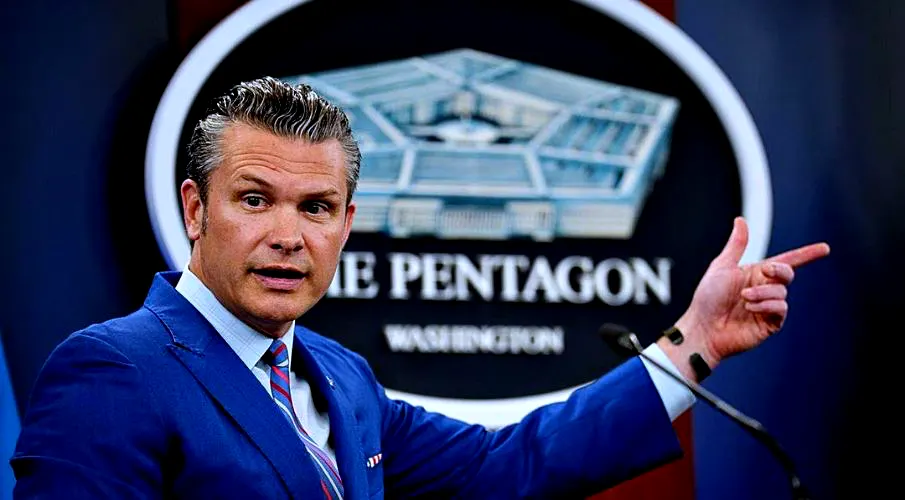
An American senator travels to the Persian Gulf to see what his country is spending billions on and finds the gates locked. The Defense Department would not let Chris Murphy onto the heavily damaged base from which the Iran war is being conducted and denied him any briefing. In Riyadh on Tuesday, the senator from Connecticut called it an “active, unprecedented, unconstitutional” attempt to hide the costs and consequences of this war from Congress and the public. He blames Defense Secretary Pete Hegseth.
Chris Murphy, Democratic Party - During my visit to the Gulf, something unprecedented happened. For the first time in my 20 years in Congress, I was denied access to U.S. military installations, as well as meetings with military leaders. An order from Hegseth - it applies to both parties - to hide the costs of the war.
Murphy wanted to see Al Udeid Air Base in Qatar, the largest American base in the Middle East and the command center for operations in the region. In the first days of the war, Iranian missiles struck the base and caused severe damage, with one hit landing right in the joint air operations center. The damage to that facility in particular shows how hard the war is hitting the American side itself. And those are exactly the ruins no one is supposed to count. The damage is probably in the billions, the senator says, and that is precisely why the gates remained closed. A secretary who keeps the damage from his war under wraps is not protecting the troops, he is protecting the story of a cheap victory.
He says he has never experienced anything like this in his time in the Senate. Congress appropriates the money for operations like these, and speaking with its own generals and soldiers, especially during a war, is part of its ordinary duties. On Hegseth’s orders, he says, he was not even granted a briefing at the American embassy. Never before, he says, has a member of Congress been kept this far away from the bases and generals in the theater of operations, and it affects Democrats and Republicans alike who travel to the Middle East. Murphy called what is happening a “deliberate campaign of concealment” that his Republican colleagues should demand an end to. No one in Congress should accept this, and neither should the public. If even the government’s own majority closes its eyes, the gate stays locked and the bill stays unpaid.
The separation of powers depends on one branch being allowed to scrutinize another. A secretary who shuts the door on the legislature that pays for his military turns that order on its head. He then decides by himself what the people’s elected representatives are allowed to know about their own war, and that means next to nothing. For any administration, that would be a serious intrusion. In the middle of a war, it becomes a blank check to kill and spend without anyone looking. The money flowed, the dead fell. But elected oversight is standing in front of a locked gate.
The department defended the denial. Murphy’s office had already been told before the trip that it would not support access to Al Udeid. A senior official pointed to a Hegseth directive dated March 3 restricting travel to the region. An order, then, written months before this visit that just happens to prevent exactly what Murphy wanted to see. The muzzle is in writing, a house rule against nosy lawmakers. This has little to do with security and much more to do with fear of what they might see.
What he is locking away has a price that can be calculated. Thousands of Iranians are dead, along with dozens of people in the Gulf states. More than 20 American soldiers have been killed. This self-chosen U.S. and Israeli war has now lasted 220 days, and according to the nonpartisan Congressional Budget Office it has already cost taxpayers more than $40 billion. It drove up gasoline and energy prices, and transportation and food became more expensive too because oil and shipping around the world were disrupted. A war that is spinning further out of control by the day, Murphy says. Pressure on the administration is growing, in human terms and financially, and yet Trump sent thousands more troops and an additional aircraft carrier to the region last week. More men for a war whose price no one is allowed to name anymore.
The locked gates and the swagger go together. While Hegseth locks the wreckage away from Congress, Trump tells his supporters that the United States is currently kicking Iran’s ass and muses that he would not mind if Iran bombed cities in California. The war is almost over and will end one way or another anyway. No one is supposed to count the dead, no one is supposed to read the bill. The government would simply like to be believed. A state that hides the costs of its war from the people who pay for it and have to live with the consequences has stopped answering to them and is governing over their heads.
Updates – Kaizen News Brief
Alle aktuellen ausgesuchten Tagesmeldungen findet ihr in den Kaizen Kurznachrichten.
To the Kaizen News Brief In English


