
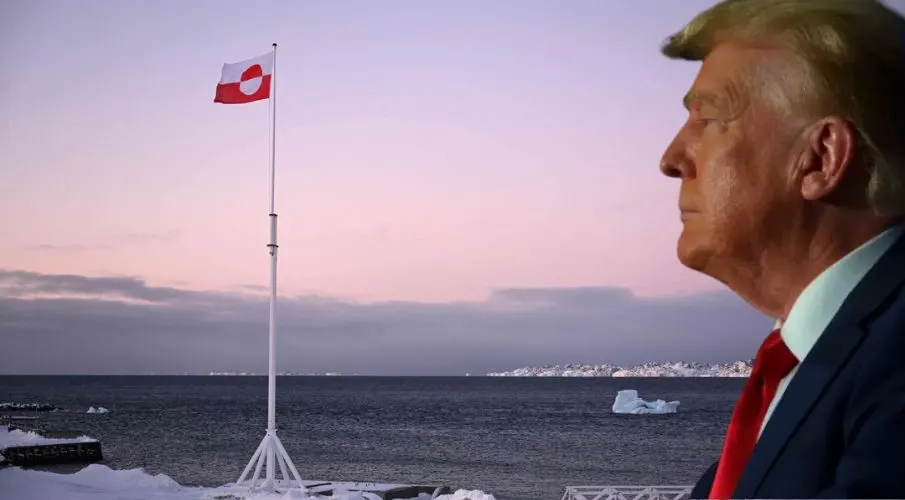
Donald Trump wanted to buy Greenland. Later, he left open whether the United States might take the island by military force if necessary. Now an agreement is close to being signed that would allow a much larger American presence while leaving the decisive point untouched: the semi-autonomous island remains with Denmark. After months in which a NATO ally was publicly confronted with the possible loss of part of its territory, the dispute ends up at a security agreement. The map stayed exactly where it was.
Trump announced Friday that Washington had reached an agreement with Denmark on a larger American military presence. The full text of the agreement has not yet been made public, and the statements from the governments involved still do not provide a complete picture of all the rights and procedures involved. That is exactly why the reach of Trump's own description stands out. According to him, the United States would gain "permanent control over security, and all other needs" in Greenland. His administration would immediately begin building up a larger military presence. That, he said, would completely address all American concerns. No adversary of the United States would be allowed to maintain a base on the island or have a military presence there without Washington's express written approval. Sensitive investments would also fall under that control.

Trump writes that the deal has been reached and gives the United States permanent control over Greenland's security. The joint statement from Copenhagen says something else: The agreement is not supposed to be signed until next week and still has to go through the parliaments afterward. There is not a word in it about permanent American rule, but there is an explicit commitment to Danish sovereignty and Greenlandic self-determination.
Trump also wrote that the United States would work with the people of Denmark and Greenland, whom he described as "wonderful," toward a "magnificent future." The United States would be very protective of the island. The language sounds like an owner talking about a piece of property. Except the property does not belong to him.
Copenhagen described the same development in considerably more sober terms. Prime Minister Mette Frederiksen's office said the agreement was expected to be signed next week during the UN General Assembly by all 3 governments. Before it could take effect, parliamentary steps would still be required in Denmark and Greenland. Frederiksen said the agreement recognized the sovereignty and territorial integrity of Greenland and Denmark. It would also uphold the right of both peoples to self-determination.
Greenland's Prime Minister Jens-Frederik Nielsen also presented the agreement as a shared benefit. The emerging agreement would benefit all the governments involved and recognize Greenland's interests as well as its place in international cooperation. There is no longer any talk of the United States acquiring the island. Yet that very demand had shaped the dispute since Trump's return to the White House.
Trump had called on Denmark to sell Greenland to the United States and repeatedly described the island as vital to American security. He publicly refused to rule out military action. Denmark and Greenland repeatedly responded that the island was not for sale. Reports of American intelligence activities in Greenland were condemned as well. Trump's approach met strong resistance in Europe. Russia also opposed an American acquisition of the island. For Denmark, the dispute at times became more than an ordinary disagreement among allies. Trump's demands were seen there as an existential strain on the relationship with Washington.

Trump acts as though everything has been signed and settled. Copenhagen says the opposite: The agreement is not supposed to be signed until next week, then the parliaments still have to deal with it, and Trump's "permanent control" appears nowhere in the joint statement. His "FOREVER" and supposed "Infinite Life Agreement" are, so far, above all one thing: Trump's own version of a deal whose final text has not even been approved yet.
The tone had strained NATO even though military cooperation between Washington and Copenhagen has existed for decades. The United States already operates the Pituffik Space Base in northwestern Greenland. Its foundation is a 1951 defense agreement. The base supports missile warning and missile defense. It also provides space surveillance for the United States and NATO.
The 1951 agreement has no fixed expiration date. For decades, it has given the United States broad latitude to operate military facilities. Forces from other NATO countries can also gain access under that framework. What the old agreement did not contain, however, was an explicit ban on countries Washington considers adversaries. That is where part of the new agreement changes things. The technical difference is smaller than Trump's rhetoric would suggest, but politically it is far from meaningless. The United States wants the ability to act on its own in the future while also deciding which foreign powers stay out.
According to a U.S. State Department official who spoke anonymously because he was not authorized to speak publicly, any base operated by a non-NATO country would be prohibited in Greenland going forward. Access for investments from adversarial countries would also be restricted. Under that arrangement, neither China nor Russia would have the right to maintain a base on the island. In confidential talks in Washington, American negotiators had also pushed for veto power over major investment projects. Greenland's natural resources were part of the background as well.
Trump described the agreement as permanent American control over security matters and other needs. Washington would also "FOREVER" have the full ability to do whatever was necessary to secure Greenland. The sentence sounds like a historic breakthrough. Except America has had military access since 1951. What is new above all is that potential adversaries would be explicitly excluded and investments would come under stronger American scrutiny. Secretary of State Marco Rubio celebrated the agreement as a "historic deal" and a "huge win" for the United States. Greenland would forever be part of North America's strategic defense area and keep adversaries out of that region. The agreement would permanently resolve America's security concerns. The big words fit an administration that spent months talking as though Greenland still had to be discovered for the defense of North America.
Geographically, there was nothing left to discover. Greenland lies northeast of Canada, with more than 2 thirds of its territory inside the Arctic Circle. During World War II, the United States occupied the island to keep it from falling under Nazi German control. At the same time, important shipping routes in the North Atlantic were to be protected. During the Cold War, the United States maintained several bases and installations there before later reducing its presence.
Despite Trump's aggressive language, Danish officials had repeatedly made clear that they were open to a larger American military presence. Broader U.S. economic interests in Greenland were also negotiable in principle. The red line was ownership. Foreign Minister Lars Løkke Rasmussen said earlier this year that American ownership of Greenland remained off the table. At the same time, the sides agreed to set up a high-level working group to explore a shared path forward. The confidential talks then focused on stronger military cooperation and natural resources. According to people familiar with the discussions, the American side had also demanded veto power over major investment projects in order to keep Russia and China out. The new agreement apparently takes up that approach. Washington gets more influence, Copenhagen keeps state sovereignty.
Trump's repeated claim that Russian and Chinese military forces were lurking directly off Greenland's coast was not supported by the information available. Competition with both countries in the Arctic still forms the strategic backdrop. That is exactly why Denmark's willingness to cooperate more closely was never the problem. Danish officials had repeatedly offered to discuss more American troops and deeper economic cooperation. Washington did not have to kick the door in. It had long been open for security talks. The dispute began because Trump turned a security question into a question of ownership and left military coercion against an ally hanging in the air.

Frederiksen and Nielsen can now point to a text that explicitly preserves sovereignty and self-determination. Trump can tell people at home that he secured permanent American security rights. Both sides get language they can live with. The difference between them lies in the verbs. Washington talks about control. Copenhagen talks about recognition.
American influence over investments could become almost as important in the long run as additional troops. Greenland is rich in minerals, and that is exactly why the confidential talks had involved economic interests alongside security questions. According to the information available, Washington had pushed for the ability to block major deals if companies from countries it considers strategic adversaries were involved. The island therefore remains Danish, while its economic room to maneuver in sensitive areas could become more tightly tied to American security priorities. The parliamentary process will still have to decide that as well. An agreement about soldiers can quickly look like defense. A veto over investments reaches deeper into a country's everyday life.
For Trump, the agreement still offers a political success story. The American military presence is supposed to grow. Adversarial bases would be excluded. Major investments from problematic countries would face tighter controls. At the same time, the starting point of his demand has disappeared. Greenland is not being bought. It is not becoming American territory either. The island remains part of the Kingdom of Denmark.
The foreign-policy cost of the past several months does not disappear with it. Imran Bayoumi of the Atlantic Council said people in the United States underestimated how damaging Trump's approach had been to the country's image in Europe. In Greenland and Denmark, he said, the approach had been understood as an attack on sovereignty. That trust would have to be rebuilt first. A signed agreement gets filed away faster than the memory of the threat that came before it. That is exactly where the irony of this outcome lies. Trump had demanded a transfer of ownership and left open the possibility of military force. Washington is now getting more of what Denmark had already been willing to negotiate: a larger military presence and greater influence over security-related investments. Sovereignty remains where it was before. The detour through threats did not change that. It only showed how much diplomatic china can be smashed before everyone finally ends up at the same negotiating table that had been waiting from the beginning.
What began as an announced grab for an island is now becoming a security agreement with far-reaching American rights. That may carry weight for the defense of North America. The political balance sheet also includes what is not in the agreement. No annexation. No sale. No American Greenland. After months of threats, the dispute ends for now with more U.S. military presence on Danish soil.
Updates – Kaizen News Brief
Alle aktuellen ausgesuchten Tagesmeldungen findet ihr in den Kaizen Kurznachrichten.
To the Kaizen News Brief In English


