
On November 19, 2025, hundreds of bald eagles stood on a golf course in Georgia. 10 months later, a highway bridge over the A20 was covered in AfD flags and German flags. Two unusual images, and both times the verdict took less time than the first look. Under the eagle video, one woman wrote: “Isn’t that AI? Those aren’t flocking birds.” One man had already gone further: “No way in hell that footage is real.” When it came to the photo of Alice Weidel, the certainty was even louder. One woman wrote: “That isn’t real and it’s from last year.” One man opened with “FAKE FAKE FAKE.” The evidence arrived later. By then, the verdict had already taken its seat. A comment section rarely wants to know. It wants to be right, and that is a world of difference.

Back then in Georgia, the post was supposed to show nothing more than a rare sight. Bald eagles had gathered on the Old Toccoa Farm Golf Course and temporarily brought play to a halt. The video showed the birds on the grass, some taking off, others sitting scattered closely across the grounds. Then came the sound, and it did not match the eagle that decades of Hollywood have planted in people’s heads. One woman asked: “What are those sounds? They don’t exactly sound like eagle cries.” One man listened to the recording later and remained completely certain: “Dear Mr. Hofmann, the video is AI.” The screen had spoken, and its voice replaced the view outside.
We identified the location where the footage was recorded. Then we looked at the birds’ behavior, and finally we examined their calls. Bald eagles sound higher-pitched than the ear expects. The famous deep scream from the movies often comes from a red-tailed hawk. Real bald eagle calls sound whistling and thin, and in large groups they create a sound that can easily strike laypeople as strange. That very irritation became supposed proof in the comments, as though nature had to conform to expectations rather than expectations conforming to nature. Another man wrote: “That’s fake,this was made with AI and badly done at that.” From someone else came: “Everything points to AI.” When we asked for specifics, surprisingly little remained of that “everything.”
One discussion from that November deserves to be preserved almost word for word. A man said he did not believe the video was real. We asked for evidence. Another participant essentially asked where that certainty came from. The answer: “because I know who made it”. After that, the debate continued as if that sentence were already a source citation. A little later, someone claimed the spacing between the eagles on the grass was evidence of artificial generation. We replied that we had checked and researched the material, “basically everything you possibly can, even though world peace wasn’t exactly at stake here.” That is how unremarkable the work looks that ultimately holds up. Someone shouts fake, others pick it up. The newsroom then sits there for hours turning a real bird back into a real bird.
One woman remained skeptical about the sound. We explained what bald eagles actually sound like and pointed her toward a way to identify bird calls. Later, she replied: “you’re right. You can figure it out if you can and want to.” That little sentence carried more weight than some pages full of certainty. A person had doubts, checked an explanation, and then changed her opinion. That is what facts are for. They are not supposed to flatter anyone. Their value only shows when they correct an error, including your own, and that one reversal hurts enough that most people avoid it.
Others did not want to pay that price. “In my opinion it’s clearly AI. The blurry and imprecise look,” one man wrote, then again: “No way in hell that footage is real.” After turning on the sound, he once again declared the video AI. The reasoning changed, the conclusion stayed put. First it was the birds. Then it was the image. After that, the sound. Whenever one piece of proof fell apart, the next one was already waiting at the door. Skepticism looks different. Skepticism asks whether it might be wrong. This attitude only asks how it can keep its verdict.
Almost a year later, the same lesson came wrapped in politics. Alice Weidel published a photo of a bridge over the A20 in Mecklenburg-Western Pomerania, where people stood with AfD flags and German flags. Weidel wrote that she had just driven underneath it and had tears in her eyes. Politically, people can judge that appearance any way they want. For our work, only one question mattered at first: Is the photo real? In the comments, the question had already been pushed aside by an answer before the examination had even begun. The image was published on the evening of September 17, 2026, and the action on the bridge is documented by additional material. “That isn’t real and it’s from last year,” one woman wrote. One man followed with “FAKE FAKE FAKE.” Weidel supposedly could not possibly have uploaded the image at that time, and besides, the same scene had existed since 2025. The wind direction did not match either. Another profile mocked the supposed “flag manipulation.” The case sounded closed. It wasn’t.
We searched for the bridge and compared older footage with the current image. Then we worked our way through vehicles and perspective, and later additional footage of the action appeared. Our assessment moved along with the material, first landing at about 80 percent authenticity, later at more than 90 percent. That is exactly what we wrote publicly, with no magic and no hero story. Research is allowed to be uncertain while it is still working. It actually has to be allowed that uncertainty before the evidence is in. Claiming 100 percent when you are only at 80 percent has nothing to do with verification. The final percentages cost time again, and they cost money. Image verification does not fall from the sky, and a newsroom cannot survive on the electrical warmth of a comment section.
The bridge could be identified as the Damerow Bridge carrying the L322 over the A20 near Rollwitz. Older material showed the same bridge, but not the same photo. The vehicles were different, and the lighting conditions did not support the claim that this was simply an old image with party flags pasted into it. Additional footage supported the sequence of events on September 17. At that point, the matter was clear to us. The image was real. An independent verification later reached the same conclusion.
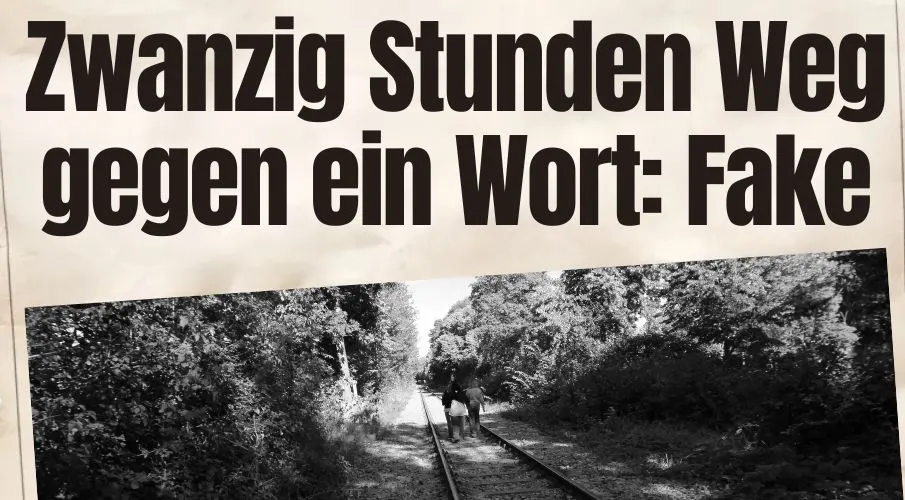
The decisive sentence during our ongoing A20 investigation was, for a while, essentially: “Unfortunately, it looks like the picture is real.” That “unfortunately” belonged to our dislike of the staging. It changed nothing about the pixels, because pixels do not have political beliefs. We found witnesses and were able to pin down several videos of the action, but that settled nothing by itself. Every piece of material had to be checked again, because a video can be real and still come from a different day. We compared weather data with the footage. Highway police were brought into the process, and colleagues from the region helped us place the location and sequence of events. Recording after recording, we cross-checked everything until the traces pointed to the same evening. In the end, three people were working on this single question and together spent more than 20 hours on it. Meanwhile, other work sat untouched, and on top of that came insults from people whose own effort consisted of one glance and a tossed-off “fake.”

Our published closing line was appropriately dry: “Result: The photo is 100% real, and the truth leaves you quiet.” Quiet it did become.
Before that, one woman had asked: “and where would the guardrail be there, the absence of which turns the oncoming vehicle into a ‘wrong-way driver’? The vehicle is clearly coming toward us in the left lane?” She was referring to a distant vehicle light behind the bridge. With heavy magnification, gray pavement and a gray guardrail turned into a featureless surface, and suddenly a wrong-way driver had been born. We had to take that apart too. A wrong-way driver does not rearrange the world. The effort was about something else: Someone had built proof out of a handful of pixels and crowned it with the word “clearly.” Certainty now appears faster than perception.

Another woman wrote: “If the photo is AI, it now has to be clearly labeled as such! If that notice is missing, legal action can follow!” If the image was real, she said, then the action was simply a traffic hazard. That was almost elegant. Whatever the verification produced, the blame was already waiting. Research had become decoration for a verdict that was perfectly satisfied with itself. This is where know-it-all certainty becomes dangerous. It no longer needs evidence because it feels right, and the feeling of being on the good side has always had a way of making evidence seem unnecessary.

Then came the correction from a German fact-checking site. It said: “We made a mistake and fell for supposed evidence that had been sent to us, without examining it thoroughly.” And further: “This photo is neither AI-generated nor edited.” The claim that Alice Weidel had lied about the photo was also explicitly withdrawn. We are leaving out the name of the newsroom because we do not publicly pillory colleagues, regardless of whether they belong to the major professional associations or smaller organizations. You could hardly hand the AfD better material for free. A party whose supporters already talk about hostile media merely has to hold up that correction. The rest was done by people who wanted to be faster than the facts.
That is exactly why this goes beyond Alice Weidel. Our political position is no secret. We stand against Donald Trump, and we are out on the streets at protests against ICE. Our people work in war zones. We know up close how quickly a false claim can damage a person. We also know how uncomfortable research becomes the moment its result contradicts your own convictions. That is precisely where the craft is decided. An AfD image does not become false because we oppose the AfD. A Trump quote does not change because we criticize Trump. Facts do not take on our party colors, otherwise they would not be facts.

Outside, the cheaper version kept running: judge first, then look for reasons. At least one apology came. After the confirmation, one man wrote: “I apologize to you.” He said he had read the claim shortly before on “4 or 5, normally reputable profiles and pages” presented as fact and had therefore repeated it. “I really thought it was true and so did many others.” He announced that he would delete his earlier comment: “I’m sorry.” That man showed more character than many of those who had been the loudest before. Being wrong is part of thinking. Character only begins when the mistake becomes visible and you still say it out loud.
Some comments carried an almost comical self-confidence. “Yeah yeah, Alitsche and her flag manipulation …,” one profile wrote, as though the manipulation had long since been entered into the official record. Another comment consisted of nothing but “Fake picture.” Under the eagle video, one man needed only the word “Fake,” while another followed up: “No way in hell that footage is real.” Sentences like these look small. Through repetition, they become heavy inside a comment section. The 20th unsupported suspicion eventually sounds like a confirmed fact even though all that happened was 20 people placing the same suspicion next to each other. Truth does not grow with the height of the pile.
The other side spoke up too. During the A20 debate, one woman wrote that she was afraid of falling for artificially generated content, while at the same time saying that she trusted our research. That attitude does not require political loyalty from anyone. It allows a photo of Alice Weidel to be real while the political message can still be rejected. That distinction is adult. It costs something that social networks rarely reward: patience. A quick suspicion immediately produces a reaction, while careful verification is sitting at a desk comparing guardrails. It rarely provides the instant thrill, but it carries the responsibility once a suspicion becomes a published claim.
From most people, nothing came at all. No apology for the insults. Not one word about the hours their claims had added to the work. The damage to reputation, never mind, some readers are always happy to throw that in too. No curiosity about how the investigation had turned out. The issue that had seemed so urgent moments earlier evaporated as soon as the result no longer matched their certainty. The noise had done what it was there to do, then moved on.
Many of the people who demanded additional checks for hours or put their certainty up against our research did not even consider it necessary afterward to look at or react to how much work all of this had caused. We are writing that once because it shows how part of the reading public operates. The comment was worth the click. Good research is taken for granted. It should be fast and solid, but the moment it requires effort, the grand demand shrinks to a tiny movement of the mouse. That is bitter, because behind “check this out” or “this is fake” lies real work. While a comment takes 15 seconds to type “Fake,” a newsroom searches for the original material. Footage gets compared, and when necessary someone has to spend a lot of time on the phone. With images, the technical verification gets added, while the day-to-day work keeps running alongside it. The comment costs its author nothing. The rebuttal costs time. People who disappear afterward leave the bill with the people they had just told to do more thorough work.
The eagle video played out exactly the same way, just without party flags. A beautiful moment in nature turned into a small evidentiary hearing. Instead of marveling at hundreds of bald eagles, suddenly we had to explain why they did not scream the way they do in movies. Then the debate moved to the spacing on the grass. Then the blurriness. Finally, back to the sound. One man dryly wrote “Fake,” another declared the video artificially generated. The explanations came afterward. By then, the joy of the scene had long since been dismantled.
That should concern us more than the question of whether someone on Facebook got something wrong once. Artificial intelligence has made real fakes easier to produce and at the same time created a new laziness in thinking. Anything unusual can now be placed under suspicion, and the word “AI” already sounds like expertise. Nobody needs image analysis anymore, confidence is enough. One blurry tree will do. An unusual bird call will do just as well. On the A20, in the end, a gray guardrail was enough. Knowledge has rarely been this cheap to obtain, and rarely worth so little.
The result is grotesque. The very people who want to fight disinformation end up supplying fresh material to the people they oppose through premature certainty. In the Weidel photo case, that is already written into the correction, which apologizes for inadequate verification and withdraws the claim that she lied. For AfD channels, something like that is a gift. They point to one real mistake and infer from it that every other criticism must be invented too. The first mistake was the false claim. The second is failing to see who benefits from it. Yet criticism of the photo never depended on it being fake. People could have talked about the organized staging, as well as the effect such images are meant to produce. The role of these bridge actions could also have been examined. Instead, part of the debate got obsessed with pixels. Apparently, the claim “Fake” was more tempting than the uncomfortable question of why a real image has political power.
Almost a year lies between Georgia and Rollwitz. The first time, eagles sat on a golf course and people declared them artificial. The second time, flags hung from a bridge and people declared the image manipulated. Back then, correcting the claim took hours. This time, it did again. The tools for checking have gotten better. The patience of many users apparently has not. Our job remains the same. We check even what we do not like, and we correct ourselves when the evidence gets stronger. We expect nobody to submit to our articles. Criticism is welcome, evidence even more so. Insults followed by silence are something we have gotten pretty good at reading by now. They say little about a photograph and a great deal about the person who wants to be right at any price.
Journalism is not a request show. A result does not become true because it comes out against Weidel. A claim does not become false because it comes from people we oppose. That simple distinction has become harder in the constant digital barrage, and that is the most uncomfortable lesson from both stories. Many people demand truth as long as it looks like them. The bald eagles were real. The A20 photo was real. 10 months lay between them and plenty of opportunities to learn something. In this case too, we started all over again.
To be continued, courtesy of Facebook …
Updates – Kaizen News Brief
Alle aktuellen ausgesuchten Tagesmeldungen findet ihr in den Kaizen Kurznachrichten.
To the Kaizen News Brief In English


Danke wieder einmal für eure Arbeit!
vielen dank
Danke, dass Ihr Eure knappe Zeit und Energie darauf verwendet habt.
Das war ja schon etwas Großes.
Weidel und Co haben leider damit in den Social media sehr viel Aufmerksamkeit bekommen.