
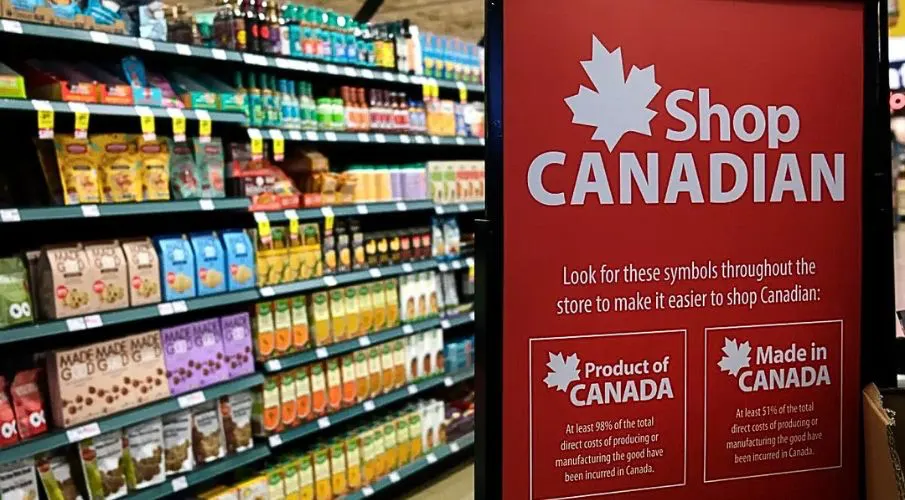
Canada's supermarkets are changing in the refrigerated aisle. What Donald Trump started as a trade war is landing between strawberries and oranges, right where political decisions suddenly come with a country-of-origin label. More and more Canadians are buying domestic goods and avoiding products from the United States. Grocers are improving country-of-origin labeling and looking for other suppliers. The "Buy Canadian" movement began last year after Trump imposed tariffs on Canadian goods. It has grown more intense recently. Trade talks broke down on August 21, followed by new tariffs and countertariffs. Trump had also ordered a name change to "Lake America" by executive order. The dispute between governments has now made its way to the refrigerated aisle.

Giancarlo Trimarchi, president of independent grocer Vince's Market in Ontario, received angry emails and comments because his stores were carrying American fruits and vegetables. He publicly showed customers that most of the products on his shelves came from Canada. His 4 stores across the Greater Toronto Area now carry around 90 percent Canadian fresh produce. Trimarchi now gets strawberries from Quebec instead of the United States. The switch is costing money, which is why he said he has even cut his advertising budget. In the past, the tradeoff was between quality and price. Now country of origin has been added to the equation. "This time around, it's much more aggressive than it was last year," he said.
The big retailers are reading the mood too. Loblaw Cos, Canada's largest food retailer, brought maple leaf signs back to its produce and fresh-food sections in August after a brief hiatus. A "T" also identifies products affected by tariffs. The idea is to make Canadian products easier to spot. Metro, the country's No. 3 grocer, said it would continue to prioritize Canadian products under the current circumstances. Gary Sands, senior vice president of public policy and advocacy for the Canadian Federation of Independent Grocers, said Canadians' attitudes had changed permanently. A grocery list can now be a political statement, even when all that's on it is milk and potatoes.
Government data shows just how deep the dependence has been. By value, Canada is the world's 5th-largest importer of vegetables. The United States remains its biggest supplier and accounts for more than half of those imports, with Mexico coming next. The U.S. share of Canada's vegetable imports fell to 62.6 percent. In July 2023, before Trump's election, it had been 69 percent. More than half of Canada's fruit imports still came from the United States in July. In their place, products from Morocco and South Africa are showing up on store shelves. Spain and Brazil are supplying more as well, and so is Honduras. Every crate arriving from a new country loosens another piece of the old habit.
Canada's winter puts hard limits on this new self-reliance. Fresh produce traditionally comes from greenhouses or stored supplies. Much of it is imported because that is cheaper. The government is investing around C$3 billion over 10 years in greenhouses and vertical farming to expand domestic production during the winter. At the same time, it wants to curb food prices, whose rise ranks among the highest in the G7. More domestic production is supposed to help. Political defiance eventually needs heated buildings and an electric bill.

Gordon Dean, owner of Mike Dean Local Grocer, which has stores in rural Ontario and Quebec, said nobody was rushing back to the old U.S. supply chains. Once new supply routes had been established, supply would become more diversified and therefore safer. Different regulations between the provinces continued to make it harder to move food within Canada. Many grocers therefore remained dependent on suppliers south of the border.
Mike von Massow is a professor of food and agricultural economics at the University of Guelph. His field also includes resource economics. He said national sentiment was currently pushing economic considerations partly aside. That could change again if the relationship improves. The relationship between Canada and the United States may never fully return to what it once was. A future easing of tensions, especially under a new U.S. administration, could make American products more attractive again because they are often cheaper. Trump, meanwhile, said in Dublin on Saturday that Canada wanted a deal with the United States very badly and that an agreement could come "fairly soon." Canada had treated American farmers unfairly and needed to remove tariffs, he said. While Washington is still talking about the next deal, Canadian grocers are already building routes that bypass the United States.
Updates – Kaizen News Brief
Alle aktuellen ausgesuchten Tagesmeldungen findet ihr in den Kaizen Kurznachrichten.
To the Kaizen News Brief In English


Bravo Kanada! Ich wünschte, Europsa würde Kanada noch viel mehr unterstützen. Die USA können ohne Im- und Exporte nicht überleben, sie zu isolieren, ist das Beste, was die zivilisierte Welt tun kann.