
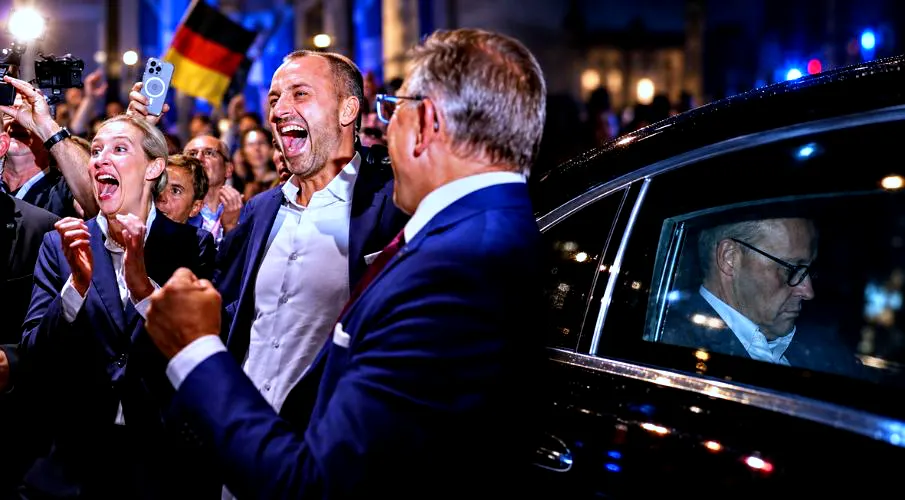
The morning after the election, the strongest force in the state stands in front of a door it cannot open. 43.8 percent in Saxony-Anhalt, more than double its 2021 result, and yet only 39 of 83 seats, not enough for a majority of its own. The Alternative for Germany won and still has to go looking for support. It is turning to individual lawmakers from the Christian Democratic Union, to possible defectors. A victory like that is loud and limited at the same time. The number lifts the party to the top and, in the very same moment, shows it its own limit. The victory cannot carry itself. It needs others to carry it, and those people are sitting in the camp of the defeated.
Its platform is well known and remains hardline. The party wants to deport immigrants and take Germany out of the euro. Support for Ukraine is supposed to end, and it sees a friendlier relationship with Moscow as the better path. It calls the firewall, the agreement among the other parties not to govern with it, undemocratic. The accusation has its own trick to it: exclusion gathers up those it hits and turns into a promise for them. The other parties have held on to that refusal for years, and with every election night it becomes more expensive. Around 83,000 former CDU voters moved to the AfD, while the CDU's result was nearly cut in half, down to 17.2 percent.
Tino Chrupalla, one of the party's national co-leaders, says politics always means compromise and invites CDU lawmakers to make a "center-right conservative majority" possible. The CDU, he says, should ask itself what conclusions it draws from this disastrous result. Party games should be a thing of the past. The compromise he means is aimed at the courage of individuals willing to step out of line, past their own parliamentary group. A pitch for betrayal, delivered in the language of reason. These are the words of someone who was still standing on the margins and is now demanding the manners of the center.
Ulrich Siegmund, the party's lead candidate in the state, hopes to become minister-president if a stable majority can somehow be put together. He has announced talks with the parliamentary groups in the state legislature. Between the desire to be called minister-president and the majority that would make him one lies the entire arithmetic of this parliament. His tone is that of a man who already thinks the invitation is in his pocket, while the door in front of him is still locked.
A crack is showing in Sahra Wagenknecht's alliance. It is the only party that says it is willing to talk to the Alternative for Germany. Wagenknecht warns that even the attempt to build another firewall coalition would be an affront to voters. Her party shares the hostility toward immigration, which it describes as an attack on the rights of local workers. Ending aid to Ukraine is also among its demands, along with restoring good relations with Moscow. An abstention in the vote could put Siegmund into office and allow him to lead a minority government. He has rejected such a solution in the past. Whether ambition outlasts that old refusal will become clear in the talks.
Above all of this stands the classification by the domestic intelligence service. It lists the Alternative for Germany as extremist and is therefore allowed to monitor the country's largest opposition party more closely. The party strongly rejects the classification. The label is public and it did not stop the voters. That kind of surveillance does not scare off its supporters. It confirms the hostility they already believe is directed at them. The strongest force in a state parliament carries the stamp of surveillance at the same time, and both facts stand side by side like witnesses who do not contradict each other.
Alice Weidel, the other national co-leader, calls the evening a milestone and sets the next target: at least 40 percent in the 2029 federal election. Saxony-Anhalt is a small state, one of the poorest in the east of the former German Democratic Republic. Since reunification, that part of the country has struggled to catch up, and the gap makes people receptive to anyone who offers them someone to blame. Where prosperity is thinnest, the loudest harvest grows, and the party that manages the anger gets to reap it first.
The neighbors are watching with unease. French Finance Minister Roland Lescure calls the result a deeply worrying sign and speaks of a populist wave spreading around the world that must be resisted. His own country votes next year, and Marine Le Pen could become president. Polish Foreign Minister Radosław Sikorski calls the outcome worrying. The concern in Paris and Warsaw is also about their own ground, where the same movement is growing. From the outside, people already see in Saxony-Anhalt what at home is still treated as a distant possibility.
On the currency markets, the euro is almost unchanged this Monday. Kathleen Brooks, research director at XTB, warns that the development is dangerous for the longer-term stability of the common currency. The coming years could bring waves of political change and a shift to the right in Europe's two largest economies. The markets are calm because the day after tomorrow cannot yet be traded today. But behind the result in Saxony-Anhalt stands Berlin. Friedrich Merz, the most unpopular chancellor in German history, is struggling with a sluggish economy. Sven Schulze, the CDU's lead candidate in the state, blamed part of the defeat on what is happening in the capital. The state party points to Berlin, and the votes remain where they fell on Sunday.
The math of this evening is simple and still cannot be settled. The election winner without a majority of its own, and behind it a chancellor whose weakness was also on the ballot in Saxony-Anhalt. The door is still closed for now, but nobody in the state still believes it is made of stone.
Updates – Kaizen News Brief
Alle aktuellen ausgesuchten Tagesmeldungen findet ihr in den Kaizen Kurznachrichten.
To the Kaizen News Brief In English


