
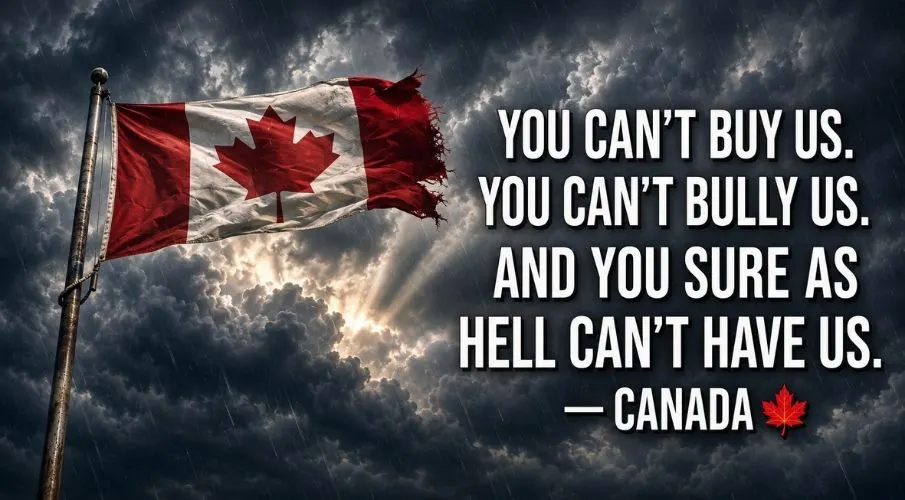
The quiet neighbor stays quiet until someone mistakes politeness for weakness. In Washington, that line has been crossed, and a country that long considered its composure a virtue is now discovering the pleasure of defiance. Canadian gentleness never meant softness. It was patience, and patience eventually runs out.
“WE DON’T NEED CANADA, THEY NEED US!” U.S. President Donald Trump wrote this week. On Monday, he announced that tariffs on Canadian cars and auto parts would rise to 50 percent starting January 1. Shortly before that, new 50 percent tariffs had already taken effect on goods worth $20 billion. Ottawa responded on Tuesday with retaliation, dollar for dollar.

To some in the country, that still sounds too tame. Ontario Premier Doug Ford, a longtime adversary of the president and the man in charge of a province being hit especially hard by the tariff barrage, said out loud what many were thinking: “As far as I’m concerned, he can kiss my ass.” Ford has threatened to shut off Ontario hydropower that supplies electricity to millions of American households. And he is already doing the math out loud: “We should charge him triple for oil, triple for potash, for our uranium, our metals and rare earths.” Industry Minister Mélanie Joly made clear that the government is still holding back its strongest cards. “Everything is on the table,” she said. “But you don’t play all your cards in the first hand. We have options.”

Just how strong that hand is can be seen in Jason Kenney, the former premier of the oil-rich province of Alberta. He raised the idea of export taxes on the 4 million barrels of crude oil that flow south every day and keep the world’s largest economy running. Every barrel Ottawa could make more expensive shows up sooner or later at gas stations south of the border. It would be foolish, Kenney said, to give up that leverage simply by warning Trump about it in advance. Reaching for it would send a “very strong economic message.” The dependence speaks for itself: Around 80 percent of imported potash in the United States comes from Canada. For imported crude oil, it is 2 thirds, and for natural gas, nearly the entire amount. The giant lives off the goodwill of its smaller neighbor without much liking to admit it.

For 18 months, one attack after another has been coming out of Washington, aimed at the country’s sovereignty and its economy. Trump’s threats have long included the territory itself. The attacks have gone so far that even lawmakers from his own Republican Party are publicly criticizing the way the oldest ally is being treated. Prime Minister Mark Carney, whose trade talks with Washington collapsed over the weekend, chose the strongest word: “You’re at war when you’re attacked, and we got attacked.” Giving in was out of the question with a president whose signature, as he put it, was written in pencil. The White House doubled down and circulated images meant to show off the superior economic power of the United States. That turned into an exchange of mocking images that both sides are carrying on with visible enjoyment. Power that has to put itself on display in pictures admits that the numbers alone no longer speak for themselves. Somewhere between tariff tables and caricatures, the trade war is turning into a pastime with serious ground beneath it.

The fact that Carney rejected the “bad deal” from Washington, even though the smaller Canadian economy is paying the price for it, touched a sore spot in the nation’s self-image. A people that understands itself through surviving hard winters recognizes itself in its own toughness. Pride has a price, and this country seems willing to pay it as long as it writes the bill itself. Bob Rae, a former Canadian ambassador to the United Nations, put it without beating around the bush: “American protectionism really means the destruction of Canada. No Canadian government could ever accept that.”
The anger reaches all the way into the ranks of the famous. Author Margaret Atwood shows it openly, and comedian Mike Myers does too. Rock singer Neil Young is calling on Americans to rise up against the White House. Even Conrad Black, the disgraced newspaper publisher whom Trump pardoned in May 2019 after Black had spent more than 3 years in prison for fraud, is furious with his former benefactor. Canada has historically not been a particularly aggressive country, Black wrote, which is why the president wrongly sees it as compliant. He will find out otherwise.
Carney’s toughness is cold calculation and at the same time rides a broad wave of anger. According to an Angus Reid Institute poll from Sunday, 76 percent of respondents support his decision to walk away from the talks. 2 thirds expect Canada to come out of the dispute stronger despite all the damage. Joly summed up the national mood: “Canadians are angry. Canadians are also concerned. But Canadians are extraordinarily proud.”
Carney had already set the tone during his first visit to the White House in May of last year: “Canada is not for sale.” Trump joked at the time that he had helped the Canadian win the election. In reality, Carney’s campaign had drawn its energy from resistance to the south, under the slogan “Elbows up,” borrowed from the rough physical play of hockey. The phrase sounded like something from the rink and yet meant the real thing for an economy that looks small next to America’s. Some critics in the country do warn, however, that the raised elbow confuses emotion with strategy, and that retaliation against such overwhelming power does not yet amount to bargaining power.
Defiance is also creating prosperity on the side. Domestic tourism is booming, and the commitment to buying homegrown goods, that “Buy Canadian” message from Ottawa that Washington would have liked erased during the talks, is even providing a modest economic boost and easing part of the tariff burden. The resentment is also finding other outlets. Nearly 260,000 people are calling, according to an online petition, for the expulsion of U.S. Ambassador Pete Hoekstra, who had publicly repeated Trump’s threat about Canada becoming the “51st U.S. state.” A second petition seeking to strip SpaceX owner Elon Musk of his Canadian passport has, by its own count, nearly 377,000 signatures.
“We will not allow any nation to determine our future,” Carney said over the weekend. “We will go our own way and continue building a stronger Canada for everyone.” The polite neighbor has not sent the bill yet. So far, he is only sorting out the charges.
Updates – Kaizen News Brief
Alle aktuellen ausgesuchten Tagesmeldungen findet ihr in den Kaizen Kurznachrichten.
To the Kaizen News Brief In English


Die Kanadier zeigen, wie man mit Trump umgehen muss.
Stärke und Würde zeigen.
Nicht einknicken.
Und ihn mit den eigenen Waffen schlagen.
Bisher ist fast Jeder vor Trump eingeknickt.
Die, die es nicht taten, erlebten in der Regel, wie Trump über kurz oder Lang zurück ruderte.
Ich wünschte mir, dass UK, Australien und die EU die gleiche Stärke zeigen würde.
Denn gemeinsam wären wir stark und Trump würde dumm da stehen.
Aber leider versuchen sich die europäischen Politiker lieber weiter im Stiefel küssen.