
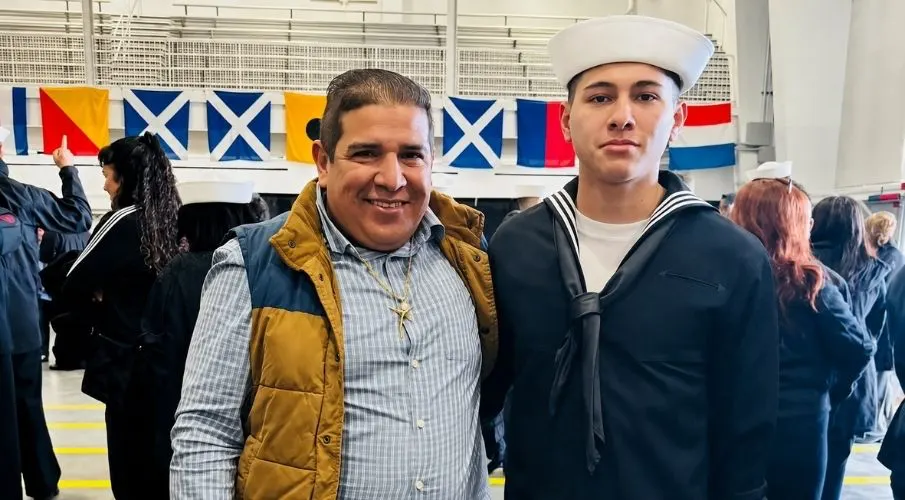
Joshua Aviles was in his ninth month at sea when the call reached him. On the USS Abraham Lincoln, which holds a U.S. military record for the longest uninterrupted stretch at sea, he had been working 12-hour shifts for more than 250 days, with food running short, in the Middle East. "I fight for a country that has given me everything," he wrote. That same Saturday morning, Border Patrol arrested his father. The country his son was going hungry for reached for the man he wanted to protect.
The ship itself has long since become news. Consistent reports and investigations describe dwindling supplies and a crew whose mental condition is deteriorating. The strain on the ship and its equipment is also growing the longer the deployment lasts. The mission has raised broad concerns about what it means for service members to go so long without setting foot on land. Through all those months, the father kept wishing he could finally see his son again, and the further the homecoming was pushed back, the heavier that absence weighed at home.

Read also our articles: Kaizen Inside Story: The Verdict on Trump’s War Is Written in the Dust on an Aircraft Flap
For Luis Manuel Aviles, an ordinary trip to the repair shop ended in immigration detention. Luis Manuel Aviles, 48, left his home in Key West to get his car repaired and never came back. He works there as a mechanic and has a work permit for the United States. He is from Nicaragua and has lived in the country for 19 years. Border Patrol agents arrested him on a Saturday; he remains in ICE custody while the government moves to deport him. A photo from last October shows him with his son outside their home in Key West, one month before Joshua went aboard.

His wife knows a different man from the one the agency portrays. "He is a good father. He loves his children with all his heart," said Argelia Aviles, 47; he devotes himself entirely to his work so there is food on the table at home. His son's long deployment had worn him down, and after 6 months without his son coming home, he had become desperate. Again and again, he had said how badly he wanted the deployment to end. "He was so excited," she said. "He just wanted to hug his son because he hadn't seen him in 9 months."
The news hit his son in the middle of duty. Still aboard the Lincoln, he learned of the arrest Saturday morning and wrote about it publicly. "It breaks my heart," Joshua Aviles said. He did not know how he was supposed to keep working more than 12 hours a day while knowing that his father was being held somewhere and might be treated like a criminal. A service member defends the order of a country that, at the very same hour, is taking his father away.
On top of the exhaustion aboard ship now comes the worry about home. A man who has barely slept and eaten poorly for months is supposed to keep grinding through his shifts while his father sits in a cell waiting to be deported. Service members do not leave news like that behind when their shift ends. They carry it with them.

His sister knows why her brother joined the Navy in the first place. Katherine Delgado, 28, said Joshua had hoped his service would improve his father's chances of obtaining citizenship so that he would "no longer have to live in constant fear" of being arrested. The young man had hoped the uniform would protect his father. It did not. Being separated from her brother, whom she calls her best friend and someone who stands by her no matter what, had been devastating; for weeks, she had not known where he was. When he told her he was not getting enough to eat, she spent hundreds of dollars on packages of food and hygiene supplies, some of which never arrived. The ship is expected to leave the Middle East soon. "He's coming home, and his dad won't be there," she said.
The case does not stand alone, it has become a method. As the Trump administration rolls back immigration protections for military families to drive its mass deportations, at least dozens of parents and spouses of active-duty service members have been arrested. An initial systematic count has found at least 6 relatives who were deported, while one other person left the country on their own. The wife of a service member, held in immigration detention for more than a month, was pulled off a flight to Brazil only after public reporting on her case. We reported on that case.
At the same time, the very same military promotes one of its most visible benefits, one that is supposed to prevent exactly this. The "parole-in-place" program allows relatives of active-duty service members and veterans, from parents to children, to apply for legal status while remaining in the country. But it does not cover everyone, including some people who overstayed a visa or already filed an application at the border. The door is loudly advertised and quietly shut.
The state speaks a cold language in this case. The Department of Homeland Security said Border Patrol agents arrested Luis Aviles in Key West on Saturday and that he remains in ICE custody. Having a family member in the military is "not a free pass to violate the laws of our country," the department said, adding that the government does not get to pick and choose which laws it enforces and which it does not. The Pentagon referred all questions to the Navy, which stayed silent. Defense Secretary Pete Hegseth had previously called reports about conditions aboard the Lincoln "completely misrepresented." The statement is dated Sunday, the arrest happened Saturday; between the two sits a man in a cell.
Applied to a mechanic with a work permit, on his way to the repair shop, the phrase "free pass" sounds like mockery. A country celebrates the long deployment of its sailors and stays silent about the price their families pay for it. It demands loyalty as a duty and treats it as a one-way street. This country had "given him everything," the young man said; now it has taken his father from him. The government does not even want to count how many families are breaking apart along the way, and what you do not count, you
This is the bill being handed to this son: 9 months at sea, and at the end of it, a father in detention. His homecoming leads to an empty place at the table. A fatherland that rounds up the fathers of those who defend it may still carry the name, but it is throwing away what that name is supposed to mean.
Updates – Kaizen News Brief
Alle aktuellen ausgesuchten Tagesmeldungen findet ihr in den Kaizen Kurznachrichten.
To the Kaizen News Brief In English


Und wie Du schreibst, nicht der Erste und nicht der letzte Fall.
Wann endlich lehnt sich das Militär auf?
Hegseth geht gegen Transgender, Homosexuelle, Muslime, Frauen vor.
Und dennoch steht das Militär zu Trump anstatt zur Verfassung?
Leider voten Militärangehörige mehrheitlch republikanisch.
Hoffentlich ändert sich das jetzt endlich mal.