
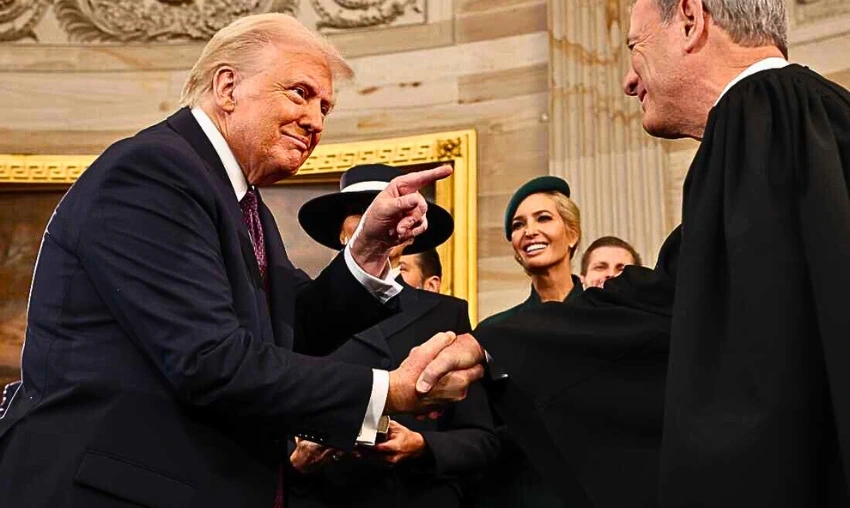
Just hours before midnight, shortly before the cranes were supposed to fall silent at 11:59 p.m., Chief Justice John Roberts signed a single sheet of paper. It temporarily put on hold the preliminary injunction issued by the U.S. District Court for the District of Columbia and allowed the White House to keep working on Donald Trump’s ballroom. There is no explanation in it, and no date for the next decision. Roberts signed it because emergency applications from the capital fall to him. He did not say whether the project is lawful. What he did say is that the work goes on.
Chief Justice John Roberts is a danger to democracy
This is how emergency relief works. One judge decides alone, without oral arguments, without a written explanation, on a matter that actually demands time and the full court. He leaves the outcome open and still creates reality, because while Washington keeps deliberating, the machines keep running. Trump is reaching for presidential power on a scale no one before him has claimed, and he is reshaping the capital to his own taste. The ballroom is the most visible piece of that transformation. Time works for the man who is already digging.

The Court of Appeals for the District of Columbia ruled 2-1 on August 7 that Congress holds exclusive authority over construction and demolition at the White House. Because Trump began without its approval, the project violates the law. The ruling states that Congress did not give the executive branch unlimited authority to redesign and rebuild the People’s House according to the tastes of a single president. The lawsuit was brought by the National Trust for Historic Preservation. By then, the East Wing that the ballroom is replacing was already gone.
The question of who is allowed to remake the White House also decides who the building belongs to: the person temporarily living in it, or the elected representatives who fund it. The appeals court denied the administration precisely that authority and removed the residence from the control of a single individual. The preservationists argue that no president may reshape the building however he pleases, and they point out that the demolition had already happened before a court ever got to hear the case. Roberts has now left that answer hanging for a few weeks. Meanwhile, construction continues.

Construction goes on 20 hours a day, 7 days a week. According to the administration, 65 percent of the roughly 8,400 square meters, more than 90,000 square feet, is complete, built on the ground where the East Wing stood before Trump ordered it demolished. Lawyers for the preservation group accuse the White House of trying to outrun the courts through sheer speed. The accusation hits home. Concrete hardens, and once something is standing, it begins to defend itself; a building no longer needs permission once it is already there, because its mere existence argues for keeping it.

When Trump announced the project, he promised the ballroom would not interfere with the existing building. That promise collapsed when the first images of the gutted White House appeared. The numbers grew too. First he said $200 million. Then it became $300 million, and finally $400 million. Later it emerged that taxpayers were expected to cover half the cost of a project totaling $600 million, while the president continued calling it a gift to the nation.

At first, the money was supposed to come from private donations, including Trump’s own pocket. Nobody was talking about national security then. Now the administration cites it as the main reason. The president has full authority to renovate federal buildings as he sees fit, the filings say, and the ballroom must be completed for security reasons. Trump himself tied the two together, writing that the Military/Ballroom Complex on the hallowed grounds of the White House would be the greatest of its kind. His administration was grateful for the order, he said, and the project was under budget and ahead of schedule. That is what it sounds like when a hall for banquets and state receptions is suddenly declared a defense installation the moment a court tries to stop it. The justification changes as needed. The only thing that remains is the goal: keep building.

The road to this point was opened in April by U.S. District Judge Richard Leon in Washington, once appointed by Republican President George W. Bush. He stopped everything being built above ground and allowed only underground work on bunkers and military facilities to continue. His order was briefly suspended and then upheld by the higher court. Two judges appointed by Democratic presidents declared that the project was a matter for Congress; there was no room for unilateral action by the executive branch. The judge appointed by Trump held that the group bringing the lawsuit lacked standing in the first place and did not touch the substance of the case.
Before the Supreme Court, Solicitor General D. John Sauer attacked that approach and called the construction halt extraordinary and unlawful. Completing the project was vital to national security, he said. On the emergency docket, the administration has already pushed through several things that had been denied to it through the ordinary process. When some of its most important measures later received full and thorough review, they still failed. The head start on the emergency docket gives the administration time, nothing more. Which of those two outcomes awaits the ballroom remains open.
A spokesperson for the National Trust said Roberts’ order was not a final decision; the organization is waiting for the next steps. The full court is expected to decide next whether construction may continue throughout what could be a long legal battle. A single judge stopped the clock that was running against Trump; whether it ever starts again is now up to the full court. Until then, it all comes down to that one sheet of paper, which answers no question and still moves everything.
Trump says he will name the donors in a few weeks, after checking with them. It is all private money, no taxpayer money, he says. That is false. Public funds are being used for the building’s security-related areas. According to Justice Department filings, around $200 million in private commitments have already been spent or pledged. The ballroom will cost hundreds of millions of dollars, Trump says, paid for by patriots and patriotic companies. The rest, as so often, is carried by the public while the president celebrates himself as a benefactor and patriotic builder.
Roberts did not declare Trump’s unilateral move constitutional. He did something potentially more consequential and allowed him to keep building while a federal appeals court had just ruled that this decision belongs to Congress. A court ruling can be overturned. A finished building cannot. By the time the Supreme Court finally decides, $400 million in concrete and steel may already have created facts on the ground. The law will arrive behind the wrecking ball, ruling in hand and nothing left for it to apply to.
Updates – Kaizen News Brief
Alle aktuellen ausgesuchten Tagesmeldungen findet ihr in den Kaizen Kurznachrichten.
To the Kaizen News Brief In English


Der orangefarbene bekommt alles, was er will!!! Sagt irgendjemand NEIN, nimmt er es sich trotzdem…!!! Und der NEINSAGER ist ein böser Mensch!!!
Jahrzehnte ist das Weise Haus ohne so etwas ausgekommen.
Nun ist es angeblich eine Frage der nationalen Sicherheit?
Je mehr gebaut wird, desto unwahrscheinlicher wird es, dass dieser unsägliche Bau gestoppt wird.
Roberts ist mit Sicherheit korrupt, genau, wie Alito.
Eben der Marionetten Supreme Court.
Hat ihm Trump einen Platz im Bunker versprochen?
Wenn alles zusammenbricht?