
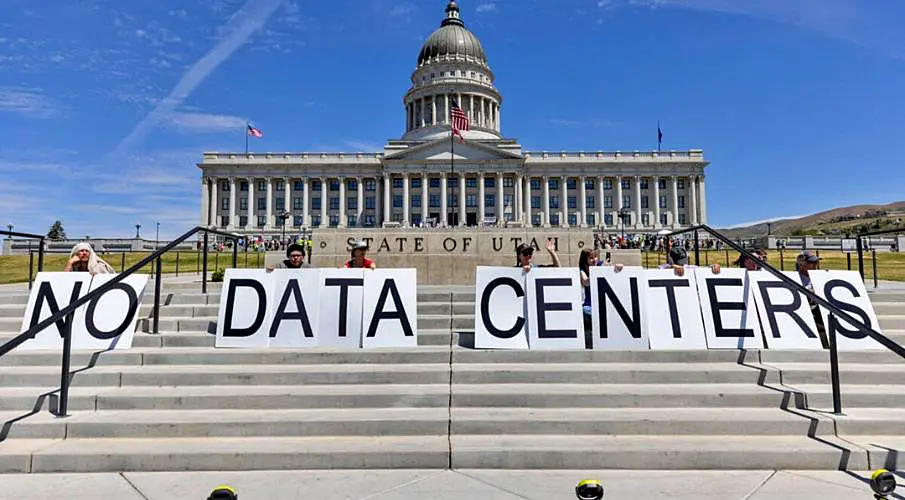
Alongside the big names in the crypto industry, Trump stood at the White House this week and praised data centers in terms that almost nobody wants to use in the middle of a midterm campaign right now. If he were the mayor of a town or the governor of a state and had the chance to get a major AI facility, he said, he would absolutely want it, the number of jobs would be enormous and so would the tax revenue. What the president praises as a win, his own party now treats as poison. The hostility toward these facilities runs across the political spectrum. Some are larger than a football stadium and draw more electricity than a small town. Residents fear rising power bills and wells being pumped dry. Bad air and noise come on top of that, and entire communities lose their character. At the same time, the operators collect the very tax breaks states use to compete for these projects.
Trump: "If I were the mayor of a town or the governor of a state, and I had a chance to get a big data center, I would absolutely want it."
Trump is selling these facilities as essential to winning the artificial intelligence race against China, one of his highest priorities. He has acknowledged concerns about electricity prices and previously said it was only fair for the companies to cover their own costs. This week, he admitted that the industry needs some help with public relations. He said he had pushed major technology companies into making voluntary commitments to protect consumers from higher electricity costs and was pressing for easier permitting so they could build their own power plants. But power plants do not spring up overnight. James Henson, who heads the nonpartisan Texas Politics Project at the University of Texas at Austin, hears mostly deafness coming from the White House. It is another level on which the administration is ignoring the political mood, at best deaf, at worst indifferent to its own candidates. Between the race against China and the well in somebody's backyard lies the ground on which elections are decided.
From Nevada to Pennsylvania, candidates from both parties are turning data centers into an attack line, and those being hit are scrambling to distance themselves from the projects. The issue does not follow party lines, it follows the water pipe and the electricity bill. In Ohio, one of the centers of the construction boom, the National Republican Senatorial Committee warned in an internal memo Tuesday that Senator Jon Husted could lose his seat over the facilities. Democrat Sherrod Brown is calling him the face of data centers in Ohio in his advertising, while residents are collecting signatures to ban new construction.
A data center in Florida shows in the morning just how massive the energy consumption of facilities like these can be: Row after row of generators fires up while thick black smoke rises into the air. Data centers can now consume amounts of electricity comparable to the needs of entire cities. The sight raises an uncomfortable question: While climate protection is constantly demanded everywhere else, the enormous energy consumption of AI infrastructure suddenly seems to matter a whole lot less once economic and technological interests are involved.
The memo admits that the issue has been underestimated throughout the entire campaign. Brown is using it because it works, the memo says, and the facilities are hanging around Husted's neck like an anchor. If he loses because of them, it will push politicians across the country to stay away from the next project. At the same time, the memo recommends a middle position, allowing data centers only with the approval of local residents and only if operators cover their own electricity and water costs, along with the rest of the infrastructure they require.
The numbers back that up. According to a July poll, a majority of voters oppose having a data center in their own neighborhood. Ahead of the November election, the issue still ranks behind the cost of living, but in a June poll, 4 in 10 voters nevertheless said AI data centers were important to their vote.
In Nevada, Democrat Aaron Ford immediately tied Trump's appearance to Republican Governor Joe Lombardo, saying the two were marching in lockstep on data centers. The two, he said, were the biggest boosters of the industry in the state and were serving only their billionaire friends while ordinary people paid the price. Ford wants to stop $200 million in new tax breaks and review existing projects to see whether they have lived up to their commitments. Operators should pay for their own electricity and protect Nevada's water, and he wants to help local governments negotiate binding agreements with them.
Texas put the reversal on full display. Governor Greg Abbott had celebrated Google's $40 billion commitment last November and declared the state the epicenter of AI development. Yesterday the project was something to celebrate, today everybody is looking for the emergency exit. Democrat Gina Hinojosa is now attacking him over it, and Abbott is backing away, saying he wants to eliminate the sales tax exemption and delay projects while their consumption is reviewed. Trump recently called the reversal a mistake. Abbott's office responded that the safety of Texans and the stability of the power grid and water supply came first, and Texans had to come first.
Even Trump's own people are grabbing onto the issue. In Wisconsin, Republican Congressman Tom Tiffany, backed by Trump and running for governor, brands his opponent in an ad as the Democrats' data center guy, using his own statement that Wisconsin could become the data center of the entire world. Yet Tiffany himself praised the technology in January and voted in December for the bipartisan SPEED Act, which is intended to accelerate projects like these and has so far stalled in the Senate. Democrat David Crowley, backed by the environmental group Clean Wisconsin, counters that Tiffany says one thing and does another and is running away from his own record. Crowley is demanding veto power for local communities while at the same time calling the facilities part of the modern economy that could benefit the state. Neither supports a moratorium, and both are demanding tougher rules.
One president still sees the price as a gift, while his party is counting it in lost seats. The facility that once promised prosperity is becoming a word nobody wants to say on the campaign trail anymore. The future being sold as a necessity in the fight against China reaches local residents as a higher bill and a sinking well. The anchor described by the party's own committee is hanging around more necks than just the one in Ohio.
Updates – Kaizen News Brief
Alle aktuellen ausgesuchten Tagesmeldungen findet ihr in den Kaizen Kurznachrichten.
To the Kaizen News Brief In English


Man sent seinen Anspruch.
Wenn es all die menschenverachtende Politik, die offene Korruption, die Untergrabung der Demokratienicht geschafft haben Republikaner zum Umdenken zu bringen.
Dann von mir aus die Datenzentren.
Hauptsache es wird gegen die Republikaner mobile gemacht!