
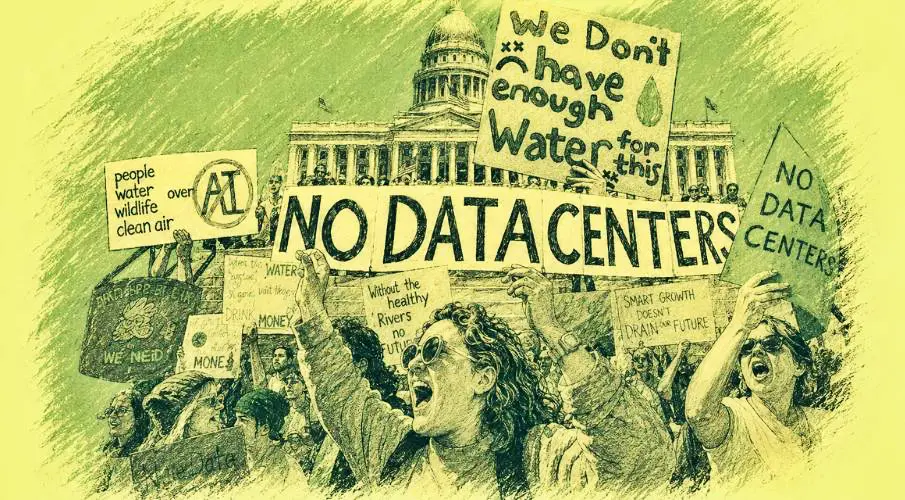
In the hottest summer the country can remember, facilities are being dug into the ground that drink rivers dry and burn through power plants just to compute. The computing itself belongs to a handful of people. Outside, the heat makes it hard to breathe, inside, the data centers for artificial intelligence keep running, and both fires, the one in the sky and the one inside the server halls, burn from the same source, just distributed differently.
The summer of 2026 already carries enough plagues. Screwworms are eating their way through cattle across the South, a parasite in contaminated vegetables is tearing up people’s guts. Wildfire smoke hangs in the air, and Trump’s illegal war against Iran is driving up the price of gas and bread. Above it all are heat waves with record temperatures, while fossil-fuel-driven climate change keeps heating things up unchecked. And right into this inferno they are building the most power-hungry machine ever conceived, with Trump pushing the expansion hard.

The facilities take water and sleep away from local residents, they raise electric bills and put pressure on the grids. Living next to one of these projects means watching a giant drink from your own well. No wonder the answer is short: "Hell no." According to a Gallup poll, more than 70 percent oppose construction near where they live, across political lines. Behind the environmental concern is a bigger one, that a class of billionaires is dictating the terms of a technology that is turning life upside down while working people pick up the bill.
Everyone paints a different picture of what the technology will do. Some hope for breakthroughs in medicine and science, others fear the end of schools and the loss of millions of jobs. At the farthest edge is a conscious digital collective that could one day wipe out its creators once it began competing with them for resources. Whether we are heading toward that singularity or not, the present is already dark enough.

The company Palantir helps Immigration and Customs Enforcement, ICE, surveil and capture immigrants. It supports the Israeli government in Gaza and supplies the Pentagon with targeting systems for weapons the U.S. military is using in Iran. Palantir CEO Alex Karp wrote a manifesto arguing that the big tech companies have a moral duty to defend the West, including with AI weapons. Members of the British Parliament called it a parody of a RoboCop movie and the ramblings of a supervillain.
Even the harmless applications, from chatbots to self-driving cars, are growing in a market with no democratic guardrails. This AI oligarchy puts enormous power into very few hands while the technology reshapes life and the public gets neither a say nor protection. Billions are now propping up parts of the economy, and the same frenzy is driving inequality and concentrating wealth among fewer and fewer people. Add in a future that looks like something out of a Paul Verhoeven movie, and the unease runs deep. A July poll from Athena Insights found Americans almost 3 times more likely to be worried than excited, across party lines.

The deeper break lies one level below that. These machines rest on the accumulated knowledge of humanity and the work of millions whose words and images they have swallowed. What belonged to everyone is being fenced off and handed back as the property of a few. The thinking of an entire species is being turned into the wealth of a club. No theft requires less violence than fencing off something that belonged to no one and therefore to everyone.
The owners can feel the ground moving beneath them. Karp, co-founder and CEO of Palantir Technologies, recently complained that it starts with the billionaires, and everyone at his table will end up paying a wealth tax just as punishment. His fear has a reason. According to Impact Research, 77 percent support higher taxes on billionaires, and according to Verasight, more than 2 thirds favor taking wealth back from AI companies, as Vermont Senator Bernie Sanders is proposing. His fund would give Americans a 50 percent stake in the major AI companies, with an estimated starting value of $7 trillion and annual payments of more than $1,000 to every citizen. Housing and healthcare could be funded from it as well. Education would be added too.
Objections are coming from many sides. Some fear that the public good would then depend on corporate profits, others warn of an AI nationalism that ignores the people suffering from the technology beyond national borders. But the idea holds up. AI rests on the knowledge of humanity and the work of millions, Sanders said, and the people must be able to slow it down so that it serves humanity and not only the richest.

From nationalization to full democratization, people are already arguing over whether the technology could let us work less and enjoy more of the wealth of the world. Instead of bombing refugee camps or spying on neighbors, it could give us shorter workweeks, time to dance and sit around a fire with friends. The most direct lever runs through the construction sites themselves. In Britain, demonstrators are marching from the offices of OpenAI and Microsoft to Meta’s headquarters and then on to Google DeepMind, demanding a pause until laws and oversight are in place.
In the United States, the resistance is taking shape. Sanders and his colleague Alexandria Ocasio-Cortez introduced a nationwide construction moratorium bill in Congress, while similar rules are emerging at the local and state levels. New York Governor Kathy Hochul became the first in July to sign a 1-year halt on new large-scale facilities, after years of fighting by local residents. Ahead of the midterms, progressive candidates are carrying the same message. In Michigan, Senate candidate Abdul El-Sayed is demanding public ownership of AI. Congressional candidates like Claire Valdez in New York and Justin Pearson in Tennessee are calling for a pause on new construction, as is Melat Kiros in Colorado, whose home city of Denver has already approved a 1-year freeze. Kiros, backed by the Democratic Socialists of America, draws the line between those who bear the consequences and those who profit from them. That, she says, is where the rare unity across political camps comes from, and at the very least people want some say. At best, the technology will upend labor and energy, at worst, researchers and the industry’s own CEOs have warned, it could lead to extinction. The stakes, she says, could hardly be higher.
That future has not been written yet. Humanity built this intelligence, and humanity could take it back, right in the middle of the crisis, and turn that crisis into an opportunity.
Updates – Kaizen News Brief
All current curated daily updates can be found in the Kaizen News Brief.
To the Kaizen News Brief


Erstmal herzlichen Dank für diesen Überblick. Die Auseinandersetzung der Bevölkerungen gehen die KI Giganten erscheint wie der berühmte Kampf von David gegen Goliath. Ich kann nur hoffen, das auch diesesmal David wieder gewinnt.( bezieht sich auf die Erzählung in der Bibel hat aber schon gar nichts mit dem heutigen Israel zu tun, nur zur Klarstellung)
… warten wir es ab, wir machen unsere möglichstes,
Ich hoffe, dass noch viel mehr Menschen dagegen aufstehen.
Wir sind damit nämlich auf einem sehr gefährlichen Weg.