
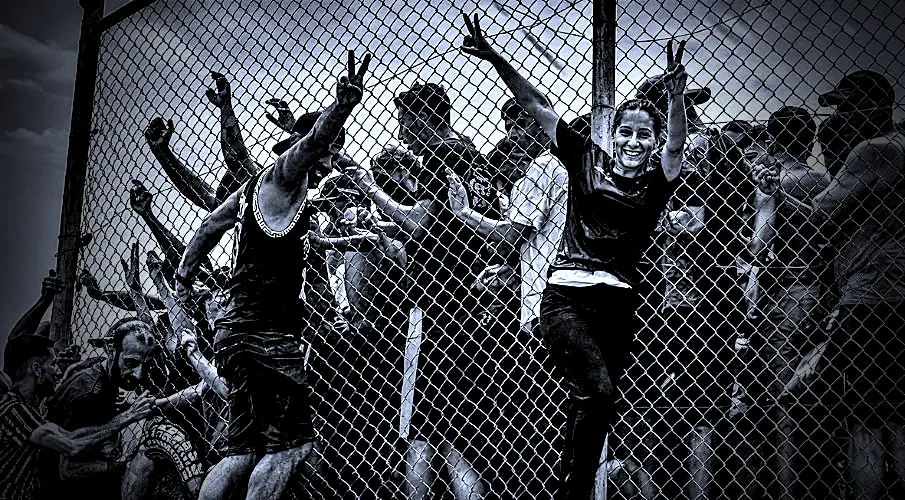
Ceuta/Rabat/Madrid - On the beach in Castillejos, across from the Tarajal breakwater, a Moroccan gendarme stands there at the end of July and watches. In front of him, young men climb down from trucks, wade into the shallow water, go around the breakwater and reach Spanish soil. He does nothing. Over two days, July 30 and 31, around 72,000 people make it into the Spanish exclave of Ceuta this way, according to a “final count by the authorities, almost as many people as the city has residents. Madrid calls it a migration crisis, the work of smuggling networks. That is only partly true - this network was used, and it gladly went along with it. The cameras and our reporting at the border tell a different story.
Let’s run the numbers for a moment. If you wanted to move 72,000 people by coach, you would need about 1,440 buses carrying 50 people each, a convoy more than 10 miles long. You can only move that many people through the water and across a border in such a short period of time if nobody on the other side stops them. That is exactly what happened. The Guardia Civil, which guards the crossing, pointed to the inaction of Moroccan forces on the very first day. In videos from those days, the gendarmerie and traffic police direct the flow of people toward the border, while one officer watches as dozens climb onto a truck.
Then came the first indications
On August 2, according to our reporting, backed up by our inquiry with the Guardia Civil’s command staff, agents of the Moroccan intelligence service were among the migrants. They had reportedly already been identified during the first hours of July 30 through cameras used by Spanish border surveillance. Other sources inside the Spanish services confirmed our reporting, as did two other Spanish colleagues, and they describe what happened as the kind of operation that belongs to hybrid warfare, something unthinkable without the intelligence service. The agents’ job, they said, was to watch the movement of people toward the border while at the same time measuring the Spanish forces and the police response. The military foreign intelligence service DGED is part of the armed forces and, in practice, answers to King Mohammed VI.

The price can be counted. At least 77 people drowned trying to reach the Spanish coast. On August 4, more than 5,000 people were still in Ceuta, the number of minors in emergency shelters had risen from 180 to 862, and a plan by the responsible minister, Elma Saiz, to provide 25 million euros for their care drew anger online. Anyone who comes through the sea without supplies has nothing, and so some looted; on July 30 and 31, stores closed and residents stayed inside their homes. Meanwhile, the Interior Ministry in Madrid thanked Morocco for its exemplary cooperation and fired the communications chief of the National Security Council because he had released the government’s own numbers on the influx. The silence is deliberate.
Anyone who knows the history recognizes a repeat. In May 2021, the border at Ceuta opened overnight once before, using the flow of people to put pressure on Madrid to recognize Moroccan rule over Western Sahara. A secret Spanish report dated May 19, 2021 names the man who pulled the strings: royal adviser Fouad Ali El Himma, popularly known as the king in the shadows. According to the report, he coordinated the line from Office 21 in the palace with Foreign Minister Nasser Bourita and the two intelligence chiefs, Yassine Mansouri for the foreign intelligence service DGED and Abdellatif Hammouchi for the domestic service DGST. During those same weeks, Pegasus spyware penetrated the phones of Prime Minister Pedro Sánchez and several ministers, among them Fernando Grande-Marlaska, Margarita Robles, Arancha González Laya and Luis Planas, ordered, according to the investigation, from the royal palace.
The crisis subsided when Spain removed its foreign minister, González Laya, at Morocco’s request and Sánchez adopted the Moroccan position on Western Sahara in March 2022, the territory that had been a Spanish province until 1976. Rabat made public the letter in which he aligned himself with the king. Why Sánchez made such a sharp turn has never been publicly explained by his government; his handling of Rabat has since been regarded as one of the most controversial moves of his time in office. The background reaches back to the Abraham Accords, under which Morocco recognized Israel in 2020 and Donald Trump, in return, recognized Moroccan sovereignty over Western Sahara, a territory the United Nations still lists as non-self-governing. Morocco is not the only case. In 2021, Belarus directed migrants toward the borders of Poland and Lithuania, which filed a case over it at the International Court of Justice in May 2025; at the end of 2023, Russia moved migrants toward the Finnish border under FSB supervision. Every time, the human being became the lever against the neighbor.
A word about one interpretation currently making the rounds
Because Donald Trump’s relationship with Morocco is close and Washington has recognized Rabat’s claim to Western Sahara, social media posts sometimes allege direct U.S. involvement in the Ceuta crisis; current American support for the country fuels that suspicion. There is no evidence for it. Operational control by the United States has not been established, and anyone claiming otherwise is confusing closeness with an order.
Many of the documents now circulating have been misrepresented or pushed as clickbait, without context and without any original reporting, simply to rile readers up, as the comment sections have demonstrated quite impressively. That is one of the bigger problems of our time. Too many people think they can try their hand at political news the way they might try baking, except they have neither dough nor raisin. So our advice is simple: if you come across a sensational claim designed mainly to get you worked up, check it. And if you are still unsure, ask us - because inside this newsroom we have built one of the largest political databases.

Here's our fact check: Ceuta, or the Art of Turning a Border Surge Into a Narrative
Three months after the reconciliation came what Rabat later called a misstep. To prove itself indispensable as the guardian of Spain’s border, Moroccan security forces drove a mass rush toward the fence at Melilla in June 2022. It became the deadliest incident ever recorded at a European land border, with 37 dead and at least 70 missing according to Amnesty International. Five days later, Madrid hosted the NATO summit and pushed through language identifying the instrumentalization of migration as a hybrid threat for the first time. The victim became the weapon, and the weapon made its way into a strategic document.
Underneath all of this is a story of betrayal. It begins in 2011. When the Basque separatist group ETA declared its armed struggle over, jihadism became the main concern of the Spanish services, and because that kind of terrorism crosses borders, they looked for partners. In 2014, the Guardia Civil began working with Morocco’s powerful domestic intelligence service DGST under Abdellatif Hammouchi. Visits and joint exercises became trust, and trust became an exchange that brought Moroccan officers to Ceuta, Málaga, Marbella and Madrid, even to tours of Real Madrid’s stadium. Spain’s GAO special unit trained Moroccan guests in Fnideq on the border, in Tangier and Rabat, including in tracking and infiltration, covert surveillance and infecting mobile phones with spyware. Its motto is Videre sine visum, to see without being seen. Later, the students turned the lens around. The Moroccan service gave little in return; it owed its first drone deployment to training by the Spanish in Málaga, and today Morocco builds such systems with Israeli assistance. Spain’s National Police took separate phones with them for operations in Morocco, the GAO did not. “We didn’t think it was necessary,” one Guardia Civil officer said. “We didn’t expect to be spied on.” Another admitted that their own lack of knowledge about Morocco had become a problem. Through a chat network the Spanish did not know about, and using devices that impersonate cell towers, Moroccan services intercepted the phones of their former teachers. “We spy on everyone,” one of those involved said, “just in case.”

Alberto Aguilera, who had set up the joint center in Tangier and later headed the Guardia Civil intelligence service in Catalonia, appeared five times on Morocco’s Pegasus target list, the first time on March 8, 2019; in 2024, he became a colonel in Madrid. A former Moroccan agent calls it highly unusual that a man with that background moved to the top of intelligence after serving in Morocco, saying it ran counter to every security protocol. A senior Guardia Civil officer used the word betrayal when he learned what had been found. The evidence is based on leaked documents and statements from several people involved on both sides, including a former DGST officer. Those leaked documents show that the Moroccan service continues to monitor Spanish officers to this day - the very people who trained it.

The document dated April 29, 2017 shows just how closely Spanish and Moroccan security services were already working together at the time. This was not a courtesy visit and not an exchange at the leadership level, but a jointly prepared practical exercise called “TAAKHI-01.” Weeks earlier, on February 23, representatives from both sides had met in Rabat to coordinate it. The exercise itself was scheduled to take place from May 8 to 12 simultaneously in Spain and Morocco. Operational procedures were prepared, responsibilities assigned and liaison officers designated to work out the final details through their normal official channels. Even the long list of earlier matters referenced in the letter stands out: the cooperation did not begin with this meeting, it had been well established for some time. At the bottom, the document explicitly states that it is the property of the issuing service, must be treated as confidential and may not be shared in whole or in part with other parties without the issuer’s consent. The document puts in black and white just how far the cooperation had already gone: joint planning, joint exercises, permanent points of contact and operational coordination on both sides of the border. It was precisely this relationship that later created the trust Spanish officers described as a grave betrayal after the revelations about surveillance and Pegasus.
What the students did with what they learned can be seen in a department whose trade is destroying journalists. It installs hidden cameras in the homes of reporters and activists and breaks into their networks. Omar Radi, one of the country’s first Pegasus victims, was imprisoned on fabricated charges and went into exile. Souleiman Raissouni, smeared as a sex offender by regime-aligned outlets such as Chouf TV, Barlamane and Le360, was arrested two days after issuing his denial. During a hunger strike, he lost 31 kilograms and received barely any care, confronted with fabricated evidence until he too left the country. A network of fake media outlets across several countries floods the internet with false reports. Unlike European services, the Moroccan service does not need a judge’s permission to surveil whoever it wants.
And Spain? It hands out medals. In November 2025, Interior Minister Grande-Marlaska awarded intelligence chief Hammouchi the Guardia Civil’s Grand Cross of Merit, and in July 2026 the same Hammouchi received a high-level Spanish delegation led by General Luis Peláez Piñeiro. Back in 2022, Morocco had published photos of a secret meeting between Spanish intelligence chief Esperanza Casteleiro and Hammouchi without asking; in 2023, it became known that Rabat had recruited the daughter of a senior police official. And in April 2022, at the fast-breaking dinner with Mohammed VI, one of the nine guests was El Himma, the man who had ordered the spying on Sánchez. In the official photo, the Spanish flag was hanging upside down.

In the end, we are back at the beach, and in the shallow water are the 77 who never made it across. They were never the target of this operation, they were its tool, a lever used to move a line on a map. Anyone who uses people this way violates the oldest principle that the Enlightenment gave to human conduct: that no one may be used merely as a means to someone else’s end. A state, meanwhile, that calls someone a friend and strategic partner while that same partner blackmails it and spies on its ministers has to ask itself what friendship still means. The gendarme on the beach knew and looked the other way. Madrid knows and says thank you.
Updates – Kaizen News Brief
All current curated daily updates can be found in the Kaizen News Brief.
To the Kaizen News Brief


Eure Recherche ist sehr aufschlussreich.
Wie weit Konflikte zurück reichen.
Sanchez Kehrtwendung bezüglich Westsahara ist in der Tat eigenartig.
Vor allem weil er/die Regierung schweigt.
Das der marokkanische Geheimdienst bei Ceuta involviert ist, ist schon heftig.
Und Spanien weiß es und verleiht Orden.
Das ist doch verrückt.
Es ist traurig, das Menschen (!) Als Hebel, als Waffe genutzt werden um etwas zu erreichen.
Die benutzten Menschen sind die Leidtragenden.
Sie glauben den Bersprechungen und stattdessen erwartet sie Tod, Gefängnis oder Anderes.😞
Vielen Dank und die Recherche gehen noch weiter. Ich denke, hier sollten Hintergründe sachlich aufgearbeitet werden und nicht mit Halbwahrheiten oder Fantasien eine Geschichte unbeendet lassen.