
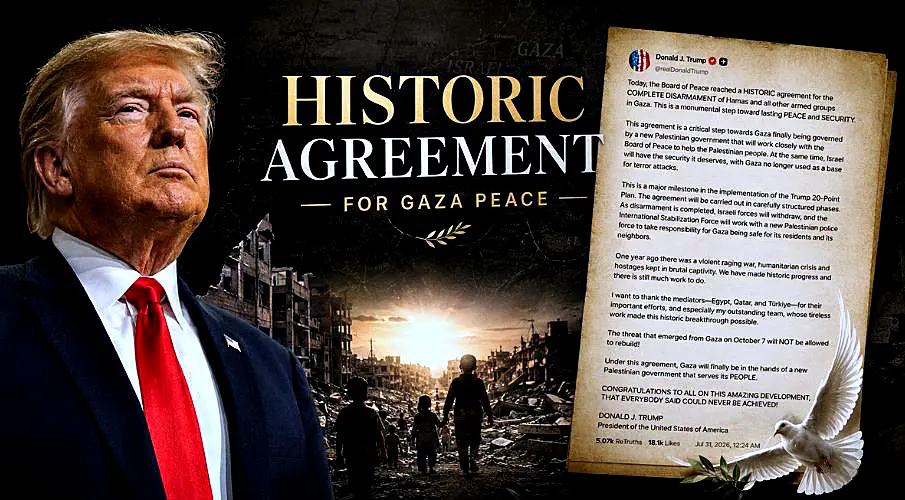
At 12:24 a.m., in the middle of the night, a post appears on a platform called Truth Social. It is the hour when claims tolerate no contradiction because almost no one is awake to challenge them. The President of the United States announces that the body he created, known as the Board of Peace, has reached a historic agreement that day: the complete disarmament of Hamas and every other armed group in Gaza. He thanks the mediators from Egypt, Qatar, and Turkey. Above all, he thanks his own team, then closes with a sentence that applauds itself. Everyone had said it could never be done.
A U.S.-brokered ceasefire had been signed 9 months earlier. Since then, it has remained stuck in its second phase, the stage dealing with weapons and reconstruction. That, supposedly, is where the breakthrough has now occurred. But anyone who waits through the night and reads the morning finds a very different picture than the one written in capital letters.

Who Agreed, and Who Remains Silent
On Friday, Hamas officially declares that it has agreed to a document providing for phased disarmament, with the exact timetable to be worked out within 14 days under the supervision of an international body. That is one side's account, advancing its own narrative, and like any other, it has to be verified. Yet the very same statement adds a condition that undercuts the entire process: no step toward disarmament will take place until Israel has withdrawn its forces from Gaza. The surrender of weapons, Hamas says, will happen without Israeli involvement. Earlier this month, Hamas also announced that it had dissolved its government in Gaza in order to transfer authority to a technical committee backed by the United Nations. The agreement ultimately envisions the reconstruction of the devastated territory. The underlying 20-point plan, overseen by a Washington-appointed body, calls for the surrender of every weapon and the destruction of Gaza's vast tunnel network.
That is not what the President describes. In his version, Israeli forces withdraw while disarmament moves forward, a carefully phased process that ultimately ends with an international stabilization force and a new Palestinian police service providing security while a technocratic government takes over Gaza. Hamas presents the exact opposite sequence: first the withdrawal, then the weapons. Two timelines that cannot both be true, yet both are presented as part of the very same agreement.
Under the text, the Israeli military would initially pull back only to the so-called yellow line it had advanced to after last October's ceasefire. Any further withdrawal would depend on complete disarmament. At the same time, Israel would suspend targeted killings inside Gaza, unless an immediate threat emerged.
And Israel? Israel remains silent. As of Friday afternoon, no public approval has been given. Officials close to the government have made it clear that they remain deeply skeptical Hamas will ever surrender its weapons. One U.S. official acknowledges that Israel is not obligated to do anything beyond its original commitments. If it still refuses, the President, according to that official, would be very disappointed. Disappointment is not a signature.

The Arithmetic of Approximation
What is particularly revealing is the way officials, shielded by anonymity, frame the details. They cannot provide specific deadlines for the disarmament. The Gaza police, which explicitly exclude the bulk of Hamas fighters and all heavy weapons, are supposed to hand over their light arms to the new administration within 14 days. Everything else - the heavy weapons and the tunnels - would come later, over a period officials describe as somewhere between 200 and 350 days.
200 to 350 days. That is the level of precision behind an agreement whose most important provision has yet to be defined. Those two numbers are separated by 150 days, nearly half a year of uncertainty, packaged in the language of completion. A seventeenth-century philosopher who believed order arose from fear once wrote that covenants without the sword are merely words, lacking the strength to protect anyone. Here, the sword is missing twice over, because neither side that actually wields it has signed.
So far, only the opening section of the document has been released, Principles 1 through 5. It invokes Trump's peace plan and United Nations Security Council Resolution 2803 of 2025 as its framework, setting out the goals of a full Israeli withdrawal, Palestinian self-government, reconstruction, and a political process culminating in self-determination and statehood.
The entire process is tied to conditions. Israel is expected to fulfill its outstanding commitments under the Sharm el-Sheikh Protocol, above all ending the fighting. Hamas and the other factions are likewise expected to halt their military operations. The timetable for the second phase is to be drawn up only within 14 days after all parties have given their approval, with the possibility of extensions granted by a verification body.
That verification body, the International Verification Committee, does not yet exist. It is to be created by the Board of Peace and made up of representatives from the guarantor states, the board itself, and the international stabilization force. Every transition from one phase to the next depends on the committee confirming that the previous phase has been completed. It is also supposed to monitor violations committed by both sides.
Civil administration is to be handled by a National Committee for the Administration of Gaza, which, after receiving approval from the factions, is expected to operate independently and continue running civilian institutions. The actual disarmament - its timetable, its sequence, the heavy weapons, and the tunnel network - is not described anywhere in the released principles. Those details have been pushed into later sections and annexes.
What Is Happening on the Ground
While the announcement makes its rounds through the news cycle, life in Gaza continues exactly as it has for months. Since the ceasefire took effect on October 10, 2025, nearly 1,200 Palestinians have been killed, according to Gaza's Health Ministry. Israel controls more than half of the Strip, while people live in tent camps and among the ruins of their own neighborhoods. The Israeli line - the so-called yellow line - has been pushed deeper into the territory, something observers believe may constitute a violation of the existing agreement.
That is the peculiar nature of these kinds of announcements. They bend time. The President writes that a year ago there was a raging war, and now historic progress has been achieved. Yet the deaths that have continued ever since have no place in that narrative. They do not fit into capital letters.
The Announcement as an Event
By now, the pattern has become familiar enough to study. It begins with a claim presented as an accomplished fact. Attention immediately locks onto it. Headlines appear. Images circulate showing the President as the peacemaker reshaping the Middle East. Only afterward - with delay and considerable effort - does the verification begin, and time after time it reveals less than what was originally proclaimed. Yet it never reaches the same audience as the original claim. Verification takes time. It costs money. And in this year, patience for either seems to have gone out of fashion. That is the political calculation. Whoever speaks first decides what everyone else talks about. The announcement creates a reality before reality itself has a chance to catch up. By the time the facts arrive, the statement has already done its work. Here, language acts before the facts do.
On Tuesday, the President and the Israeli Prime Minister met at the White House for the first time since both launched the war against Iran in February. They said nothing about what was discussed. Iran, once Hamas' principal patron, is now viewed by American officials as both unpredictable and too consumed by its own conflict to come to the group's aid.
What Remains to Be Said
There is now a plan published by the American side. That is more than empty rhetoric. Hamas has signaled its general approval, though only under a condition that leaves everything unresolved. Israel has not agreed. The disarmament has not begun. What was announced as an accomplished fact is, in reality, the outline of something whose success depends on conditions that directly contradict one another.
An honest summary therefore reads far more soberly than the one issued in the middle of the night: the President announced a historic agreement for the complete disarmament of Hamas. In reality, what exists is a published plan whose implementation depends on several unresolved conditions. Hamas ties its approval to a full Israeli withdrawal, while Israel, as of Friday afternoon, has not publicly endorsed the agreement. Everything else remains expectation, written in the language of fulfillment. The numbers tell us what the war has been. What the peace will become, for now, is known only to a text written in capital letters - one that nobody carrying a sword has signed.
Updates – Kaizen News Brief
All current curated daily updates can be found in the Kaizen News Brief.
To the Kaizen News Brief In English


Das Muster ist leider immer gleich.
Trump verkündet einen „riesigen Erfolg“, der durch ihn erreicht wurde.
Wenn man nur etwas genauer schaut, bleibt von der Ankündigung in Großbuchstaben auf Truth Social eigentlich nichts übrig.
Vor allem meist nichts Neues.
Etwas „Vorhandenes“ wird neu verpackt und als Erfolg von Trjmp gepostet.
Die Märkte reagieren.
Die Aussagen werden von fast allen Nachrichtenagenturen ungeprüft übernommen.
In zwei oder 3 Tagen wird relativiert.
Die Märkte reagieren.
In der breiten Öffentlichkeit geht das unter.
Bei fast allen großen Medien, wie ntv, tagesschau etc, wurde Trumps Posting als „Trump erreicht einen großen Durchbruch im Gaza Krieg“ beschrieben.
Ohne Recherche, ohne kritisches Hinterfragen…
Leider werden heute so Nachrichten gemacht.
Schnell um viele Klicks oder gute Einschaltquoten zu bekommen.
Nicht mit sorgfältiger Recherche, wie sie ihr betreibt.